
ARCHEOLOGICAL SITES
Fraidees Mountain
(Herodium)
Fraidees Mountain contains some incredible buildings and architecture
that were built during the early Roman period. 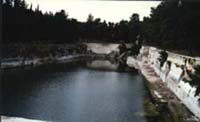 Most of the buildings were constructed during the reign of Herod the Great.
There are many amazing ruins that have maintained the interest of archaeologists
worldwide. The magnificent palace houses many rooms that leaves an explorer
breathless. This site has seen revolts, crusaders, and other historical
occasions. Click on to any of the following to learn more about this extraordinary
site.
Most of the buildings were constructed during the reign of Herod the Great.
There are many amazing ruins that have maintained the interest of archaeologists
worldwide. The magnificent palace houses many rooms that leaves an explorer
breathless. This site has seen revolts, crusaders, and other historical
occasions. Click on to any of the following to learn more about this extraordinary
site.
- Location
- History of the Site
- History of the archeological excavation
- Description of the site
- Actual situation of the site
Location:
The site of Herodion (or Arabic Jabal Al Fraidees) lies 10 kms. east
of Bethlehem and 15 kms. south of Jerusalem. 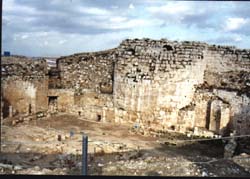 This
location proved to be a blessing for its inhabitants when the Romans failed
to conquer the mountain during the Jewish revolt of 60-70 AD.Herodion was
conquered only after the capture of Jerusalem itself, and the defenders
of the mountain chose to commit suicide collectively rather than surrender
to the Romans, the same way their comrades did in Massadah and Mckarius. This
location proved to be a blessing for its inhabitants when the Romans failed
to conquer the mountain during the Jewish revolt of 60-70 AD.Herodion was
conquered only after the capture of Jerusalem itself, and the defenders
of the mountain chose to commit suicide collectively rather than surrender
to the Romans, the same way their comrades did in Massadah and Mckarius.
History of the Site:
The mountain and most of the buildings at the site were constructed
in the Early Roman Period, particularly during the reign of Herod the Great
37-4 BC. The work was completed around 20 BC and is the only work of Herod
that bears his name.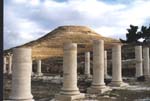 The palace was inherited by Herods' son Arkhilaous who governed Palestine
between 4 BC and 6 AD. After his death, the place was turned to the Roman
governors of Palestine. In the year 66 AD Jewish rebels, known as the Zealots,
took over the mountain and kept it for 4 years until they were defeated
by the Romans. The place was then abandoned until 132 AD until Jewish revolt
broke up once more. This revolt was crushed by the Romans in 135 AD. Between
the 4th and the 7th centuries AD, the place was occupied
by a large group of Byzantine monks who inhabited the foot of the tell
until the Muslim conquest. During the crusaders' era, a group of Franciscan
crusaders occupied the hill before it was conquered again by the Muslims.
It seems that the recent name of the locality has something to do with
those Franciscans. The Arabic name is similar to the name used by some
European travelers "Mountain of the Franks." Some interpret the
name Fraidees to mean paradise from the Arabic ferdaous, a name
designating the magnificent garden that was built by Herod in lower Herodion.
The palace was inherited by Herods' son Arkhilaous who governed Palestine
between 4 BC and 6 AD. After his death, the place was turned to the Roman
governors of Palestine. In the year 66 AD Jewish rebels, known as the Zealots,
took over the mountain and kept it for 4 years until they were defeated
by the Romans. The place was then abandoned until 132 AD until Jewish revolt
broke up once more. This revolt was crushed by the Romans in 135 AD. Between
the 4th and the 7th centuries AD, the place was occupied
by a large group of Byzantine monks who inhabited the foot of the tell
until the Muslim conquest. During the crusaders' era, a group of Franciscan
crusaders occupied the hill before it was conquered again by the Muslims.
It seems that the recent name of the locality has something to do with
those Franciscans. The Arabic name is similar to the name used by some
European travelers "Mountain of the Franks." Some interpret the
name Fraidees to mean paradise from the Arabic ferdaous, a name
designating the magnificent garden that was built by Herod in lower Herodion.
History of the archeological excavation on the site:
Although the site has attracted the attention of researchers very early
on, organized archeological research at the top of the mountain did not
start until 1962. The foot of the mountain was not excavated until 1972.
In the period between 1962 and 1967, a mission guided by the father Van
Gilio Corio from the Franciscan Custodia di Terra Santa in Jerusalem, lead
an exploration at Herodion, and he discovered most of the buildings that
are seen on the hill today. Most of the buildings were erected during the
reign of Herod the Great, and some date to later eras till the Byzantine
period. From 1972 to 1987 a mission from the Hebrew University, under the
supervision of Ehoud Nizer, conducted ten seasons of excavation in Herodion,
particularly at the foot of the hill.
Description of the Site:
The mountain has a conical shape cut from the top. It is composed
of a natural hill to which an artificial one has been added. The site includes
what could be considered the greatest architectural achievement of Herod.
It was utilized as a summer palace, a shelter in times of danger, a regional
capital, and a burial place for the king.
Yosefos, a contemporaneous historian to Herod, gave a magnificent description
of the palace and of Herod's funeral ceremony, when his corpse was brought
from his winter palace in Jericho to Herodion in 4 BC. However, the place
of the his tomb has not yet been located.
According to Yosefos' narrative, the way to the top of the hill was
through 200 white marble stairs in the northern side of it. Remnants of
those stairs still exist. Today, the way to the summit is to zigzag from
the south western side of the hill, and it takes fifteen minutes to climb.
Most of the grand buildings that were in existence at the time of Herod
became ruins. However, archeological excavations have revealed the remnants
of numerous buildings belonging to different eras which may have belonged
on the hill or at its feet. The site can be divided into two main parts:
1. Upper Herodion: On the top of the hill, 60 meters above the
level of the butte, there lies a circular building that represents the
royal palace or the royal castle. This belongs to the Herodion era. The
castle consists of two circular walls separated by a corridor with a width
of 3.5 m. The diameter of the external wall is about 62 m. At the eastern
part of the wall, stands a great cylindrical tower 18 meters in diameter
and sixteen meters high. The wall is supported by other three semi-circular
towers in the west, north, and south. The entrance of the castle is located
to the north of eastern two, and it is 3.5 meters width and leads to a
vault that ends at the palace garden.
The circular planning of the Upper Herodion was not common in ancient
architecture; therefore, Herodion represents a unique archeological site.
There were many other discoveries made at the Herodion site: there was
a developed water system, composed of a number of wells. The wells have
a depth of about 15 meters and are connected to the palace by stairs scraped
in the rock. There is also a big water basin, to which water was brought
on the backs of animals from the foot of the hill. Secret tunnels, used
for escape in case of danger, were also found in the hill. Temples and
big halls used for celebrations were also discovered. Complete bathrooms,
churches, buildings, and other archeological things belonging to Roman
time and the successive eras, particularly to the Byzantine era, were also
discovered. The palace can be distinguished into two major parts:
Eastern part: This represents the first half of the palace and
contains a garden (12.5 x 33 m) surrounded by pillars from three sides
and a wall from the fourth (eastern) side. To the south and north of the
garden, there are two crooks with two pillars at the entrance of
each. To the south of these crooks, there exists two rooms leading
to the palace. The palace has two other entrances to the east of the side
crooks.
Western part: This is divided into two parts by a grand cross
shaped hall, where the Roman bath occupies the Northern part of the parts.
The bath is considered as the most beautiful part of the palace. It is
adorned in a magnificent way and contains a mosaic covered floor. by. It
includes a warm room (Tepedarium) with a circular shape and is 4.15 m in
diameter. This is covered by a dome of 5 m in height. There is also another
hot room (Caldarium) and cold room (Frigidarium). The southern part is
rectangular in shape (10.6 x 15.15 m) and contains 4 pillars for supporting
the ceiling. There is a northern entrance that contains two windows. It
has additional doors in the northern and southern walls that lead to other
rooms in the palace. In these rooms there exists some indications of a
second floor that furnished living rooms and bathrooms. There are signs
pointing to the existence of a third floor in the corridor found between
the walls and the northern tower.
2. Lower Herodion: The Lower Herodion is found at the foot of
the mountain. The excavations have revealed the existence of several buildings
and constructions. In Roman time, it seems that the Lower Herodion was
a big city with a surface area of about 60 dunums. Herod built a grand
Roman garden, 110 x 145m in dimensions. The
center of the garden is occupied by a big pool (70 x45 m) that provides
stairs in the 4 corners leading to the floor of the pool. Water used to
be brought to the pool through a canal from Irtas springs, Solomon's pools,
to the South of Bethlehem. It is believed that the pool was used for swimming,
for the sailing of small boats, and a strategic storage of water. In the
center of the pool there is a cylindrical building of 13.5 m in diameter.
This was probably used for rest and pleasure. Out of the prominent discoveries
in this part is a number of palaces and their annexes, most of them concentrated
around the pool. These belonged to Herod's family, his friends, and the
employees of the administration. The most important of these discoveries
are: a bathroom, one of the biggest Herodion bathrooms; big magazines of
130 x 55 m dimensions. Recently, a theater was discovered near the pool,
and to the south of it there was a square building that was used as a center
for the palace. At the peripheries of this building there is a road of
350 m in length; archeologists think that it was built purposely for the
funeral ceremony of Herod. To the western side of the road existed ruins
of other buildings. It is believed that these are some way connected to
the tomb of Herod. However, the tomb itself has not been discovered yet.
Most of the discoveries in the site belong to the Herodion era. Very
few additions were added in the proceeding eras. Out of these additions:
a Jewish temple (synagogue), purgatories, and about 300 tunnels
in the hill were built during the Zealots and Parkokhian eras. In the Lower
Herodion , the Byzantine built three or four churches and other buildings.
Actual Situation of the Site:
At the foot of the Fraidees Mountain stands a small Arabic village called
Za'tareh. On the land of this village, a military Jewish settlement, Takou',
was built. The site is protected is under the authority of the Natural
Reserve Authority. Tourists are permitted to visit the hill and the tunnels
during specified hours, and the visitors have to pay fees of about four
dollars. However, the situation of the Lower Herodion is worse, even though
free visits are permitted. Until now, the responsibility of the site has
not been transferred to the National Authority because it is found in Zone
C where
|