
ARCHEOLOGICAL
SITES
Tell Balata
(Shechem)
Location:
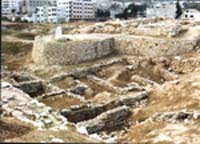
The ancient Canaanite city of Shechem lies 67 km
north of Jerusalem at a distance of about 1.5 km east
of the center of modern Nablus. The ruins of the city
occupy a tell of about 50 dunums rising some 525m
above sea level and 25m above the fertile plateau of
Askar. This plateau starts at the edges of the Gerzim
and Ebal Mountains and descends east towards the
Jordan valley; it represented the economic foundation
of the city.
Shechem, meaning shoulder or high place, is the
first name of Nablus. It was given to the area by the
Canaanites who settled the area from the middle of
the 3rd millennium BC. The site is locally called
Tell Balata after the modern Palestinian village of
Balata to the east. Next to the tell, to the east, is
Joseph's Tomb (Maqam Al Nabi Yosef), and further to
the south-east is Jacob's well.
The tell is strategically positioned at the
junction of two important ancient commercial routes,
the one connecting the coast to the Jordan valley,
and the mountainous route connecting northern
Palestine to the south. Because of this important
strategic location, the ancient city of Shechem
played an important role. It was very much like its
descendant, modern Nablus, an important economic,
administrative as well as political center, for the
region and for the country as a whole.
History of the site:
Archaeological excavations at Tell Balata indicate
that the site was first settled during the fifth
millennium BC (The Chalcolithic Period). The
Canaanite city, 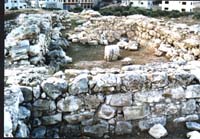 the
remains of which we can still see today, seem to have
been built around 1900 BC. The Egyptian records from
the reign of the Egyptian Pharaoh Senwosret III imply
that Shechem was an important citystate during the
Middle Bronze Age period (1900-1550 BC). This Age is
recognized as the age of citystates in the history of
Palestine. The city flourished greatly during this
period as can be seen from the great defensive system
and the fine houses that have been excavated at the
site. Since then the city has been destroyed and
rebuilt several times. the
remains of which we can still see today, seem to have
been built around 1900 BC. The Egyptian records from
the reign of the Egyptian Pharaoh Senwosret III imply
that Shechem was an important citystate during the
Middle Bronze Age period (1900-1550 BC). This Age is
recognized as the age of citystates in the history of
Palestine. The city flourished greatly during this
period as can be seen from the great defensive system
and the fine houses that have been excavated at the
site. Since then the city has been destroyed and
rebuilt several times.
During the reign of the Egyptian Pharaoh Ahmose
(1550-1525 BC), the city was destroyed by the
Egyptians after they expelled the Hyksos and chased
them into Palestine. The city was once more destroyed
in 1360 BC at the hands of a mysterious nomadic group
known as the "Hapiru". It was destroyed for
the third time in 923 BC at the hands of Shishak of
the Bible, probably the Egyptian Pharaoh Shoshenq I.
After that, the city was neglected especially when
King Omri built Samaria as the new capital of his
northern kingdom in 876 BC.
In 724 BC the Assyrians destroyed Shechem and
Samaria; they deported some 30,000 people from the
region and brought new people loyal to them from
distant regions of their empire (Elam, Babylon and
Syria). Some of those newcomers later converted to
Judaism and formed a new sect known as the
Samaritans, some of whom are still living on mount
Gerzim in Nablus today. The deportees became to be
known in Jewish traditions as "the ten lost
tribes"
After the death of Alexander and the division of
his empire in 323 BC, most of Palestine including
Shechem came under Patolomic rule until the Silucidis
occupied it in 198 BC. The town flourished briefly
during the Hellenistic period, and some of its
buildings and homes were restored and rehabilitated.
Archaeological excavations at the site uncovered a
quantity of coins dating to this period. But the city
was once more destroyed by John Hyrkanus the
Maccabbee in 117 BC. Shechem was already exhausted by
this time, and what followed was gradual abandonment
of the town. The final signs of human settlement at
Tell Balata date to the end of the first century BC.
The city was totally abandoned after that, and a new
page in the history of the city and the country was
opened when the Romans occupied Palestine in 63 BC
and in AD 70 when they built the new city of
Neapolis.
The Old Testament teaches that Shechem was the
first Palestinian city visited by Abraham after his
migration from Ur in his native Iraq. It is believed
that this might have happened in the nineteenth
century BC. Shortly after, Jacob, coming from Fadan
in Syria, passed by the city. According to the Old
Testament, during the Period of the Judges (11th.
century BC), the Jews in Shechem converted to the
Canaanite religion and worshipped Ba'al in the
fortress temple. Abimalik, one of the 71 sons of
Judge Gideon, destroyed the town and burned it after
killing all of his brothers in the wars of succession
to the throne. Biblical texts, however, are very
confusing, and it is very hard to verify their
accuracy and historicity.
Description of the site:
The site includes many architectural elements; the
most impressive of which are the defense system: 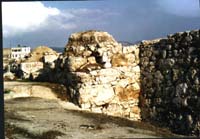 the
walls and the entrance complexes. The defenses of
tell Balata are the best example of a Canaanite
defensive system in Palestine. They date from the
Middle Bronze Age (1900-1550 BC). The walls are the
first thing that attracts the attention of the
visitor while approaching the site from the north.
The massive wall that is standing today is the third
of four consecutive walls that were built around the
city in different periods. It is a well preserved
structure of Cyclopean masonry around 1600 BC. The
other walls are less impressive and date to earlier
periods of the Middle Bronze Age. the
walls and the entrance complexes. The defenses of
tell Balata are the best example of a Canaanite
defensive system in Palestine. They date from the
Middle Bronze Age (1900-1550 BC). The walls are the
first thing that attracts the attention of the
visitor while approaching the site from the north.
The massive wall that is standing today is the third
of four consecutive walls that were built around the
city in different periods. It is a well preserved
structure of Cyclopean masonry around 1600 BC. The
other walls are less impressive and date to earlier
periods of the Middle Bronze Age.
The second architectural feature of the site are
the massive and unique gate complexes. Two city gates
have been excavated, one in the north-west, and the
other in the east of the city wall. The remains of
both are still visible today. The main gate is that
to the north-west dating back to the 17th century BC.
It is triple chambered with two massive towers on
each side. It opens to the main street of the city
and right inside it is the governors palace on both
sides of the street. The Eastern gate is double
chambered and is dated to 1625-1575 BC. It is
believed that the city had a third gate on the south
eastern side of the wall, but it is not visible
today.
In addition to the defenses, Shechem has several
impressive buildings such as the governors palace,
the fortress temple and the holy temple that some
call Abraham's temple.
The Palace right inside the northern gate
includes: a small temple, guard rooms, main assembly,
kitchen, and living rooms.
The holy temple, east of the palace, dates from
the end of the Middle Bronze Age.
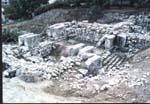 The
fortress temple is on the summit of the hill, next to
the holy temple. It is the largest and the most
impressive surviving Canaanite temple in Palestine.
It measures 26.80m in length and 24.2m in width. Its
walls are about 5m thick. Archaeologists believe that
it was a two story building. It has one entrance to
the east, in the middle of which is a column to
support the roof, and on each side of the entrance is
a massive tower. The eastern tower has a stairway
that might have led to the second floor. Inside the
main hall of the temple there are two rows of three
columns. The
fortress temple is on the summit of the hill, next to
the holy temple. It is the largest and the most
impressive surviving Canaanite temple in Palestine.
It measures 26.80m in length and 24.2m in width. Its
walls are about 5m thick. Archaeologists believe that
it was a two story building. It has one entrance to
the east, in the middle of which is a column to
support the roof, and on each side of the entrance is
a massive tower. The eastern tower has a stairway
that might have led to the second floor. Inside the
main hall of the temple there are two rows of three
columns.
History of archaeological excavations at the site:
It was H. Thiersch who first identified Tell
Balata with Shechem in 1903 AD. In 1908 a resident
from Balata discovered, while building a house, a
collection of bronze arms which ended up in a museum
in Berlin. Following that in 1913, the first
systematic excavation began under the direction of
the German Biblical scholar Ernest Sellin; the
excavations continued in 1914 and then in 1926-1929.
From 1932-1934 excavations at the tell were led by
Walter. Sellin returned to the site in 1934 and
excavated until world War II broke out. It is
unfortunate that most of Sellin's records and finds
were destroyed in the bombing of Berlin in 1943.
In 1956 an American expedition, led by the
biblical scholar G.E. Wright, resumed excavations at
Balata, and those excavations lasted until 1964. E.
Campbell resumed excavations at the Tell between
1965-1968. W. Dever conducted some clean up work and
salvage excavations at the site in 1972-1973. The
later excavations employed better excavation
techniques and better recording system.
The state of the site:
The houses of the modern village of Balata occupy
the southern part of the tell, about one third. The
northern part is not occupied; it is on this part
that all archaeological work has been conducted. In
spite of the very significant historical and cultural
importance of the site, it is very unfortunate that
the site is in bad shape and is scarcely visited. It
lacks services and is in much need of clean up work;
this is due to the negligence resulting from the
unstable political situation in the country. The site
is also not easily accessible because it is in the
middle of living quarters. There are plans in hand by
the Palestinian Department of Antiquities to
rehabilitate the site.

|