His branches shall spread, and His beauty shall be as the olive tree"...(Hosea 14:6).

"Out of the ground, the Lord God made to grow every tree that is pleasant for the sight and good for food, the tree of life also in the midst of the garden, and the tree of the knowledge of good and evil." Genesis 2:9"
The olive tree is native to the Holy Land where it has been cultivated since ancient times. According to historians, the first olive groves took root in the Holy Land and along the coast of the eastern Mediterranean around 4,000 B.C.
The olive tree is a slow growing tree which fills during the first 7 years of it's life. It is especially productive thought out her life. Growing to heights ranging from 10 to 40 feet (3 to 12 meters),
Reaching the age of 200 the trunk disappears, shoots develop at the base of the trunk which eventually grow into a new tree, hence the reputation as the immortal tree.
Between April and June a multitude of small, white perfumed flowers appear in groups under the preceding year's leaves. They only last a few weeks. One olive is born for about 20 flowers. Normally the first flowering only takes place after about 8 years.
The Olive Tree has both a sentimental and religious significance to all nations and all religions. In the Old Testament, olive oil was used to anoint prophets and kings, and to light the lamps at the temple of Jerusalem, the house of God. For nourishment, healing, cleansing, lighting, and symbolic purposes, olive oil was important.
Later in the New Testament, Jesus Christ was described as the "Anointed One" the Messiah, Christians were called Nozreem or Masseheen, which in Aramic and Arabic means anointed with olive oil. Jesus told the story of the Good Samaritan who used oil for healing.
When Jesus went to Jerusalem, he went up to the Mount of Olives where he prayed and taught his disciples the word of God. The agony of our Lord was in the midst of many of these olive wood trees in the Garden of Gethsemane where He prayed asking His Father, "Let this cup pass from me but not My will but Yours be done."
Jesus Christ was arrested on The Mount of Olives that fateful night, and He ascended into Heaven from there after His Resurrection from the tomb.
Out of great respect, the people of the Holy Land protect (at times with their lives) the trees refusing to ever cut them down. In the middle of October, the people of the Holy Land pick the olive fruits to either press them and get the olive oil or to make olive to eat and cook.
Once the oil has been pressed out of the olives what remains can be used to make pure olive oil soap. This reminds us of how Jesus was pressed down in pain in the Garden as He prayed and how His expressed love for people cleanses and washes away the sins of the world.
Once the olives have all been picked it is time to cut the branches and begin the pruning process. These sacred and holy olive trees require that we use hand saws only because of the danger electric and gas saws inflict upon these trees.
In the Holy Bible, Jesus spoke of pruning that, there might be stronger life.
He cuts off every branch in me that bears no fruit, while every branch that does bear fruit he prunes [15:2 The Greek for prunes also means cleans.] so that it will be even more fruitful. --John 15:2
In the Book of Genesis the dove sent out from the ark by Noah returned with an olive branch (Genesis 8:11). Here it became the great symbol of peace, indicating the end of God’s anger.
The olive Tree plays a significant role in the life of the people of the Holy Land from the olive tree the people of the Holy Land get their olives and from the olives they get their olive oil and from the olive oil they make their soap and from the trimming of the olive tree the olive wood carvers make their arts and from the left over the light fire to cook and for heat.
The Holy Land Olive Trees Today
Since the days of Noah, the olive branch has been a symbol of peace and goodwill. Unfortunately, in recent years, the war in the Holy Land has often led to the uprooting of olive tree orchards more than 50,000 olive trees have been uprooted and destroyed, the sole source of income for many farmers. The olive tree have traditionally symbolized the spirit of the Holy Land farmers and their connection to the Holy land a connection that has remained strong, despite years of war and political unrest.
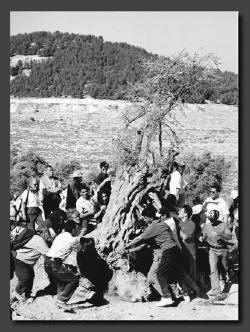
A group of peace advocates and international supporters replant an ancient olive tree that was uprooted in Bethlehem.
According to old wisdom... "the olive tree stands as a perfect personification of man's historical memory on earth. It is the tree with the highest endurance and fruitful capacity. It is the sign of peace between God and mankind.
Solon's Olive protection Law during the Athenian democracy (600 B.C.), in the first written legislation of the world, prohibited the cutting down of olive trees.
