|
 The
Church of the Nativity is the cradle of Christianity and one of the
earliest Christian structures. The original Basilica, erected in the 4th
century by St. Helena in 334 and completely destroyed in the
Samaritan Revolt of AD 529, was replaced during the reign of Justinian
(527-65) on the same site, by a larger Basilica, slightly different in
plan and incorporating different parts of the original building. The
Basilica was built in the shape of a cross with a trilateral apse.
The
Church of the Nativity is the cradle of Christianity and one of the
earliest Christian structures. The original Basilica, erected in the 4th
century by St. Helena in 334 and completely destroyed in the
Samaritan Revolt of AD 529, was replaced during the reign of Justinian
(527-65) on the same site, by a larger Basilica, slightly different in
plan and incorporating different parts of the original building. The
Basilica was built in the shape of a cross with a trilateral apse.
Enter the
Nativity Church through
The Door of Humility
 The
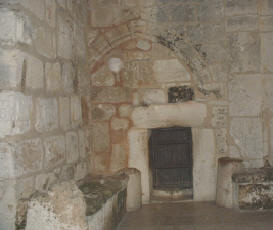
main access to the Basilica is by the very small Door of Humility.
Visitors must enter bending over, as if to a real cave. Originally the
church had three entrances, two of which have been walled up. The present
small entrance was made during the Ottoman era to prevent mounted horsemen
from entering the Basilica. The
main access to the Basilica is by the very small Door of Humility.
Visitors must enter bending over, as if to a real cave. Originally the
church had three entrances, two of which have been walled up. The present
small entrance was made during the Ottoman era to prevent mounted horsemen
from entering the Basilica.
 The
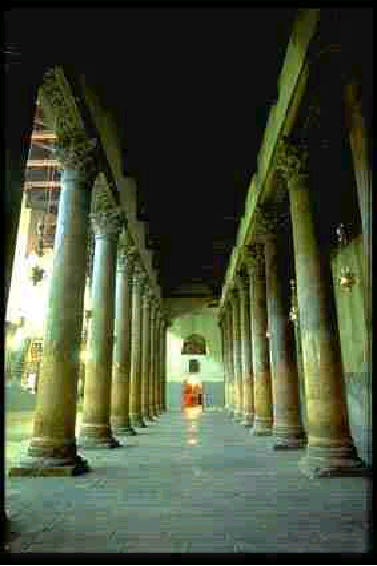
interior of the church is impressive chiefly because of its simplicity. It
contains four rows of monolithic columns of Corinthian order carved from
local stone. The columns were painted during the Middle Ages with frescoes
of the Apostles. Originally, all the inner walls of the church were
covered with mosaics. The remaining mosaics on the side walls and floor
attest to the former splendor of the sanctuary. The mosaic floors were
covered up with two feet of imported soil, and a pavement of marble slabs
was laid at a higher level by the Greeks in 1842. Since the pre-Crusader
times the roof has been of cedar wood with the rafters exposed.
The
interior of the church is impressive chiefly because of its simplicity. It
contains four rows of monolithic columns of Corinthian order carved from
local stone. The columns were painted during the Middle Ages with frescoes
of the Apostles. Originally, all the inner walls of the church were
covered with mosaics. The remaining mosaics on the side walls and floor
attest to the former splendor of the sanctuary. The mosaic floors were
covered up with two feet of imported soil, and a pavement of marble slabs
was laid at a higher level by the Greeks in 1842. Since the pre-Crusader
times the roof has been of cedar wood with the rafters exposed.
Evidence
of the turbulent history of the church can be readily seen in the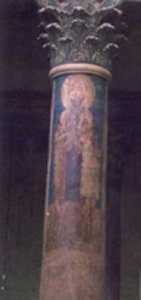 fabric of the building; for centuries it was one of the most fought-over
of the Holy Places. It was only by chance that this building escaped
destruction during the Persian invasion of AD 614. It was the only major
church in the country to be spared. The Persians were surprised to
discover a representation of the Magi from Persia on a facade decorated
with a colorful mosaic. So out of reverence and respect for their
ancestors, they decided to honor these sages by sparing the church. Later,
the building was seized and defended by a succession of Muslim and
Crusader armies; this explains the fortress-like appearance of its
exterior. In the course of time, the complex was expanded by the addition
of several chapels and monasteries. Today the Basilica is overshadowed by
the Franciscan convent in the north, the Greek Orthodox convent in the
southeast and the Armenian convent in the southwest. Also, recent
buildings rendered the famous monument quite invisible for lack of a spot
from which it can be easily viewed.
fabric of the building; for centuries it was one of the most fought-over
of the Holy Places. It was only by chance that this building escaped
destruction during the Persian invasion of AD 614. It was the only major
church in the country to be spared. The Persians were surprised to
discover a representation of the Magi from Persia on a facade decorated
with a colorful mosaic. So out of reverence and respect for their
ancestors, they decided to honor these sages by sparing the church. Later,
the building was seized and defended by a succession of Muslim and
Crusader armies; this explains the fortress-like appearance of its
exterior. In the course of time, the complex was expanded by the addition
of several chapels and monasteries. Today the Basilica is overshadowed by
the Franciscan convent in the north, the Greek Orthodox convent in the
southeast and the Armenian convent in the southwest. Also, recent
buildings rendered the famous monument quite invisible for lack of a spot
from which it can be easily viewed.
The
present ceiling is from the 14th century, and it was restored in 1842. The
two side arms end in a semicircular apse similar to that of the center. In
front of the central apse, stands the Iconostasis which was erected by the
Greeks in the 17th century. The southern apse opens onto the courtyard of
the Greek Orthodox convent. The steps of this courtyard lead down into a
series of burial grottoes extending under the southern aisles.
The
part of the Church of the Nativity with the greatest religious and
historical significance remains the Grotto of Nativity, the traditional
site of Jesus' birth. In the church, two flights of stairs now lead to the
Grotto. An altar was erected over the birthplace, and a fourteen-pointed
silver star was embedded in the white marble to
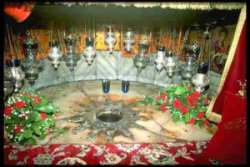 mark
the birth place of Jesus. It is lit by fifteen silver lamps representing
the different Christian communities. Opposite the altar of the Nativity,
three steps lead the visitor to the Altar of the Manger, the place where
the Baby Jesus was laid after he was born. A third altar has been erected
opposite the Manger. It is dedicated to the Wise Men who came from the
East to Bethlehem under the guidance of a star. The grotto is decorated
with numerous lamps, figures of saints, embroidery, and a variety of
sacred ornaments. mark
the birth place of Jesus. It is lit by fifteen silver lamps representing
the different Christian communities. Opposite the altar of the Nativity,
three steps lead the visitor to the Altar of the Manger, the place where
the Baby Jesus was laid after he was born. A third altar has been erected
opposite the Manger. It is dedicated to the Wise Men who came from the
East to Bethlehem under the guidance of a star. The grotto is decorated
with numerous lamps, figures of saints, embroidery, and a variety of
sacred ornaments.
The
present Franciscan church of St. Catherine of Alexandria is entirely
modern. It was built by the Franciscans in 1881 to replace the old chapel
of the Augustinian Canons on the north side of the church, which was
probably an adoption of the original chapel belonging to St. Paula's
convent. Little remained of this chapel when the Crusaders arrived in
1099; therefore, they built a cloister and monastery which was given to
the Canons of St. Augustine and which became in 1347 a Franciscan convent.
The fame of this church rests on the solemn Roman Catholic midnight mass
celebrated there on Christmas Eve and broadcast live by satellite to TV
networks all over the world.
In
the center of the cloister, stands a pillar crowned by a capital of white
stone with the sculptured figure of St. Jerome. St. Jerome came in AD 384
with a group of pilgrims to settle in Bethlehem and founded a western
monastic tradition which has endured with interruptions, till this day.
Here, in a cave under the Church of the Nativity, St. Jerome produced his
great literary works among them is his Latin Translation of the Old
Testament now known as the Vulgate.
“Glory to
God in the Highest Heaven and on Earth Peace for Those He
Favors.”
Luke 2,14
|