 June Friday 01
-2001:
June Friday 01
-2001:
“Israel” violates Blue
Line in Ghajar again
Observation post was erected Saturday, 20 meters into Lebanese territory…(1)
UNIFIL confirmed on
Thursday that “Israeli” troops have established an observation post north of the
Blue Line in Ghajar, the third breach of the UN-delineated boundary in the
divided village since January.
UNIFIL senior adviser Timur Goksel said that last Saturday, “Israeli” soldiers
erected a sandbagged observation post 20 meters into Lebanese territory
overlooking the Hasbani River.
“We saw it and have been protesting it to the “Israelis” since then,” Goksel
told The Daily Star. “They said they’re studying it and they haven’t yet given a
response (on removing the post).”
Ghajar is split by the Blue Line with two-thirds falling inside Lebanon and the
remainder in “Israeli”-occupied Syria.
The “Israelis” are in the process of erecting a sophisticated electrified fence
along the Blue Line from Ras Naqoura on the coast to opposite the village of
Shibaa at the northern end of the Shibaa Farms. Following protests by Ghajar’s
residents, the “Israelis” have so far agreed to refrain from running the fence
through the middle of the village.
But the “Israeli” Army believes that the absence of a fence in Ghajar poses a
security risk. It tried to circumvent this dilemma in January by swinging the
new fence around the northern tip of Ghajar on Lebanese territory. “Israel” was
forced to abandon the plan after the violation was protested by Lebanon and the
UN.
In April, the “Israelis” erected a camera mounted on a pole about 20 meters
north of the Blue Line on the western edge of the village overlooking a deep
wadi through which the Hasbani River flows. The pole was taken down two weeks
ago after protests by UNIFIL.
The new observation post has been built on the same spot.
Part of the Hasbani River Gorge the bend near the new water-pumping station
cannot be seen from the “Israeli” side of the Blue Line.
A UNIFIL officer said that the camera and observation post were set up to allow
the “Israelis” to monitor the wadi, which they consider a potential route for
guerrillas to infiltrate the “Israeli” side of the line, even though the
surveillance measures violate the Blue Line.
“Israeli” helicopters strike Lebanon after explosions in disputed area…(2)
“ “Israeli” helicopters fired Thursday night on positions in south Lebanon following five explosions in the “Israeli”-held Shibaa Farms area, Lebanese police said. They gave no indication of any casualties.
The helicopters launched heavy machine-gun fire for half an hour around three “Israeli” positions in the Shibaa Farms, after five blasts, the origins of which were not clear, were heard from the area, police said.
The “Israeli” air force, apparently fearing a guerrilla infiltration, also struck an entry point into the Shibaa Farms from Lebanon.
The militant movement Hizbullah has since October launched a series of attacks on the area, capturing three “Israeli” soldiers and killing three others.
Jewish state’s troops threaten farmers…(3)
Farmers harvesting wheat
near the border with “Israel” at Metulla were threatened by “Israeli” troops
Thursday, who warned them at gunpoint to leave the area.
Mehdi Fawaz and two brothers, Ahmad and Mohammed Daher, were harvesting wheat in
a field just north of the border beside Metulla when an “Israeli” military
vehicle stopped opposite them. The soldiers climbed out of their vehicle and,
pointing their rifles at the three farmers, yelled at them in Arabic to leave
their field.
The three men initially ignored the order and continued working. But they
abandoned their equipment and left the field when the “Israeli” soldiers were
joined by extra troops and took up firing positions on the other side of the
fence.
The “Israeli” soldiers left the area shortly afterward when the farmers returned
with several local reporters. Lebanese Army officers also arrived.
“We ploughed the land in October and the “Israelis” are preventing us from
harvesting our crop,” Fawaz told The Daily Star.
He called on UNIFIL to “protect us from the “Israeli” soldiers, so that we can
return to harvesting our wheat.”
1- The Daily Star, 1-6-2001.
2- AFP, 31-5-2001.
3- The Daily Star, 1-6-2001.
June Saturday
02-2001:
De Mistura slams “Israeli” air violations…(1)
The United Nation’s chief south Lebanon
official said Friday that “Israel’s” repeated violations of Lebanese airspace
were “unacceptable.”
Referring to the death last week of Steffan Nikolian the Armenian pilot shot
down and killed by an “Israeli” helicopter near Haifa Staffan de Mistura said:
“This should remind us about the violations that we are getting across the Blue
Line from the “Israeli” Air Force.
“I already raised it several times that this is happening every day and we
consider it unacceptable. It is a serious violation,” De Mistura told reporters
after a meeting with Foreign Minister Mahmoud Hammoud at Bustros Palace.
Referring to an “Israeli” observation post north of the Blue Line in the divided
village of Ghajar, he said the UN would attempt to have the position removed.
“The Blue Line is sacred as far as we are concerned and we’re going to make an
official move on (the violation),” he said.
“Israelis” take down observation post at Lebanese border after complaint…(2)
The “Israeli” army Friday dismantled an observation post that stretched 20 meters (yards) into Lebanese territory facing the village of Ghajar, an AFP reporter on Interim Forces in Lebanon (UNIFIL) earlier this week told “Israel” of the new violation of the blue line, which marks “Israel’s” May 2000 line of withdrawal from southern Lebanon after a 22-year occupation.
UN peacekeepers said it was a "temporary observation post" set up to replace an antenna for electronic surveillance taken down May 22 after a UN complaint.
But in Al-Quds, the “Israeli” army denied it had violated the blue line.
"There has been no redeployment of troops in the Ghajar sector. All the “Israeli” army's activities in this sector are done in coordination with UNIFIL," said an army statement.
On May 1, UN peacekeepers dismantled a cement barrier “Israel” had erected 300 meters (yards) into the Ghajar sector.
1- The Daily Star, 2-6-2001.
2- AFP, 1-6-2001.
June Tuesday
05 -2001:
Syrian vice-president accuses “Israel” of stirring up trouble…(1)
Syrian Vice-President Abdel-Halim
Khaddam said Monday that no one in Lebanon sought to make the country a source
of trouble for Syria.
“I don’t believe there is anyone in Lebanon trying to turn the country into a
thorn in Syria’s side,” Khaddam told reporters after meeting with former Premier
Omar Karami.
“It is “Israel” which is definitely doing its utmost to do so, along with all
international circles which have no interest in a just and comprehensive peace,
or in stability reigning in the region,” said Khaddam soon after being released
from hospital.
The vice-president collapsed while making a speech Sunday during a ceremony
marking the 14th anniversary of the assassination of Rashid Karami.
Khaddam said the peace process needed a “microscope to trace, and in fact it
doesn’t exist” as “Israel” foiled negotiations and ignored UN resolutions.
“Peace in itself is not an aim. The aim is to liberate occupied Arab territories
and make sure that the Palestinian people recover their rights and that
stability reigns in the region,” he said.
“If peace is the aim, then it is the Arabs who are supposed to pay the price
with “Israel” retaining its aggression.”
Asked about the tension possible moving to the Golan Heights, Khaddam said his
country’s policy was based on facts.
“If “Israel” commits an aggression against us, it is natural that we retaliate
with all our resources and in the appropriate manner,” Khaddam affirmed.
In turn, Karami said his talks with Khaddam covered the situation in Lebanon. In
view of the “delicate situation through which Lebanon and the region are
passing, all sides should rise to a level of responsibility,” Karami said.
“Israeli” planes fly over Lebanon again…(2)
“Israeli” warplanes flew again Monday over Lebanon, breaking the sound barrier over Beirut, one day after the Lebanese army opened fire on intruding “Israeli” planes.
Two planes flew at medium altitude over southern Lebanon before going over Beirut.
The Lebanese army had Sunday fired anti-aircraft batteries on intruding “Israeli” aircraft for the first time since “Israel” ended its 22-year occupation of southern Lebanon in May 2000.
Case against Sharon mounts…(3)
“Israeli” Prime Minister Ariel Sharon,
on the verge of unleashing his army against the Palestinian territories in
retaliation for last week’s deadly suicide martyrdom bombing in Tel Aviv, could
soon find himself standing trial for a war crime committed against Palestinian
refugees 19 years ago.
Two lawyers, a Lebanese and a Belgian, filed a law suit on Monday in a Belgian
court charging Sharon with responsibility for the war crime of the massacre of
Palestinian refugees in Sabra and Shatila in 1982.

Sharon then “Israeli” defense minister planned and implemented the 1982
invasion and ordered the subsequent siege of West Beirut in which daily air
raids and artillery bombardments caused thousands of civilian casualties.
He also allowed Christian militias to enter the Palestinian refugee camps of
Sabra and Shatila to ferret out possible Palestinian guerrillas. Up to 2,000
Palestinians and Lebanese were slaughtered by the militiamen over a three-day
period while the “Israeli” Army surrounded the camp. It is the Sabra and Shatila
massacre for which Sharon is being sued.
Heads of state have long benefited from diplomatic immunity and the absence of
legal mechanisms to indict them for crimes in office.
But when former Chilean dictator and senator for life Augusto Pinochet was
arrested in 1998 by British police and summoned to court for “crimes of genocide
and terrorism,” the world was stunned. Britain’s Law Lords created a legal
precedent to bring dictators and accused war criminals to justice.
“The law in Europe has changed a lot with Pinochet’s arrest, Milosevic, the
Rwanda criminal tribunals, and the wider definition of jurisdiction,” said
Chibli Mallat, a Lebanese constitutional lawyer who, along with Belgian lawyer
Michael Verhaeghe, is participating in the law suit.
Mallat, who teaches European Law at Universite Saint Joseph, said heads of state
could be prosecuted under a 1993 Belgian law modified in 1999 which expanded
the concept of jurisdiction in cases of crimes “universally recognized and not
subject to the statute of limitations. Normally, an action is only considered
criminal (and prosecutable) if it takes place on the national territory or if
the victims are nationals,” he said.
In the case of the Sabra and Shatila massacres some of the victims or
descendants of the victims may have acquired Belgian nationality. “But that is
not the real issue,” Mallat said.
For Mallat, the case is part of a greater international effort to establish
courts to bring heads and former heads of state accused of war crimes to
justice.
The law suit, according to Mallat and Rosemary Sayigh an anthropologist and
researcher who is also working on the case is strong in two ways: the first,
it is being filed in a country that has discarded immunity for heads-of-state
and has widened its definition of jurisdiction.
And secondly, for the first time there are Palestinian witnesses 30 in all
willing to testify and whose affidavits have been remitted. “Finding witnesses
wasn’t easy,” Sayigh said. “Our luck was to find someone from the camps who was
professional and ready to work.”
That someone was Sana Hussein, a Palestinian refugee herself. She tracked down
the survivors, took their testimonies and wrote the reports which, Mallat said,
required more than registering the statements. They had to be standardized,
accompanied by proper identification, and formulated in a convincing style.
In the past, journalists, medical personnel and “Israeli” soldiers were the ones
to describe the terrible events of Sept. 15-18, 1982.
“Victims have been the forgotten voice,” Sayigh said.
Most witnesses were unable to speak out in the past for various reasons. Some
still cannot. Sayigh described one woman who was unwilling to talk because she
had lost her whole family: “She said that when she talked about it she felt ill
for days.”
Mallat and Sayigh have been working on Palestinian issues for years. Sayigh came
from England in 1953. She first worked as a journalist, married Youssef Sayigh,
a prominent Palestinian professor and former economic advisor to Yasser Arafat.
She has written two books on Palestinian issues, and started her second book,
Too Many Enemies, immediately after the massacres.
On this specific law suit, she has been working with Mallat for four months
“with a great sense of urgency because Sharon was scheduled to go to Belgium
this month,” Mallat explained.
Sharon canceled his trip, which some interpreted as a result of the uncertainty
caused by the law suit. But the official reason was Friday night’s deadly
suicide martyrdom bomb outside a disco in Tel Aviv, killing 20 “Israelis”.
“We should expect a lot of empty talk now about the timing of the law suit,
about Arafat, about Hamas … which is fine,” Mallat said. “But that doesn’t
amount to much when it comes to Sharon’s personal responsibility (in the 1982
massacres).”
Mallat said the “Israeli” government’s investigation the Kahane Commission
accused Sharon of “bearing personal responsibility” in the massacres and that
the media had later distorted this into “indirect responsibility.”
“Irrespective of our political position,” he said, “there are acts that should
disqualify a person from the political scene.”
Asked whether he really believes that “Israel” or the United States would ever
allow a senior “Israeli” official to be indicted by a European court, Mallat
seemed optimistic. “I don’t think we should despair that quickly, even of the US
and “Israel” … We have a lot of people working on the case … and it’s a case
that everyone, including “Israelis”, agree on.
“The key is legal, because the law has teeth,” he continued. “If we do it right,
and if the professionalism continues, this can be an extraordinary thing for the
Middle East … Our goal is a wider movement on the European front. I think legal
systems should be tested.”
1- The Daily Star, 5-6-2001.
2- AFP, 4-6-2001.
3- The Daily Star, 5-6-2001.
June Thursday 07
-2001:
“Israeli”
warplanes again violate Lebanese airspace…(1)
“Israeli” warplanes again violated Lebanese airspace Wednesday, breaking the sound barrier over Beirut, reporters said.
Two warplanes flew at medium altitude over south Lebanon before continuing over the Lebanese capital, the same route “Israeli” planes took Monday.
The Lebanese army Sunday fired anti-aircraft batteries on intruding “Israeli” aircraft for the first time since “Israel” ended its 22-year occupation of southern Lebanon in May 2000.
1-
AFP, 6-6-2001.
June Friday 08
-2001:
Land mine maims man in Jezzine…(1)
A 20-year old man was wounded Thursday
by the explosion of an anti-personnel mine left behind after “Israel’s” troop
pullout from south Lebanon a year ago, police said.
Mohammed Salman, 20, lost a foot from the blast as he was gathering scrap metal
near Kfar Falous, Jezzine.
His father, Salman, said that while driving toward their village of Ain Arab,
his son got out of the car and stepped over barbed wire to gather the material,
to be used in rebuilding their destroyed home.
Residents said it was the first known land-mine injury in the Jezzine district
since the Kfar Falous-Jezzine road was re-opened in 1997.
Salman, who was also injured by shrapnel released by the mine in the explosion,
was rushed to Qasab hospital in Abra for treatment, where he remained in
intensive care.
1- The Daily Star, 8-6-2001.
June Saturday 09
-2001:
When will the ghosts of Sabra and Shatila catch up with “Israel’s” prime minister?...(1)
Will Ariel
Sharon soon be sent up to the slammer? Will his lawyers argue that he suffers
from dementia, as they did in the case of Augusto Pinochet, to keep him out of
court? Not likely, although if several lawyers and an anthropologist have their
way, the “Israeli” prime minister will find it increasingly difficult to
escape a memory he has spent almost 20 years expunging: that of the massacres at
Sabra and Shatila in September 1982.
Earlier this week three lawyers (a Lebanese, Chibli Mallat, and two Belgians,
Michael Verhaeghe and Luc Walleyn) prepared a legal complaint in Belgium in the
name of survivors of the massacre. The complaint was directed against Sharon and
other senior “Israeli” officials. The lawyers based their complaint on
dozens of testimonies collected by a Palestinian refugee, Sana Hussein, working
in collaboration with a British anthropologist, Rosemary Sayigh.
The highlights of Sharon’s involvement in the massacres have long been known.
On Sept. 28, 1982, the “Israeli” government appointed a commission of
inquiry headed by the president of the Supreme Court, Yitzhak Kahan. The
commission found that Sharon was indirectly responsible for what had taken place
in the camps. What this meant, however, was that he had not actively
participated in the killings. However, in a part of the commission’s report
offering recommendations, the members found that “the minister of defense
(war) bears personal responsibility,” a considerably stronger formulation.
There are two approaches to Sharon’s responsibility outlined in the
commission’s report. Nevertheless, only one argument is developed in depth,
and it essentially states that Sharon should have known a massacre would took
place given the past performance of the Lebanese Forces, statements of intent by
the militia’s commanders, and the pervasive anger in its ranks after the
assassination of Bashir Gemayel. The commission also established that fear of a
massacre was rife in the “Israeli” military hierarchy in Lebanon.
Sharon was further accused by the Kahan commission of having taken no
precautions to prevent a massacre. On the contrary, the report stated that the
ramifications of a probable massacre “did not concern (Sharon) in the
least.” This led to his failure to ensure “effective and ongoing supervision
by the “Israeli” Army over the actions of the Phalangists at the site.” It
should also be noted that control of the Lebanese Forces in the camps area had
been granted to the “Israeli” Army on Sept. 16, the day the militiamen
entered the camps.
What the commission did not expand on, however, was Sharon’s role in inciting
the Lebanese Forces. One can turn to two leading authorities on the massacre,
“Israeli” journalists Ze’ev Schiff and Ehud Ya’ari, for a partial
answer. In a celebrated book written on the 1982 war, they described the
aftermath of Bashir’s assassination, when Sharon did two things: He rallied
the Lebanese Forces, who were demoralized by their leader’s death, and he
forcefully included them in “Israel’s” plan to enter West Beirut.
Later, he was heard telling Lebanese Forces commanders that he wanted the
PLO’s infrastructure in Beirut removed: “I don’t want a single one of them
left,” he said. Does this prove incitement? Not necessarily. However, at no
point did Sharon clarify the ambiguous statement. One would assume that if he
had wanted to avert the killing of innocents, he would have clarified an order
that could so easily have been misinterpreted by a militia impatient to
liquidate. Indeed, when the senior Lebanese Forces official on the scene asked
for clarification, Sharon evaded the issue.
Beyond the legal implications of a complaint filed against Sharon and other
“Israeli” officials, there is the matter of memory. The Jews, by virtue of
the historical torments they have endured, are often said to marinate in memory.
However, Sharon’s recent election was evidence that “Israel” is as adept
as other states in forgetting the more sordid episodes from its past. By the
same token, Sharon has always hidden behind the phrase “indirect
responsibility” to protect himself, arguing that he had not expected a
massacre and had not heard that one was taking place until a full day after it
began.
The mediocrity of that defense was summed up by the Kahan commission, which
said: “When we are dealing with the issue of indirect responsibility, it
should also not be forgotten that the Jews in various lands of exile …
suffered greatly by pogroms perpetrated by various hooligans … The Jewish
public’s stand has always been that the responsibility for such deeds falls
not only on those who rioted and committed the atrocities, but also on those who
were responsible for safety and public order, who could have prevented the
disturbances and did not fulfill their obligations in this respect.”
The passage had and still has enormous meaning. The Kahan commission,
intentionally or not, thus undermined its own reference to Sharon’s indirect
responsibility. It effectively suggested that one needn’t be an Eichmann or,
more recently, a Ratko Mladic, to be accountable for crimes against humanity.
By associating Sharon with the perpetrators of past pogroms against the Jews,
the commission dented one of the more consecrated of “Israeli” symbols,
which holds that the Jewish state, because its people were persecuted throughout
history, represents a moral force on the international scene.
If that is the case, then “Israelis” must explain how Ariel Sharon reached
the highest levels of power in their country. At some point soon, a Belgian
magistrate will take up the legal case, in a country that recognizes universal
jurisdiction in crimes against humanity. That particular aspect of international
law has changed considerably since 1982, when the Sabra and Shatila massacres
were perpetrated. Now is the time for Sharon to face up to his personal
responsibility for that odious crime.
1. The Daily Star, 9-6-2001.
June Monday 11
-2001:
“Israeli” fighter
planes violate Lebanese airspace: police…(1)
““Israeli” warplanes violated Lebanese airspace Sunday, sounding sonic booms over the northern city of Tripoli and the eastern Bekaa valley, Lebanese police said.
The planes traveled at a high altitude and did not pass over Beirut, where they have frequently broken the sound barrier.
The warplanes approached Lebanon's northern border with Syria, but Syrian and Lebanese military did not respond with anti-aircraft fire.
The UN has repeatedly called for “Israel” to stop violating Lebanon's airspace, classifying it as a violation of the UN-drawn blue line, which marks “Israel”'s line of withdrawal from south Lebanon in May 2000 following a 22-year occupation.
1-
AFP, 10-6-2001.
June Friday 01
-2001:
“Israeli”
soldiers threaten shepherd…(1)
 An
“Israeli” patrol threatened to shoot a shepherd Monday as he approached the
border near Metulla, the second such incident in the past two weeks.
Four “Israeli” soldiers pointed their weapons at Taher Hussein Merhi, 65,
when he refused to leave his field. Merhi then collected his flock and moved
away.
Earlier in the month, three farmers were ordered by “Israeli” troops to stop
harvesting their wheat and leave their field opposite Metulla.
Lebanese lawyer wants
to bring Sharon and Peres before the courts…(2)
“ A Lebanese lawyer close to the fundamentalist Shiite group Hizbullah asked Lebanese courts Monday to put “Israeli” Prime Minister Ariel Sharon and his foreign minister, Shimon Peres, on trial for war crimes against Lebanon.
May Khansa filed a complaint with State Prosecutor Adnan Addoum against Sharon and Peres for 73 "crimes" committed against Lebanon since the creation of the state of “Israel” in 1948.
Addoum told AFP the complaint had been registered by his office but added that he did not yet know how he would handle it.
He nevertheless said that if the two were found guilty, an international arrest warrant would be issued against them, via Interpol.
The prosecutor also said he had forwarded the complaint to the military intelligence services, adding he had asked them to send him the results of their investigation as quickly as possible.
Among the "crimes" Khansa blames on the two “Israeli” leaders are the invasion of Lebanon and the Sabra and Shatila Palestinian refugee camp massacres in 1982, the capture of two fundamentalist leaders, Abdel Karim Obeid in 1989 and Moustapha Dirani in 1994, the assassination of the secretary general of the Shiite movement Hizbullah, Abbas Moussaoui, in 1992, and the massacre of 105 Lebanese civilians in Qana during the shelling of a UN base in
Under Lebanese law, “Israel’s” premier and the former Nobel peace prize winner could incur the death penalty.
Khansa wants the trial to be held on central Beirut's Martyrs Square, which was devastated by the 1975-1990 civil war, where she suggested gallows should be put up.
1-
The Daily Star, 12-6-2001.
2- AFP, 11-6-2001.
June Wednesday 13
-2001:
Lahoud says Syrian
presence is vital due to Shibaa dispute…(1)
President
Emile Lahoud affirmed that Syria provides vital assistance to Lebanon, and
defended its controversial military presence as pivotal as long as parts of
southern Lebanon remained occupied.
Lahoud made the statement during an interview with the Moroccan News Agency on
the eve of a two-day visit to Morocco, which starts Wednesday.
Lahoud praised Syria’s role in ending the Lebanese civil war and in laying the
foundations of the new Lebanese state based on the Taif Accord.
“But Syria’s most significant contribution toward Lebanon was its help in
liberating the South,” he said.
He added that “just like Syria has always stood by Lebanon, it will continue
to do so until the South is fully liberated and a comprehensive regional peace
is achieved.”
Lahoud stressed that “with Syria’s support, such a comprehensive peace would
restore stability to the Middle East area and end the Arab-”Israeli”
struggle.”
The Lebanese president pointed out that “any partial peace is in fact a
surrender to the “Israelis”, which we and the Syrians have always rejected
despite the political, economic and military pressures exerted on us.”
Lahoud pledged that “the Lebanese-Syrian cooperation will continue until the
Golan Heights are liberated, just like the Lebanese south was, and until
“Israel” withdraws to the June 4, 1967, lines.”
Lahoud predicted that “there will be no stability in the region until the
Shibaa Farms are returned to Lebanese sovereignty. There is no compromise on
this issue. Lebanon is entitled to resort to all the methods at its disposal to
liberate the Shibaa Farms.”
He added that “no matter what method we employ, the Shibaa Farms will be
liberated from “Israeli” occupation just as the South and the Western Bekaa
were in May 2000.”
1-
The Daily Star, 13-6-2001.
June Thursday 14
-2001:
Hizbullah
‘will shoot back’ if “Israelis” fire across border…(1)
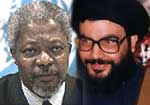 Hizbullah
will now retaliate directly against any “Israeli” troops who shoot civilians
on the Lebanese side of the border, a party source told The Daily Star
Wednesday, raising the specter of cross-border gunbattles at key flashpoints
along the frontier.
The warning came a day after Hizbullah’s anti-aircraft batteries fired on
“Israeli” warplanes flying over the western sector of the border district.
A UNIFIL officer said that one of the two reported incidents involved an
aircraft being targeted by 8 to 10 rounds of anti-aircraft fire from just south
of At-Tiri village near Bint Jbeil.
It was the first time that “Israeli” warplanes have been shot at by the
resistance since overflights resumed last October and, according to the
Hizbullah source, marks the beginning of a new retaliatory policy.
“We will return fire if the “Israelis” violate our border,” the source
said. “This is the decision we have taken. We cannot keep silent on the daily
violations any longer and we want to make the “Israelis” understand this.”
He said that retaliation would not just be confined to “Israeli” aircraft
flying in Lebanese airspace.
“If the “Israelis” kill or wound Lebanese civilians from one of their
outposts, then we are obliged to return fire directly,” the source said. “If
they fired from their post on Sheikh Abbad Hill, for example, then we will
return fire at the Abbad Hill post.”
“Israeli” troops have killed three civilians and wounded at least 29, four
of them this year, in border demonstrations, mainly at the former Fatima Gate
crossing in Kfar Kila and at Sheikh Abbad Hill.
The latest incident occurred on May 26 when a civilian was shot in the leg at
Sheikh Abbad Hill during a demonstration marking the first anniversary of the
“Israeli” withdrawal.
The prospect of shootouts blazing across the border fence, however, is likely to
increase the level of tension beyond the existing theater of conflict in the
Shibaa Farms to along the border with “Israel”.
Since the “Israeli” withdrawal, Hizbullah has refrained from responding to
border shooting incidents and has been careful to limit its activities to the
remote Shibaa Farms territory rather than launching operations directly into
“Israel”.
Combatting “Israeli” violations of the UN-delineated Blue Line might restore
some of the international legitimacy Hizbullah enjoyed during the occupation of
the South but lost when it launched the Shibaa Farms campaign last October.
Of more importance to Hizbullah, however, is the ability to maintain pressure on
the “Israeli” Army beyond the confines of the Shibaa Farms, particularly at
a time when the stakes may be unacceptably high for further attacks in the
disputed territory.
“Israel” reportedly conveyed strong warnings to Damascus last month that
Syrian military positions in Lebanon would be targeted if Hizbullah continued
attacking “Israeli” forces occupying the farms.
In mid-April, a Syrian radar station was destroyed by “Israeli” warplanes in
response to a Hizbullah missile attack in which an “Israeli” soldier was
killed.
Hammoud
seeks Arab unity to face “Israel”…(2)
Foreign Minister Mahmoud Hammoud will
seek Arab support for devising ways to confront repeated “Israeli” threats,
informed sources said on Wednesday.
Hammoud will raise the issue at a meeting of the Arab Follow-Up Committee in
Amman on Monday. The Committee was set up in Cairo last year to discuss support
measures for the Palestinian intifada. The sources said other issues to be
raised included support for the release of Lebanese detainees held in
“Israeli” jails, participation in Lebanon’s de-mining operations, and
backing the liberation of the Shibaa Farms.
1-
The Daily Star, 14-6-2001.
2- The Daily Star, 14-6-2001.
June Friday 01
-2001:
BBC Program:
Sharon should be tried for war crimes…(1)
A controversial documentary aired in
the UK last night claims that “Israeli” Prime Minister Ariel Sharon should
be tried for war crimes.
The BBC’s 45-minute Panorama programme investigated the events behind the 1982
Sabra and Shatilla massacre, and Sharon’s involvement as the then Defence
Minister.
Judge Richard Goldstone, a former chief prosecutor for the UN criminal tribunals
for Yugoslavia and Rwanda, told reporter Fergal Keane that he was in "no
doubt" that Mr Sharon is indictable.
He said: "If the person who gave the command knows, or should know
that there is a situation where innocent civilians are going to be
injured or killed then that person is as responsible, in my book more
responsible even, than the people who carry out the orders."
Judge Goldstone said that as “Israel” had invaded Lebanon in 1982, Mr Sharon
and the “Israeli” army were legally responsible for protecting Lebanese
civilians from harm.
Narrating the documentary, Mr Keane said: "Ariel Sharon said recently that
he regretted the tragedy of Sabra and Shatilla. When asked if he would apologise
he said apologise for what? "
Aired at 10pm GMT, the documentary detailed the events of September 1982, when
the Phalangists entered the camps and killed up to 2,000 people. It claimed that
Sharon ignored warnings about the events from within his own ranks.
Journalist Ron Ben Yishai said he telephoned Mr Sharon on the night of September
17. "I found him at home sleeping," said Mr Ben Yishai. "I told
him listen, there are stories about killing and massacres in the camps.
"I said you can still stop it, I didn’t know that the massacre actually
started 24 hours earlier. Do something about it, I said. He didn’t
react."
Footage taken by a Danish cameraman showed bodies scattered around the camps.
Emmanuel Rosen, then an “Israeli” Army journalist, recalled having seen
scalped children and castrated men.
"Most of the soldiers that I knew felt terrible about it and felt this was
the time to break off contact with the Phalangists, go out of this country and
go back to being an “Israel’s” Army,"
he said.
Suad Srur was then 16. She described having been raped and shot in the head by
the Christian militiamen. She was left crippled and six of her family, including
her father, were killed.
The programme highlighted the public outcry in “Israel”. There were shots of
angry protestors and scenes of fierce arguments in the Knesset. David Levy, the
then deputy Prime Minister was quoted as saying: "We will bear the
blame."
“Israel” appointed a judicial commission of inquiry into the massacre, which
found Ariel Sharon indirectly responsible. He resigned from his post, but no
further action was taken.
Mr Sharon’s legal team say allegations of war crimes are "totally
baseless".
The Phalangists leaders have not been brought to justice. Fuad Abu Nader, the
militia’s head of operations, told Mr Keane he was "not afraid of any
kind of inquiry" and that he had "peace of mind".
Elie Hobeika, widely believed to have led the attack, agreed to meet the BBC in
Beirut where he still lives.
"I don’t regard myself as a war criminal," he said. "I was a
soldier. I fought at many fronts. I survived."
Try Sharon,
says war crime judge…(2)
Ariel Sharon, the “Israeli” Prime Minister, should be tried for war crimes in connection with the 1982 massacre of Palestinian civilians in Lebanon, the former chief prosecutor to the International War Crimes Tribunal for Yugoslavia has suggested.
In a BBC Panorama programme last night, Judge Richard Goldstone, former chief prosecutor for the UN criminal tribunals for both the former Yugoslavia and Rwanda, said: "If the person who gave the command knows, or should know ... that there's a situation where innocent civilians are going to be injured or killed then that person is as responsible, in my book more responsible even, than the people who carry out the orders".
Mr Sharon was Defence (War) Minister when “Israel” invaded Lebanon in 1982, and “Israeli” forces allowed their allies in the Lebanese Christian militias to enter the Sabra and Chatila refugee camps and massacre up to 2,000 people. An “Israeli” inquiry held Mr Sharon responsible.
Judge Goldstone said it was regrettable that no criminal prosecutions had been brought.
Shatila survivor’s first step in move to put Sharon on trial…(3)
A SURVIVOR of a massacre committed
during “Israel’s” 1982 invasion of Lebanon left for Belgium with her
lawyer yesterday to try to have “Israel’s” prime minister Ariel Sharon
charged there for crimes against humanity.
Under
a 1993 law, Belgium gave its courts authority to prosecute foreign officials for
human rights violations, including genocide, committed outside Belgium.
"I
am going to Brussels on behalf of a whole people. I hope Sharon is tried and
hanged for what he did," Souad Srour al-Mere’eh told Reuters as she
prepared to leave her shanty home in the Shatila camp.
Pro-”Israeli”
Lebanese militiamen entered the camp in the summer of 1982, raped Ms Mere’eh,
then aged 14, and killed most of her family. Ms Mere’eh survived, but she is
handicapped and still has a bullet still lodged in her spine.
“Israel’s”
Kahan Commission named Mr Sharon in 1983 as the “Israeli” commander who sent
Lebanese Christian militia to the Sabra and Shatila Palestinian refugee camps,
where they massacred hundreds of unarmed civilians. The operation was part of
“Israel’s” invasion of West Beirut after “Israeli”-allied Lebanese
president-elect, Bashir Gemayel, was assassinated. The “Israeli” army
delegated "searching and mopping up" of the camps to the Phalangist
militia and Lebanese army.
Mr
Sharon was defence (war) minister at the time in the Likud government of the
late Prime Minister Menachem Begin.
Ms
Mere’eh, representing 28 plaintiffs and witnesses to the massacre, will
present a complaint in Brussels this week to a Belgian examining magistrate, who
will then decide whether it is admissible under Belgian law.
Their
written testimony says “Israeli” troops surrounded the camp and turned back
refugees who tried to flee after the militias entered and started killing.
Their
case is separate from a similar one presented to a Belgian magistrate by two
Arabs earlier this month. The magistrate has not yet ruled on that complaint.
"The
history of Kosovo and elsewhere has shown what ‘mopping up’ means,"
said Chibli Mallat, a leading Lebanese lawyer acting for Ms Mere’eh and
fellow-plaintiffs. Mr Mallat said his clients were seeking retribution.
"This is the era of global justice. Sabra and Shatila is a scar in the
collective memory of the 20th century."
The
Kahan report said Mr Sharon bore personal responsibility for disregarding
"the danger of acts of vengeance and bloodshed" by the militiamen when
he decided to have them enter the camps. However, it said "the atrocities
in the refugee camps were perpetrated by the Phalangists, and ... absolutely no
direct responsibility devolves upon “Israel”."
“Israeli”
officials last week denounced a BBC television documentary , which examines the
possibility of putting Mr Sharon on trial, as biased and anti-semitic.
Lebanese
man seriously injured by mine in former occupied south…(4)
“ A Lebanese civilian was seriously injured Sunday in a mine explosion in the zone formerly occupied by “Israel” in southern Lebanon, the Lebanese police said.
Said Ismail, 37, had his foot blown off as he was working his field in the area around Rmeish near Tyre, some 80 kilometres (50 miles) south of Beirut, they added.
Since the “Israeli” withdrawal in May 2000, 13 Lebanese have been killed and 70 others injured by mine explosions in southern Lebanon, while some 10 soldiers have been wounded in demining operations.
According to the United Nations, “Israel” left more than 100,000 mines in the 850 square kilometre (340 square mile) border zone it occupied in southern Lebanon for 22 years, and the world body estimates it will take four years to clear them.
4-
Jerusalem Post, 18-6-2001.
5-
Independent, 18-6-2001.
6-
The scotsman.com, 18-6-2001.
7-
AFP, 17-6-2001.
June Tuesday 19
-2001:
Belgian
court considers charges against Sharon…(1)
Survivors of the 1982 massacre at the
Sabra and Shatila refugee camps opened legal proceedings against “Israeli”
Premier Ariel Sharon in Belgium on Monday, accusing him of crimes against
humanity.
The 28 survivors presented their case against Sharon and others alleged to have
been involved in the massacres to an investigating magistrate under Belgian laws
that permit the country’s courts to try war crimes committed abroad.
The judge will now determine whether Sharon, then “Israel’s” defense (war)
minister, and the others should face charges.
The launch of the case coincides with uproar in “Israel” over the airing of
a BBC program which discussed whether Sharon would be indictable for war crimes
over Sabra and Shatila.
Souad Srour, who was paralyzed in the attack, read a statement to reporters of
the horror she suffered at the hands of “Israeli” soldiers.
“We heard someone knock at the door. My father asked ‘Who is it?’ And they
said, ‘We’re “Israelis” and we want to search the house.’ My father
opened the door and there were 13 armed soldiers,” Srour said. “Afterward
they started firing at us. My little sister was shot in the head, and my father
was hit in the chest but he was still alive … . But me, I was paralyzed right
away and I could no longer move.
“They raped me, one after the other, right in front of my father. They shot at
me I was hit on the left hand and then they left,” she added. “They
came back later that night and were furious to see I was still alive … They
shot me twice more.”
Srour, now 36, walks with two canes and still has nightmares about the incident.
Sharon had to resign as defense minister after an “Israeli” inquiry found
him indirectly responsible for the killings.
Belgian lawyer Michael Verhaeghe, who is representing the survivors, said there
was “sufficient evidence” to convict those responsible. “The facts in this
case undeniably reveal crimes against humanity,” he said.
If the judge decides to press charges, Sharon could be arrested if he enters
Belgium. But lawyers said that as a serving head of government, he would likely
enjoy immunity.
The plaintiffs said they could also press similar charges against Sharon in
other countries.
The move was praised on Monday by Palestinians living in refugee camps. Author
Raafat Murra, who has written about the killings, said he supported the case
even though he doubted it would lead to charges.
“It is enough that this would make international noise, annoy Sharon and
expose him as the murderer and butcher that he really is,” Murra said.
Meanwhile, the “Israeli” Foreign Ministry said that the BBC’s program was
an attempt to “tarnish “Israel” and its leader.”
The BBC said it asked Sharon to comment for its program, The Accused, part of
its Panorama series. His aide, Ranaan Gissin, gave an on-camera interview on
Sharon’s behalf, saying the “Israelis” had never expected their Phalangist
militia allies would massacre the refugees.
One of the experts interviewed was Richard Falk, professor of international law
at Princeton University in the United States, who had been vice-chairman of an
international commission that investigated the 1982 invasion.
“There is no question in my mind that he (Sharon) is indictable for the
knowledge he had or should have had,” Falk said. “Sharon’s specific
command responsibility arises from the fact that he was the minister of defense
in touch with the field commanders, that he actually was present there in
Beirut.”
Sharon’s lawyer, Dov Weissglass, was evasive when asked by “Israel” Radio
whether the premier would consider filing a libel suit against the BBC.
“Israeli” officials have in the past accused the BBC of being slanted
against “Israel” and occasionally even anti-Semitic.
The BBC said it stood by the program. The reporter, Fergal Keane, wrote in The
Independent newspaper Saturday that “I have nothing but contempt” for those
who suggest investigating the massacres indicates a pro-Palestinian bias.
Sharon's
role in Lebanon massacre returns to haunt him 20 years on…(2)
“Israeli” Prime Minister Ariel Sharon's dark past returned to haunt him Monday as a controversial British documentary revisited his role in the massacre of Palestinian refugees in Lebanon two decades ago and a survivor sought to bring war crime charges against him.
In a courtroom thousands of miles away from the scene of her ordeal, Suad Srur el-Marai relived her terror when Lebanese Christian militiamen went on the rampage in the Sabra and Shatilla refugee camps during the “Israeli” invasion of Lebanon in 1982.
El Marai, who was raped and left paralysed in the attack on her family, is one of a group of survivors seeking to press charges in a Brussels court against Sharon for crimes against humanity.
"We heard someone knock at the door. My father asked 'Who is it?' And they said, 'We're “Israelis” and we want to search the house.' My father opened the door and there were 13 armed soldiers," Srur said in a statement to reporters at the court.
"Afterwards they started firing at us. My little sister was shot in the head, and my father was hit in the chest but he was still alive ... But me, I was paralysed right away and I could no longer move," she continued.
"They raped me, one after the other, right in front of my father. They shot at me -- I was hit on the left hand -- and then they left.
"They came back later that night and were furious to see I was still alive ... they shot me twice more," said Srur, now 36, who walks with two canes and still has nightmares about the incident.
The complaint hinges on a 1993 law that makes it possible for Belgian courts to try cases of genocide and other crimes against humanity that took place in foreign countries.
Sharon, a hawkish former general known as the "Bulldozer," was declared unfit to be defence minister after an “Israeli” commission of inquiry in 1983 found him indirectly responsible for the killings during the invasion he orchestrated.
His career was blighted for years by the scandal, and his landslide win in the February election in “Israel” over Labour prime minister Ehud Barak had seemed all but impossible only weeks beforehand.
But Sharon has never apologised for his role. And his government slammed a BBC "Panorama" documentary, which ran Sunday, for suggesting Sharon should be indicted for the massacre.
"“Israel” takes a grave view of the slanted and unfair nature of the Panorama programme," the foreign ministry said in a statement. "The timing of the programme, 19 years after the events ... constitutes an attempt to sully the name of “Israel” and its leader by any means."
On the programme, former International War Crimes Tribunal chief prosecutor Judge Richard Goldstone said Sharon, now 73, should be held responsible for the massacre.
"In the case of Sabra and Shatilla, clearly the Kahan Commission found that very serious crimes had been committed and I have no doubt that any decent person would regret the fact that not a single criminal prosecution followed," Goldstone told the BBC programme, entitled "The Accused".
Richard Falk, professor of international law at Princeton University, said of Sharon: "There is no question in my mind that he is indictable for the knowledge he had or should have had."
In a statement, the BBC said it stood by the story, which it called "a legitimate analysis of a human rights issue."
In January, just a month before his election, Sharon expressed his regrets for what he said was a "terrible tragedy," but refused to apologise.
"To apologise for what?" Sharon told Arab “Israeli” weekly newspaper Kul-al-Arab.
Palestinian survivors of a massacre in Lebanon nearly 20 years ago asked a Belgian court yesterday to indict the “Israeli” Prime Minister, Ariel Sharon, for crimes against humanity over his role in the carnage.
Taking advantage of Belgium's unusually broad laws on war crimes, 28 of those who survived the killings at the Sabra and Chatila refugee camps outside Beirut filed a legal complaint with an investigating judge in Brussels. He will probably take one month to decide whether Mr Sharon and others should face charges for involvement in the murders.
In 1982 up to 2,000 unarmed Palestinians in the camps were slaughtered by a Lebanese Christian militia allied to the “Israelis”. An “Israeli” inquiry found Mr Sharon, who was then Defence Minister, "indirectly responsible" and he resigned.
Even if the case goes ahead, Mr Sharon would almost certainly not be arrested if he went to Belgium. But the attempt to purse a war crimes case has already caused a diplomatic incident, and the “Israeli” Foreign Minister, Shimon Peres, has told the Belgian government that none of his fellow ministers will risk visiting Brussels if the action proceeds.
That creates a headache for Belgium, which takes over the European Union's presidency at the end of the month and will be expected to play a leading role in Europe's efforts to help broker peace in the Middle East.
One of the survivors, Souad Srour Al-Marai, gave harrowing details of the massacre, which took the lives of most of her family. She said: "My little sister, aged 18 months, raised her hand and asked her mother to pick her up, she was frightened. Then they started shooting at us.
"My little sister received a bullet in the head, my father was hit in his chest but was still alive. My brothers and sisters, Chadi [3], Farid [8], Bassam [11], Hajar [7], Chadia [18 months] [and] also our neighbour were all killed by the first bullets."
The woman then said she was raped in front of her dying father and left for dead.
The basis for the case lies in a law dating from 1993 that gives Belgian courts jurisdiction over violations of the Geneva war crimes convention no matter where they happened, even if they involve no Belgian nationals. Earlier this month the legislation was used to convict two nuns who played a role in the genocide in Rwanda in 1994, fuelling a debate over the whole process of war crimes prosecutions.
The Belgian government, concerned at the prospect of dozens of new cases from around the world, and fearful of the political implications, now wants to amend the law.
Vincent Van Quickenborne, a Belgian senator who is sponsoring the case, said that "for Belgium as a state these facts cannot be acceptable. We as a state should indict people and try them to find out whether they have committed these acts."
Michael Verhaeghe, the lawyer who is representing the survivors, said there was "sufficient evidence" to convict those responsible, adding that "the facts in this case undeniably reveal crimes against humanity".
Yesterday's legal action is the second against Mr Sharon to be lodged in Belgium, but it is thought to stand a greater chance of leading to a trial.
The 1982 massacre unfolded over three days when “Israel” allowed its Lebanese Christian Phalangist militia allies into the refugee camps.
The subsequent “Israeli” Kahan commission report stated that “Israeli” troops surrounding the camps knew what was happening. Throughout the killings many of the victims were stabbed and a large number of women were murdered after being gang-raped. Mr Sharon was in overall command of the “Israeli” forces.
More than 400 of the dead were buried in a mass grave just inside the entrance to the camps. Hundreds of others were buried secretly during the massacre, many of them beneath Beirut golf course.
“Israeli”
warplanes violate Lebanon's skies despite UN appeal…(4)
“ “Israeli” warplanes violated Lebanese airspace again Monday, ignoring calls from UN chief Kofi Annan for them to stop.
They broke the sound barrier over Beirut as well as the southern regions of Marjayoun, Jezzine and Hasbaya, correspondents reported.
The United Nations secretary general, who has just ended a tour that took him to both Lebanon and “Israel”, criticised “Israeli” overflights as violations of the UN demarcation line drawn following “Israel’s” withdrawal from southern Lebanon in May last year.
In talks with Annan, Lebanese President Emile Lahoud said that “Israeli” planes and ships had violated Lebanon's airspace and waters 600 times since the end of the occupation.
Hizbullah, which has killed three “Israeli” soldiers and captured another three in the Shibaa Farms, said last week its forces would fire on “Israeli” warplanes.
On June 3 Lebanese anti-aircraft batteries fired on the intruders for the first time since “Israel’s” withdrawal, but scored no hits.
1-
The Daily Star, 19-6-2001.
2-
AFP, 18-6-2001.
3-
Independent, 19-6-2001.
4- AFP, 18-6-2001.
June Wednesday 20
-2001:
Italian sappers destroy “Israeli” mines in final act of
liberation…(1)
 Hundreds
of lethal land mines that ringed a former “Israeli”-proxy South Lebanon Army
outpost have been located, dug up and destroyed by a team of Italian sappers.
Reporters were invited by the Italian Embassy to the final clearing of the area
around the Teir Harfa outpost in the former occupation zone’s western sector.
As part of its “Italy for South Lebanon” project, the Italian government
donated $225,000 to fund a 35-day project to help clear land mines from the
South.
Fabrizio Gensini of Sogelma, the company appointed by the Italian government and
the National Demining Office, said the team was able to clear more than 220
anti-personnel mines, in addition to a large number of live bullets, from the
1,000 square meter post.
He said the mines were usually found at a depth of 10 to 15 centimeters, though
some were found 50 centimeters deep.
After their fuses had been removed, the 51 mines collected on Tuesday were
placed in a hole with 3 kilograms of TNT. At precisely 3pm, they were detonated
by remote control. The deafening explosion sent up a tall plume of smoke and
dust.
Gensini said the precision timing of the explosion was agreed upon by the
Lebanese Army and UNIFIL.
“The “Israelis” as well are aware of this understanding,” he said.
“That’s why they don’t worry when they hear the explosion.”
Project supervisor Silvio Ronaldi, who has previous de-mining experience in
Bosnia and Somalia, said the operation here was made easier because the mines
were installed by a regular army and not by a militia even though no maps
were available.
“Locating the first two land mines was quite difficult, but after that it
became easy because the “Israelis” have used the international standard,”
he said.
He said the team had located four lanes of mines. Each mine was one meter apart,
and each lane was four meters apart.
1-
The Daily Star,f 20-6-2001.
June Thursday 21 -2001:
Two Belgian suits
pending against Sharon for 1982 Lebanon massacres…(1)
“ Two class action suits are pending in Belgium against “Israeli” Prime Minister Ariel Sharon, charging him with responsibility in the 1982 massacres of hundreds of Palestinian refugees in Lebanon, the public prosecutor said Wednesday.
The first suit, lodged early this month by an ad hoc committee of Palestinians, Lebanese, Moroccans and Belgians, alleges Sharon was responsible for the 1982 massacres of up to 2,000 Palestinian civilians in the Sabra and Chatila refugee camps.
The second, charging crimes against humanity, genocide and war crimes, was filed on Monday by 23 alleged survivors of, and five witnesses to, the massacres.
An investigating magistrate has been assigned to determine whether the cases are admissible under a unique 1993 Belgian law that makes it possible for Belgian courts to try cases of genocide and other crimes against humanity that took place in foreign countries.
The two suits accuse Sharon of allowing Christian militias to slaughter between 800 and 2,000 Palestinian refugees at the Sabra and Shatila camps located in an area controlled by the “Israeli” military after “Israel’s” 1982 invasion of Lebanon, when Sharon was defense minister.
An “Israeli” commission of enquiry in 1983 found Sharon indirectly responsible for the killings, a finding that forced him to resign his post.
Last January, when he was campaigning for prime minister, Sharon expressed his regrets for the "terrible tragedy" of the 1982 massacres, but refused to apologise.
"What it was," he said in a press interview, "was an act of killing carried out by Arab Christians against Arab Muslims."
Arabs also blame Sharon for provoking the current intifada or Palestinian uprising with his visit to east Al-Quds's al-Aqsa mosque compound, the third holiest site in Islam, last September 28.
1-
AFP, 20-6-2001.
June Saturday 23 -2001:
“Israel” frets as
reporters enter Ghajar…(1)
The “Israeli” Army may be reviving
a plan to annex Ghajar, according to security sources, a move prompted by five
local reporters entering the Lebanese end of the divided village for the first
time since “Israel’s” withdrawal.
Ali Shaib, a reporter with Hizbullah’s Al-Manar television station and one of
the five to enter Ghajar, said they had seen “Israeli” tourists in the
Lebanese two-thirds of the village.
“We saw their tour buses with Hebrew writing on the sides,” he told The
Daily Star.
“The residents were scared and told us we should leave before the
“Israelis” came to take us,” he added.
Ghajar is split by the United Nations-delineated Blue Line with two-thirds
falling on the Lebanese side and the remainder inside “Israeli”-occupied
Syria.
After protests by Ghajar’s residents last summer, the “Israeli” Army
agreed not to physically divide the village with the sophisticated electric
fence being constructed along the 110-kilometer frontier.
Access to the Alawite village from the Lebanese side is limited. The northern
end is surrounded by an old border fence erected by the “Israelis” during
the occupation of south Lebanon. Minefields adjacent to the fence also hamper
access to Ghajar.
The only gate in the old fence lies 1.5 kilometers to the east at Abbassieh. But
Indian UNIFIL troops man an observation post by the gate and block anyone from
passing through.
Reporters in the past have approached Ghajar from Abbassieh by walking along a
narrow footpath between the old fence and the minefields.
Shaib said he and his colleagues climbed through a hole in the fence to enter
the village.
There is an understanding between the government, UNIFIL and the “Israelis”
that Lebanon will not exert its authority over the village so long as the
“Israelis” keep out.
But the “Israeli” Army believes that the absence of a fence makes Ghajar a
weak link in its chain of defenses along the frontier.
“Israel’s” Radio speculated the reporters’ visit was part of a plan by
Hizbullah to test the reaction of “Israeli” forces stationed in the southern
end of the village.
“Ghajar is a recognized breach of the border,” the radio said. “This no
doubt will continue to cause anxiety to security officials on the northern
border, as well as on the political level who do not know how to prevent
this.”
Experienced security sources in the South suspect that the “Israeli” Army
has not abandoned its plans to seal off the village from the rest of Lebanon.
One foreign observer, familiar with the “Israel” radio report, suggested the
“Israeli” Army “might be exaggerating the case to create a pretext for
physical measures on the Lebanese side of the village.”
“They are going to put up something there, no doubt about it,” commented a
UNIFIL officer. “Otherwise, why all this fuss?”
Lebanon to present resolution to OIC…(2)
A draft resolution will be presented to
the Organization of the Islamic Conference meeting opening Monday in Mali to
gather support for Lebanon’s stand in the conflict with “Israel”,
government sources said Friday. The draft will demand the release of detainees
held in “Israeli” jails and affirm Lebanon’s right to compensation for
human and material losses resulting from “Israeli” attacks.
It will condemn “Israel’s” continued aggression against Lebanon, including
the recent attack on a Syrian military radar post. In addition, the draft will
urge the international community to exert pressure on “Israel” to hand over
maps of land mines planted during its occupation.
1-
The Daily Star, 23-6-2001.
2-
Same source.
June Tuesday 26
-2001:
Military prosecutor
re-opens Sabra and Shatila inquiry…(1)
Chief Military Prosecutor
Nasri Lahoud is planning to re-open an investigation into the 1982 Sabra and
Shatila massacre, with the findings possibly being used to help prosecute
“Israeli” Prime Minister Ariel Sharon.
However, the investigation is not expected to go beyond Sharon’s complicity in
the massacre. Former MP Elie Hobeika, the commander of the Phalange militia
forces in Sabra and Shatila, and individual militiamen who carried out the
killings will not be questioned nor face prosecution, according to a source at
the military court.
Lahoud has received several reports from military intelligence detailing
possible war crimes committed during “Israel’s” 1982 invasion of Lebanon,
the source continued. The reports could be used to back a lawsuit filed last
month by May Khansa on behalf of Naji Zeidan, a writer.
The Lebanese authorities’ investigation is the latest move in a growing
campaign to indict Sharon for his role in the slaughter of at least 1,000
Palestinians at the Sabra and Shatila camps.
Massacre survivors filed a case with a Belgian court last week, accusing Sharon
of crimes against humanity.
The US-based Human Rights Watch on Sunday called for a criminal investigation
into the massacre and charges brought against those found responsible.
The source at the military court said that the investigation posed difficulties
due to the passage of time and the lack of a proper judicial investigation at
the time of the massacre.
In 1982 the government ordered then-Public Prosecutor Asaad Germanos to
investigate the massacre. Social Affairs Minister Asaad Diab, an investigating
magistrate at the time, entered the camps to survey the aftermath of the
killings: “I saw there was no exchange of fire the shooting came from one
side only. I took the names of the victims and sent the report to Germanos,”
he told The Daily Star.
Diab said he was unaware of the report’s findings and Germanos could not be
reached for comment.
London demonstrators target Sharon over Sabra and Shatila massacres…(2)
Earlier Sharon held talks
in London with his British counterpart Tony Blair. A Downing Street official
said Blair spoke of the importance of using the Mitchell commission as a basis
for future peace negotiations. The commission, led by former US Senator George
Mitchell, called for a ceasefire and confidence-building measures, including a
complete freeze to Jewish settlement activity, before peace talks can be
re-launched. Blair was quoted as telling Sharon he is a friend of “Israel”.
Sharon was met by dozens of demonstrators near Blair's residence. They called
for the “Israeli” prime minister's prosecution after a BBC documentary
suggested Sharon should be held responsible for war crimes over his role in the
1982 Sabra and Shatila massacres in Beirut. Sharon was defense minister at the
time. He was found indirectly responsible by an “Israeli” commission for the
massacres that left some 2,000 civilians slaughtered. A British official said
controversy over the BBC show was not raised in Blair's talks with Sharon.
“Israel” had condemned the BBC as anti-semitic. The leading New-York based
Human Rights Watch joined calls for investigations into Sharon's involvement in
the massacres. It said there is abundant evidence that war crimes and crimes
against humanity were committed during the massacres. Survivors of the massacres
have filed a lawsuit against Sharon for crimes against humanity.
Palestinian
massacre continues to dog Sharon…(3)
On the eve of “Israeli” Prime Minister Ariel Sharon's meeting with President Bush, human rights activists and others are calling for a criminal investigation into his role in the 1982 massacre of civilians in the Palestinian refugee camps Sabra and Shatilla.
Human Rights Watch -- an international
watch-dog group that monitors and reports on atrocities inflicted on civilians
both in times of war and by oppressive regimes -- said Friday that former
“Israeli” defense minister should submit himself to the scrutiny of an
international investigation.
"There is abundant evidence that war crimes
and crimes against humanity were committed on a wide scale in the Sabra and
Shatilla massacre, but to date, not a single individual has been brought to
justice," said Hany Megally, executive director of the Middle East and
North Africa division of HRW. "President Bush should urge Prime Minister
Sharon to cooperate with any
investigation."
The announcement comes amid a flurry of controversy
stirred up by a recent British Broadcasting Corp. documentary on Sharon and his
role in the attack on the Palestinian refugee camps in Lebanon.
Sharon was the commander of the “Israeli” Army
which allowed the Lebanese Christian Phalange militia into the refugee camps,
where they went on a 62-hour rampage that left several thousands dead.
The victims included infants, children, women, and
the elderly, many of whom were reportedly raped and disemboweled before they
were killed.
Since the killings were committed in “Israeli”
Army-controlled territory, and given that the militia was trained and supported
by “Israel”, Sharon has been dogged for nearly 20 years by charges that he
must bear responsibility for the most gruesome massacre in the history of the
“Israeli”/Palestinian conflict.
According to the Kahan Commission, an independent
investigation led by an “Israeli” supreme court judge in 1983, Sharon
"bears personal responsibility" and should "draw the appropriate
personal conclusions arising out of the defects revealed with regard to the
manner in which he discharged the duties of his office."
The commission recommended that he be relieved of
his duties as defense minister. Sharon -- after initially refusing to step down
-- resigned, though he subsequently assumed other Cabinet positions.
Morris Draper -- U.S. special envoy to the Middle
East at the time – said in the BBC program that U.S. officials were horrified
when Sharon had allowed the Phalange militia into West Beirut and the camps.
Draper said he cabled Defense Minister Sharon
telling him, "You must stop the slaughter ... the situation is absolutely
appalling."
The United States had a substantial interest in the
case.
The “Israeli” occupation of West Beirut at the
time of the massacre followed U.S. assurances that Palestinians remaining there
would be safe, as part of an arrangement that saw the evacuation of Palestine
Liberation Organization forces, according to Richard Murphy, a former assistant
secretary of Near East affairs, who is now a senior fellow for Council on
Foreign Relations.
And now, with scholars like Richard Falk, professor
of international law at Princeton, telling the BBC that Sharon is indictable as
a war criminal, the controversy surrounding the prime minister's role in the
killings has been given a new lease on life.
Following the June 17 airing of the
documentary, some survivors of the massacre lodged a complaint against Sharon in
a Belgian court, demanding he be indicted under a 1993 law that allows Belgian
magistrates to try war-crime cases no matter where committed. The prime minister
has temporary immunity as “Israeli” prime minister, though could be tried
once he leaves office.
Reaction to the documentary in “Israel” has
overwhelmingly been critical of the BBC and its portrayal of Sharon as a war
criminal.
Berri accuses
“Israel” of conspiracy…(4)
“Israel” has attempted
to keep Lebanon “financially crippled” in order to undermine international
confidence in the country’s banking system, according to Speaker Nabih Berri.
Berri, who was speaking Sunday evening at the inauguration of a state-owned
hospital in the southern town of Mais al-Jabal, said that “Lebanon will not
reward “Israel” for its aggression, its crimes, and its invasion of
Lebanon.”
Drawing a parallel between the Egyptian town of Taba which was the focus of
Egyptian-”Israeli” negotiations following Camp David and the Arabic word
for ball (taba), Berri pledged, “We would like to convey the message to
“Israel” that (unlike the Egyptians), the Lebanese are not going to offer a
Taba, or any taba to the “Israelis” because we do not reward our enemies.
“Lebanon will continue to fight until all the occupied territories are
liberated,” he added.
The speaker also said that ““Israel” has provoked the Shibaa Farms problem
knowing full well that these farms belong to Lebanon.
“Tel Aviv knows that there are French maps dating back to 1925 showing that
the farms belonged to Lebanon,” he added.
1-
The Daily Star, 26-6-2001.
2-
Future TV, 25-6-2001.
3-
United Press International, 25-6-2001.
4-
The Daily Star, 26-6-2001.