 February Thursday
01 -2001:
February Thursday
01 -2001:
Trigger-happy
“Israelis” open fire on ‘nothing’ in Shibaa…(1)
“Israeli” helicopter
gunships targeted a “suspicious” object in the Shibaa Farms area Wednesday,
but nothing was found.
Heavy machine gun fire and explosions were heard at dusk in Kfar Shuba and
several helicopters were seen flying over the Shibaa Farms.
In Al-Quds, an “Israeli” army spokesman said the troops had seen
“something suspicious but it was found to be nothing.”
The “Israelis” reportedly decided to destroy the object with helicopters
rather than send troops to investigate.
The shooting, which occurred on the “Israeli” side of the United
Nations-delineated Blue Line, came four days after two Palestinian fighters were
killed and one other was wounded by “Israeli” tanks and helicopters.
The “Israeli” Army is in a state of heightened alert in the Shibaa Farms
following several attacks and a renewed threat by Hizbullah to capture more
soldiers if “Israel” fails to meet the party’s demands for a prisoner
swap. Three “Israeli” soldiers were snatched along the Blue Line last
October.
“Israel’s” military intelligence expects further attacks from Lebanon in
the coming weeks, claiming Iran has stepped up weapons and funds to Hizbullah
and Palestinian groups opposed to the peace process.
In connection with “Israel’s” tightening of security in the area, work has
continued uninterrupted on what is thought to be a new fence on Lebanese
territory in the divided village of Ghajar.
UNIFIL spokesman Timur Goksel said that a team from the Observer Group Lebanon,
part of the UN Truce Supervision Organization, plans to visit Ghajar Thursday to
investigate the construction work at first hand.
“There is nothing significantly different,” Goksel said. “There continues
to be more work on the new fence.”
Ghajar is divided by the Blue Line with two-thirds falling inside Lebanon and
the remainder in “Israeli”-occupied Syria.
Construction work began last week in the Lebanese part of the village on what
appears to be the foundations of a new security fence. So far, the construction
activity extends around 50 meters into Lebanon.
UNIFIL suspects that the “Israelis” intend to cordon off the village as part
of its security precautions along the border.
1-
The Daily Star, 1-2-2001.
February Friday
02 -2001:
UN
buzzes “Israeli” Blue Line violation at Ghajar…(1)
A
senior United Nations official inspected “Israeli” construction work on a
new security fence on Lebanese territory in Ghajar on Thursday as moves to halt
the Jewish state’s latest violation of the UN-delineated Blue Line shifted
into gear.
Steffan de Mistura, the personal representative of the UN secretary-general for
southern Lebanon, flew over the divided village of Ghajar to check reports that
“Israel” is building a security fence north of the Blue Line. De Mistura
reportedly flew over the village at low level several times.
“He wanted to let the “Israelis” know that the UN is watching them
closely,” a UNIFIL officer said.
The officer said that the concrete foundations of the new fence now reach 350
meters into Lebanon.
“Israeli” engineers were spotted last week working north of the Blue Line in
Ghajar, raising suspicions that “Israel” had resurrected a scheme to cordon
off Ghajar behind the new security fence being erected along the length of the
Blue Line.
Ghajar is split by the Blue Line, with two-thirds of the village in Lebanon and
the remainder in “Israeli”-occupied Syria. Although the Alawite residents of
the village are permitted access to both ends of the village, “Israelis” are
forbidden from entering “Lebanese” Ghajar.
Ghajar’s residents have voiced strong opposition to having their village
physically split by the fence. To appease the local population, the
“Israelis” are running the new fence up the eastern flank of “Lebanese”
Ghajar until it meets an old security fence some 500 meters north of the Blue
Line.
The old fence was built by “Israel” during the occupation. It skirts the
northern and western ends of “Lebanese” Ghajar. When the new stretch of
fence is completed, “Lebanese” Ghajar will have been incorporated inside
“Israeli”-occupied Syria.
The Blue Line violation was raised during the Cabinet meeting. The Cabinet
condemned “Israel’s” latest violation and called on UNIFIL to end the
construction work.
De Mistura is expected to brief US Ambassador David Satterfield on the
construction at Ghajar in the hope of enlisting Washington’s support in
pressuring “Israel” to end the violation.
“We have to make a fuss and a noise over this,” the officer said. “We need
to find a way to prevent this from becoming a dangerous flashpoint.”
UN
condemns “Israel’s” latest border violation with Lebanon…(2)
With the naked eye, you can see
the yellow bulldozer and the long trail of dust as it pushes the foundations for
a new frontier fence north into Lebanon. The Indian UN soldiers watch it through
fieldglasses. "How can we tell how far it will go?" Major Chhahal
asks. "They've been doing this work for three days, right on the edge of
Gaghar."
It all looks innocent. But it is not. Just days before the elections that may turn Ariel Sharon into a prime minister, the “Israeli” army is building a new border fence on Lebanese territory and in clear violation of UN Security Council Resolution 425.
The UN has condemned the "violation of the Blue Line," the UN's own south Lebanon frontier beyond which the “Israelis” agreed not to go. The Hizbollah guerrillas who hounded the “Israeli” army out of Lebanon less than a year ago, and who have their men watching scarcely half a mile away, are well aware of what is happening in Gaghar – and of the excuse it gives them to strike once more at “Israeli” troops.
Like all Lebanese dramas, this one has a beautiful complexity all its own. For when the “Israelis” retreated last May, the UN drew its blue line through the middle of the Arab village of Gaghar. Two-thirds of the village is on Lebanese territory, the lower third is in occupied Syria; the town's few hundred inhabitants are Syrian Alawites – the same sect as Syria's President, Bashar al-Assad – who cling to their Syrian citizenship but hold “Israeli” identity papers. And since the “Israelis” could not build their frontier fence through the middle of the town – and since the residents refused to accept a frontier gate on the “Israeli”-occupied Syrian side – it looks as though the “Israelis” are willing to violate the UN's demarcation to mark a border at least 150 feet inside Lebanese territory.
Because they cannot run barbed wire through the village, the “Israelis” call Gaghar a "soft underbelly" on the Lebanese border, through which guerrillas could infiltrate into Lebanon. Already, “Israel” has violated the blue line by sending ambush patrols into the northern, Lebanese end of Gaghar at night.
But that is hardly the fault of the people of Gaghar. They did not ask “Israel” to occupy their village when it captured the Golan Heights from Syria in 1967 and then annexed the land against international law. The “Israelis”' security problem, they say, is of “Israel’s” own making. If “Israel” left Syrian territory, it would not have to worry about this stretch of frontier between Syria and Lebanon.
The UN, many of whose soldiers are positioned only metres from “Israeli” bunkers, are well aware that they will be caught in a firefight if the Hizbollah decide to use this violation as a justification for attack; which is why Major General Seth Kofi Obeg, the UN's commander, went to complain to General Gaby Ashkenazi, the head of “Israel’s” Northern Command, on Sunday. Not to worry, General Ashkenazi said, it is not an annexation of Lebanese territory. It is the people of Gaghar who are building the new fence, he went on, not the “Israeli” army.
This does not fool the UN. Indeed, there is as much chance that “Israel” would allow Syrians under occupation to decide the route of the border fence as there is that General Ashkenazi keeps a crocodile in his bathroom.
So, earlier this week, Major- General Obeg's adviser, Timur Goksel, took a helicopter along the blue line to look for himself. Flying over the gorge of the Wazzani river, he hovered over the construction. "They are putting in concrete foundations to 50 metres [inside Lebanon] in what looks like preparation to extend the line northward," he said. "The “Israelis” are creating another point of friction along the border."
Gaghar lies perilously close to Chebaa farms, Lebanese territory that was policed by Syria after 1947 and then captured and, in effect, annexed by “Israel” in 1967, with Golan. Already, three “Israeli” soldiers have been captured by Hizbollah on the farmlands and there have been two infiltration attempts in the past two months.
How far will the new fence stretch into Lebanon? In all, it might take in several square miles; big enough to cause a major crisis in southern Lebanon. Meanwhile, beyond the soft waters of the Wazzani, over the long grass and buried minefields north of the village, the bulldozers roar on. In three days, the UN says, it will have a better idea of where the fence is going. Until then, Major Chhahal and his men go on watching. So do the Hizbollah.
“Israeli” warplanes violate Lebanese airspace…(3)
“ “Israeli” warplanes flew over south Lebanon at low altitude on Thursday, the third such incursion this week, AFP reporters said.
The flights came one day after “Israeli” helicopters fired machine guns on valleys of the eastern sector of southern Lebanon after an explosion was heard near an “Israeli” position.
No explanation has been given for Wednesday's explosion, which occurred in the Farms of Shibaa, captured by “Israel” from Syria in 1967 but claimed by Lebanon.
“Israeli” warplaness also flew over southern Lebanon on Sunday and Monday.
Lebanon has lodged several complaints with the United Nations in recent months about “Israeli” planes breaching its airspace.
1-
The Daily Star, 2-2-2001.
2-
Independent, 2-2-2001.
3-
AFP, 1-2-2001.
February Saturday
03 -2001:
UN officials says
“Israel” violating blue line with Lebanon
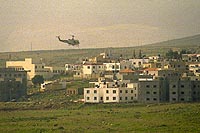 Army
will stop building fence this side of Blue Line
“Israel” is violating the UN-drawn "blue line"
border with Lebanon, in violation of its earlier promises, Staffan de Mistura,
UN Secretary General Kofi Annan's representative to south Lebanon, said Friday.
"This is something that is not
acceptable to the United Nations," said De Mistura, saying he would send
"urgent reports" on the matter to Annan and to UN official Terje
Roed-Larsen, who supervised the drawing of the blue line after “Israel”
ended its 22-year occupation of south Lebanon in May.
"I visited the region by
helicopter yesterday and flew over several times, slowly and at low altitude,
and I was able to notice with my own eyes that there was work well beyond the
blue line, around 400 meters (yards)," De Mistura said after a meeting with
Lebanese Foreign Minister Mahmud Hammud.
De Mistura said he saw
"non-Lebanese workers in the midst of constructing a fence identical to
that set up to mark the line" that designates the border.
He said the work stopped when he
visited. "It is necessary at all costs to verify that this was not a pause
but a halt."
"We are working to block this work and to return to the previous situation, as the blue line is for us a reference point," he said. …(1)
Later on, “Israel” informed the United Nations on Friday that
it had ceased constructing a new fence on Lebanese territory in the divided
village of Ghajar.
The decision came after Washington and UN headquarters in New York stepped up
pressure on the Jewish state to end the violation of the UN-delineated Blue
Line.
Staffan de Mistura, UN Secretary-General Kofi Annan’s personal representative
for southern Lebanon, met Foreign Minister Mahmoud Hammoud Friday and informed
him that “Israel” had pledged to halt the violation.
“We have made our concerns know to senior “Israeli” officials who have
indicated to us that this construction will stop,” de Mistura told reporters.
“Israeli” Foreign Minister Shlomo Ben-Ami reportedly relayed his assurance
that the violation would end to the UN Middle East special envoy Terje
Roed-Larsen.
“We will be watching the situation closely over the coming days to ensure that
indeed the construction has stopped and that the status quo ante in the area is
returned to in order to ensure the respect of the Blue Line by all concerned
parties,” de Mistura added.
UNIFIL’s commander, Major General Seth Kofi Obeng, received similar assurances
from the “Israeli” Army.
“The “Israeli” Army informed the force commander that work on the fence at
Ghajar has stopped,” UNIFIL spokesman Timur Goksel told The Daily Star.
“This was verified by UNIFIL through observations on the ground and by air.”
The Daily Star revealed last week that the Israelis had resurrected a plan to
incorporate the Alawite village of Ghajar within the “security fence”
presently under construction along the Blue Line. The line divides Ghajar,
leaving two-thirds inside Lebanon and the remainder in “Israeli”-occupied
Syria.
Ghajar’s residents strongly oppose having their village divided by a fence.
But the “Israeli” Army believes that the lack of a high-tech fence in the
area poses an unacceptable security risk.
As a compromise, the Israelis began building a new section of fence along the
eastern flank of “Lebanese” Ghajar as part of a move to seal off the village
in its entirety. The Israelis initially denied any responsibility, however,
claiming that the village’s residents had undertaken the work. The UN was
unimpressed with the plea of innocence..
There was no sign of construction activity on Lebanese soil Friday, although
work continued on the new fence along the Blue Line east of Ghajar.
A UNIFIL helicopter slowly circled the scene of the violation before continuing
on its daily aerial reconnaissance of the border. Soldiers from UNIFIL’s
Indian battalion kept the village under observation from the Abbassieh outpost,
two kilometers to the east.
The Israelis had bulldozed a dirt track some 500 meters long parallel to the
village, running from the Blue Line to an old fence on the northern end of
“Lebanese” Ghajar. Concrete foundations had been laid for about 350 meters.
The Daily Star was able to approach Ghajar and strike up a conversation through
the old fence with Adel Shemali, a teacher living in the village.
Shemali was cagey over the
violation of the Blue Line. “Whether there is a breach or not, it’s hard to
tell,” he said. “And even if there is a breach, we can’t really talk about
it.”
Shemali said the villagers were adamant that they would not permit their village
to be physically divided by a fence. His friends agreed: “We are Arabs
from Syria and we do not want our town to be split,” said another resident,
Mohammed.
The “Israeli” Army originally proposed annexing Ghajar behind the new fence
in November. But the scheme was dropped after UNIFIL warned the military that
violating the Blue Line in Ghajar would provoke unnecessary tensions in the
area.
“This looks like the typical bloody-mindedness of the “Israeli” Army,”
said a Western diplomat. “They knew they couldn’t get away with it but went
ahead anyway.”
The diplomat said it was plausible that the “Israeli” government had been
unaware of what was happening in Ghajar.
“The military causes the problem and the civilians have to bail them out,”
the diplomat said.
Last summer, the process of verifying “Israel”’s dragged on for two
months, in part due to numerous violations almost all of them petty in nature
by “Israeli” troops.
The diplomat warned that failing to respect the Blue Line was “asking for
trouble.”…(2)
1- AFP, 2\2\2001
2- The Daily Star, 3\2\2001
February Monday
05 -2001:
Lebanese
teenager loses foot after stepping on mine in former “Israeli” area…(1)
“ A Lebanese teenager's foot was blown up Sunday when he stepped on a mine in the region formerly controlled by the “Israeli” army, police said.
Ali Hani Srur, 18, stepped on the mine in the Aita al-Shaab village, some 500 meters (yards) from the “Israeli” border. He was taken to a hospital where his foot was amputated, the police said.
The incident brings to nine dead and 67 injured the number of civilian victims from mines left over since “Israel’s” 22-year occupation of south Lebanon.
Another 12 demining experts from the Lebanese army have also been hurt.
The United Nations estimates that “Israel” left behind at least 130,000 mines in its former self-styled security zone before leaving in May.
UN peacekeepers, who complain that “Israel” has not been forthcoming with maps of the mines, said January 15 that they have dismantled 2,159 mines and explosives from the area.
Hariri
says “Israeli” violations is a provocative act before election…(2)
Lebanese
Prime Minister Rafik Hariri confirmed the “Israeli” violation of the
"blue-line" that marks the border line between Lebanon and occupied
Palestine, according to the U.N..
Hariri said "“Israel”" is trying to take advantage of Ghajar village divided by the blue-line, and perhaps would try to provoke Lebanon and the resistance on the eve of the “Israeli” election.
Hariri said we will not be dragged by this provocation and the government is performing its duties to confront this issue.
Earlier, the United Nations acknowledged the violation and requested that occupation forces remove it promptly.
A joint Lebanese and UN field observation team will examine the site in the coming hours.
The United Nation Secretary General representative Steffan de Mistura said after meeting Lebanese Foreign Minister Mahmoud Hammoud, that the violation is not acceptable to the United Nations, and added he saw the violation with his own eyes when he flew by a helicopter over the area.
He received a confirmation from “Israeli” Foreign Minister Shlomo Ben Ami to remove the violation.
1-
AFP, 4-2-2001.
2-
Manar TV, 3-2-2001.
February Thursday
08 -2001:
Lebanese army looks forward to liberate Shibaa Farms…(1)
Representing Lebanese President in a graduation ceremony of Lebanese soldiers, Brigadier General Naiim Farah said Lebanon is still living the great joy of liberation of its South, which was achieved by the unity of the Lebanese poeple and the cohesion of the army and the resistance, which astonished the world, in addition, to the support of the Syrian army.
"You will be honored with protecting and fortifying the liberation (of the south), as well as, with liberating still occupied (Lebanese) soil in Shibaa Farms. You shall also take part in the reconstruction of what was destroyed, in order to wipe out the remains of the occupation," said Brigadier-General Farah to the soldiers.
A
herdsman escapes death after “Israeli” mine explosion…(2)
Shadi
Nader is one of few Lebanese citizens to have escaped from a land mine explosion
in the surroundings of former-”Israeli” outpost, Dabshe, facing the southern
city of al-Nabatieh.
Nader, a herdsman, was herding his livestock when the mine exploded, killing and wounding a number of his animals.
On the other hand, Lebanese security sources said that the “Israeli” occupation army shelled Wednesday night the outskirts of Lebanese villages close to occupied Shibaa Farms with flechette bombs. No casualties was reported.
1-
Manar TV, 7-2-2001.
2-
Same source.
February Monday
12 -2001:
First
Air Violation Since Sharon's Election…(1)
“Israeli”
air force jets crashed the sound barrier over Beirut Sunday, hours after Prime
Minister-elect Ariel Sharon made his first tour of the volatile border with
Lebanon since his election victory five days ago.
The intruding fighter-bombers also flew supersonic runs over South Lebanon's
port cities of Sidon and Tyre, in what Lebanese authorities described as the
first air space violation in the Sharon era. A Lebanese protest is expected to
be lodged with the United Nations.
Sharon, who defeated Labor Party ex-Premier Ehud Barak in “Israel’s” Feb.
6 elections, toured the border with Lebanon on Saturday, a day after Hizbullah
Secretary-General Sheikh Hassan Nasrallah called the new leader of the Jewish
state a "fool."
"This fool's premiership may well spell out the beginning of the end for
the state of “Israel”," Nasrallah said in remarks highlighted by
several Beirut dailies on Saturday.
1-
Naharnet.net, 12-2-2001.
February Tuesday
13 -2001:
Two
men maimed as leftover mines explode in South…(1)
One
man lost his leg and another lost four fingers in separate explosions in the
South on Monday.
Mohammed Hussein Yaacoub, 50, was tending to his sheep on the outskirts of
Hounin, close to Abbad, Marjayoun, when he stumbled upon a land mine. His left
leg was immediately blown off, and his right leg was severely injured.
Yaacoub was taken to Salah Ghandour Hospital in Bint Jbeil and was then
transferred to Hammoud Hospital in Sidon for an urgent operation on his severed
leg.
Yaacoub remained under observation following complications during the surgery.
Separately, Abdel-Rasoul Nsour, 24, lost four fingers on his right hand when he
picked up an unidentified object that blew up in Dweir, Nabatieh.
He also suffered minor injuries in his chest and abdomen.
He underwent surgery at Nabatieh’s government hospital.
Nsour said he found the device on the side of a road. He said he was intending
to throw it so that no one else would get hurt, but it exploded in his hand.
1-
The Daily Star, 13-2-2001.
February Wednesday
14 -2001:
“Israeli”
fighters break sound barrier over Lebanese port city…(1)
“ “Israeli” warplanes broke the sound barrier over the southern Lebanese port city of Tyre Tuesday, causing five supersonic bangs which unnerved local residents.
“Israeli” fighters also broke the sound barrier over Beirut on Sunday and overflew southern Lebanon on Monday.
Lebanon has lodged several complaints with the United Nations in recent months about “Israeli” planes breaching its airspace, saying these flyovers are a violation of the UN Security Council's 425 resolution which prompted the “Israeli” withdrawal of southern Lebanon in May, ending 22 years of occupation.
1- AFP, 13-2-2001.
February Saturday
16 -2001:
Israelis justify draconian strategy by creating false links to Hizbullah…(2)
There has been a noticeable tendency in recent days for
Israel to widen the circle of blame for planned acts of violence in the Jewish
state, beyond that of the Palestinians, to include Hizbullah and by extension
Iran.
The first incident was the announcement last weekend that Israel has been
holding since Jan. 5 Jehard Shuman, a Lebanese-born British national, on
suspicion that he was planning guerrilla attacks inside Israel on the orders of
Hizbullah.
Hizbullah has refused to comment on Shuman’s arrest, neither confirming nor
denying that he was working on behalf of the party.
The second incident was the assassination of Massoud Ayad, a Lieutenant Colonel
in Force 17, the personal security unit of Palestinian President Yasser Arafat.
Ayad was killed in Gaza when his car was struck by a missile fired from a
helicopter gunship.
The Israeli Army promptly issued a list of accusations against Ayad, charging
him with having planned and carried out bomb and mortar attacks against the
Netzarim settlement in Gaza, smuggling arms and drugs, and heading a Hizbullah
cell in the Palestinian territories.
The Israeli Army said that Ayad visited Lebanon last summer for training and to
receive instructions from Hizbullah.
“He maintained continuous contact with Hizbullah officials in Lebanon and was
activated by them to carry out terrorist attacks inside the Gaza Strip in the
name of Hizbullah,” the Israeli military said. “In addition, (Ayad) was
involved in the planning and attempted kidnapping of Israeli soldiers,” it
added.
The third, possibly related, incident were comments from the US State Department
aired on CNN regarding its unease at a meeting of anti-Israeli and anti-American
militant groups in Beirut last month.
In particular, one US official said that the presence of Iranian delegates to
the meeting was a “cause of concern.”
Since the Al-Aqsa intifada began last September, Iran has “stepped up its
terrorist activity … and stepped up its planning for terrorist attacks,” one
US official maintained.
The meeting in question was a well-publicized conference in which some 200 Arab
and Muslim figures met to discuss measures to protect Jerusalem from
Judaization.
The gathering was organized by Hizbullah, Hamas, Palestinian Islamic Jihad, and
the Islamic National Conference. Among the participants was Ali Akhbar
Mohtashemi, an Iranian MP, and a former Iranian ambassador to Damascus who
played a major role in the founding of Hizbullah in the 1980s.
Ironically, the flurry of accusations against Hizbullah comes at a time when the
resistance has been noticeably quiet on the Shebaa Farms front. The last
operation carried out by Hizbullah in the area was a roadside bomb ambush on
Nov. 26, in which an Israeli soldier was killed.
“There’s been too much mentioning of Hizbullah lately,” said a senior
Western military source. The source suggested that the Israeli military was
deliberately implicating Hizbullah and Iran in planned attacks in the
Palestinian territories and Israel to serve as a pretext for any military action
against the resistance in Lebanon. “They are setting up the stage, just in
case,” the source said.
Neither outgoing Israeli Premier Ehud Barak nor his hawkish successor, Ariel
Sharon, are expected to launch pre-emptive raids into Lebanon for the time
being. Given the sentiment in the Arab world, Israel is unlikely to exacerbate
hostilities by provocative actions outside the main theater of conflict in the
West Bank and Gaza.
However, linking Hizbullah and Iran to acts of violence in the Palestinian
territories and Israel planned or executed serves to defuse any misgivings that
exist over the Israeli government’s controversial policy of assassinating
Palestinian activists.
Ayad may or may not have had links with Hizbullah, but that is beside the point,
said a European diplomat.
“Palestinians come in all shapes and sizes, from those you negotiate with in
five-star hotels to stone-throwers,” the diplomat said. “But by renaming
them collectively as Hizbullah terrorists you are discrediting them to the
fullest and gaining a 100 percent acceptance rate among the Israeli public”
for the Israeli Army’s actions.
Prime Minister Rafik Hariri echoed that view in his dismissal on Thursday of
Israel’s claim that Ayad was working for Hizbullah.
“It’s easier for the Israelis to say that they have assassinated a
Palestinian belonging to Hizbullah than an aide to Arafat,” he told reporters
in Paris.
Hizbullah and Iran are regarded in Israel, correctly, as being implacably
hostile towards the Jewish state. References to Hizbullah and Iran lend the
impression that the Israeli Army is not only contending with the Palestinians
whose plight draws sympathy domestically and internationally but also a broader,
more sinister, pan-Islamist front.
The Israeli Army has long used Hizbullah as a “bogeyman” to its own
advantage usually to win increases to the defense budget.
This point was recently illustrated by an Israeli columnist, Reuven Pedatzur, in
an unprecedented opinion piece in the Haaretz daily newspaper.
“Where’s the wisdom in the commanders of the Middle East’s strongest and
most advanced army glorifying the threat of the Hizbullah, broadcasting to the
public a sense of fear in the face of a threat from such a tiny organization?”
Pedatzur asked. “The absurdity of attributing to the Hizbullah a strategic
threat is symptomatic of a certain routine on the part of the senior command. It
can’t operate without identifying and nurturing new threats.
Israel brings in military build up to South Lebanon…(2)
Lebanese President Emil lahoud on Thursday reviewed with the
representative for the UN Secretary General to South Lebanon Stavan Domistora
the general conditions in South Lebanon and the work of the UN forces ( UNIFIL)
in coordination with the Lebanese security systems.
The Lebanese President learned from the UN envoy about the moves carried out by
the UN after Israel's attacks on the Lebanese part of al-Ghajar village on the
international borders.
The two sides reviewed the general conditions in light of recent developments
and Lebanon's position regarding them.
Meantime, Israel has brought in human and armored fortifications towards its
positions facing the South Lebanon borders.
The Lebanese national news agency quoted eye-witnesses at the lines drawn for
the Lebanese borders with Israel as saying that Israeli summoned more of its
forces into the Shebaa farms.
The Lebanese agency added that more that 40 armored vehicles of M 113 and
Meikava tanks arrived in the occupied lebanese Shebaa farms.
The agency continued that 10 trucks equipped with ammunition accompanied the
armored vehicles.
It also added that on Thursday afternoon these israeli fortifications were
distributed on the Israeli positions in Rweiset al-Sammaqa, Rweisat al-Alam,
tallet al-Ramtha, Mazraat Zibdin and al-Marsad in Jabal al-Sheikh.
The Lebanese agency indicated that this is the first time since the pullout of
the Israeli forces from the Lebanese territories in May 2000, in which Israel
brings in such number of fortifications to the Lebanese borders.
On Thursday at dawn, the Israeli forces opened its machine- guns fire against
al-Arqoub heights in the eastern sector of South Lebanon.
February Monday
19 -2001:
Nasrallah slams US Ambassador for
denouncing Hizbullah’s attack
Qassem we shall liberate Shibaa Farms by armed force…(1)
Hizbullah’s secretary-general, Sayyed Hassan Nasrallah,
accused the United States on Sunday of blocking foreign investment to pressure
Lebanon into signing a peace agreement with “Israel”.
Nasrallah made the comments at a memorial gathering for the late president of
the Higher Shiite Council, Sheikh Mohammed Mehdi Shamseddine, who died last
month.
The Hizbullah leader’s remarks came one day after US Ambassador David
Satterfield spoke of the harmful economic effects of Hizbullah’s attack.
“This is not a question of the Shibaa Farms,” Nasrallah said. “Only when
Lebanon gives in and signs a settlement agreement based on the Zionists’
conditions, the American master might, just might, extend a helping hand.”
Also, Hizbullah’s deputy secretary-general, Naim Qassem,
rejected “Israeli” and UN charges that the Friday attack violated the Blue
Line, which was drawn after “Israel’s” May withdrawal from the South.
“We have never heard, in our entire history, of a ‘Blue Line’ being
regarded as an international border,” Qassem said during a ceremony in
Beirut’s southern suburbs.
“This (line) was written and made public to serve Zionist interests,” the
resistance leader argued. “The Shibaa Farms are Lebanese and we shall liberate
them by armed force.”
Replying to Satterfield, Qassem said: “Are the “Israeli” crimes against
the Palestinians not provocative? And were the “Israeli” attacks against
Lebanon not provocative? As for the Shibaa Farms, is their continued occupation
by the “Israelis”, and the continued detention of Lebanese political
prisoners in “Israel”, not provocative?”
He stressed that the attack was “in defense of our land and it was a
legitimate right to the resistance forces to launch it.”
He dismissed what he said was linkage between economic aid for Lebanon and
halting resistance actions in the South.
“We are not among those who seek economic aid through selling their pride and
independence, even if this costs us assistance from donor states,” he
declared, adding that “the Americans are the main source of trouble for
Lebanon. Their economic aid is nothing but a political and cultural trap. Thus,
we should continue with our struggle.”
Information Minister Ghazi Aridi said Saturday that attacks
against the Jewish state “had not stopped,” and that the resistance would
make the decision to halt its operations. In an interview with Egyptian radio,
Aridi noted that “Israeli” warplanes had violated Lebanese air space in
recent weeks “on an almost daily basis.”
Also on Saturday, Speaker Nabih Berri visited Damascus, where he conferred with
Assad on the latest local and regional developments. Berri later lunched with
Syrian Vice-President Abdel-Halim Khaddam.
February Thursday
22 -2001:
No
peace without return of occupied soil and detainees, says Hariri…(1)
Hariri
Lebanese Premier Rafic Hariri said that peace to Lebanon means the complete
withdrawal from Lebanese territories, which are still occupied by the
“Israeli” enemy, referring to Shibaa Farms, and the return of all Lebanese
detainees in the Zionist entity.
Hariri added that the corner stone to peace in Lebanon is the right-to-return for the Palestinian refugees to their homeland Palestine. "Lebanon does not accept settling the Palestinians in Lebanon", said Hariri.
Hariri, who was speaking in a dinner in honor of the Gabon Prime Minister said “ It is true we are working for peace and hope it would come true, but we don’t bet on it because Lebanon is not waiting for peace to accomplish its national ambitions."
1- Manar TV, 21-2-2001.
February Friday
23 -2001:
Lebanon's Lahoud says “Israeli” occupation "permanent provocation"
“ Lebanese President Emile Lahoud offered a riposte Thursday to the US ambassador to Lebanon who had recently cautioned Beirut not to antagonise “Israel”.
"Those who advise not to provoke “Israel” must know that “Israeli” occupation is in itself a daily and permanent provocation", Lahoud was quoted as saying in a statement read by Information Minister Ghazi Aridi after a meeting of the government's Council of Ministers.
Lahoud's retort alluded to the US ambassador David Sutterfield's condemnation of anti-”Israeli” attacks in southern Lebanon.
On Saturday, Sutterfield branded the February 16 attack by Hizbullah on “Israeli” soldiers in the Shibaa Farms area-- killing one “Israeli” soldier and injuring three others-- as a "provocation".
The Shibaa Farms were captured by “Israel” in the 1967 Middle East war and are claimed by Lebanon.
However, “Israel” says it captured them from Syria and their future status will only be determined in the context of a peace treaty with Syria.
Lahoud condemned what he called "a coup by “Israeli” society against the peace process". According to the Lebanese president, "facts prove that “Israel” has no desire whatsoever to reach a fair and comprehensive peace and that it is satisfied with having safety belts ... on the Golan Heights and the Shibaa Farms".
The Golan Heights were seized from Syria by “Israel” in 1967.
The statement quoted Lebanese Prime Minister Rafiq Hariri as saying the February 6 victory of “Israeli” Prime Minister-elect Ariel Sharon "did not give an optmistic vision of the peace process".
"Everybody is waiting to see what the new “Israeli” government will do. For our part, we will continue working for the liberation of occupied Lebanese land and pursue our efforts with our Arab brothers for a fair and comprehensive peace", he added.
1-
AFP, 22-2-2001.
February Monday
26 -2001:
Butros
Ghali backs claim to Shibaa Farms
 …(1)
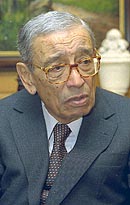
Former
United Nations Secretary-General Butros Butros Ghali supports Lebanon’s stance
that the Shibaa Farms belongs to the Lebanese, but remains non-commital on
whether the use of force should be advocated to liberate the disputed territory.
“I believe that the Shibaa Farms are Lebanese property, and that Lebanon has
every right to recuperate its territorial integrity,” Butros Ghali told The
Daily Star in an interview Saturday. However, Butros Ghali refused to comment on
the latest operations by Hizbullah in the disputed area or on how Lebanon should
regain the Shibaa.
“I am talking about the principle of Lebanon recuperating its territorial
integrity,” he said. “This goal could be achieved through negotiation,
mediation, or any other means, but I have no comment at that level.”
At the same time, however, Butros Ghali said, “negotiation to recover one’s
land is a must, it is a sacred duty.”
Butros Ghali left Lebanon Sunday after a five-day official visit as
secretary-general of the Francophone Organization. Beirut will be hosting the
annual Francophone Summit in October.
“Israeli”
warplanes break sound barrier over Lebanon, ski resort…(2)
“ “Israeli” warplanes buzzed Lebanon Sunday, breaking the sound barrier over several regions and triggering panic among skiers on the slopes of Mount Lebanon, an AFP correspondent reported.
Two “Israeli” warplanes caused two supersonic bangs over the snow-covered western slopes of the Mount Lebanon range, which was crowded with Sunday skiers.
Panic was rife at the popular ski resort of Faraya when the jets buzzed the region, leaving behind a trail of white smoke before flying further north, an AFP correspondent said.
The jets went on to cause two other supersonic booms over northern Lebanon, near the border with Syria, the correspondent reported.
Earlier in the day, “Israeli” warplanes broke the sound barrier over Bekaa Valley and the slopes of Mount Hermon near the junction of Lebanon, Syria and “Israel”.
“Israeli” jets also buzzed the southern port cities of Tyre and Sidon.
Lebanon has lodged several complaints with the United Nations in recent months about “Israeli” planes breaching its airspace, saying these flyovers are a violation of the UN Security Council's 425 resolution which prompted the “Israeli” withdrawal of southern Lebanon in May, ending 22 years of occupation.
1-
The Daily Star, 26-2-2001.
2-
AFP, 25-2-2001.
February Tuesday
27 -2001:
UAE
president meets Berri, vows to help de-mine South…(1)
The
president of the United Arab Emirates, Sheikh Zayed Bin Sultan al-Nahyan,
stressed the “need to support Lebanon and promote its development” on Monday
Zayed, who met Speaker Nabih Berri, said Lebanon should “regain its prominent
economic and cultural role on the Arab and international scenes.”
The crown prince of Abu Dhabi, Sheikh Khalifa Bin Zayed al-Nahyan, expressed his
country’s willingness to contribute to the demining in the South, with the
cooperation of the United Nations.
Sheikh Khalifa said that the UAE granted $50 million to Lebanon, but that the
Lebanese government had so far failed to use the assistance to implement certain
projects.
l Berri said that “Israel” had surely been taught enough lessons by the
resistance and would not “try its luck” again in Lebanon.
In a speech delivered in Abu Dhabi, where he flew last week to attend an Arab
parliamentary conference, Berri predicted that “Israel” would not succeed in
intimidating Lebanon. “Lebanon will not accept to be a victim of any
“Israeli” show of force. We are confident of our unity and our national army
and we are sure that “Israel” isn’t ready to try its luck with us once
again.”
He stressed that Lebanon’s peace path would continue to be closely linked to
that of Syria because Syria represented a decisive factor in the region’s
military strategy.
Berri also called on the new American administration to “seek a peace accord
which is built on comprehensive justice for all parties concerned with the
Middle East conflict.”
He urged the United States “not to push toward a military escalation in the
region and not to let its bias in favor of “Israel” blind it to the
suffering of the Arab people in general and the Palestinians in the West Bank
and Gaza in particular.”
Berri concluded that the recent “Israeli” elections were nothing but a
“comedy act” that the Likud and Labor parties played to further
“Israel’s” strategic military advantage against the Arabs.
1-
The Daily Star, 27-2-2001.