 April Thursday 05
-2001:
April Thursday 05
-2001:
Striking at “Israel’s” support with a FIST…(1)
With
bags under her eyes, Lana Khalil leans back into the sunlight and recalls how
she started an anti-Zionist “divestment campaign” on campuses across the
United States.
Khalil, a Lebanese who grew up in Nigeria, has only spent two years in Lebanon
enough time to witness firsthand what “Israeli” aggression is all about.
It was her first year here when “Israel” began its two-week bombing campaign
in April of 1996, what it named operation Grapes of Wrath. The operation was
responsible for the Qana massacre, when “Israel” shelled a UN base and
killed more than 100 women, children and elderly seeking shelter.
“When I moved to Lebanon, the images I saw epitomized the dispossession and
imperialism of a nation. Che Guevara once said that sympathy with suffering
somewhere in the world is the root of revolutionary work,” says Khalil,
sitting cross-legged in her sandals and loose tank top on a bench in Sanayeh
park.
Witnessing the aftermath of the Qana attack prompted her
to join a student group called Fight “Israeli” State Terrorism (FIST) at the
American Community School, where she was a student, that year.
It wasn’t long before she extended her sense of compassion to the Palestinian
community when she began volunteering as a teacher at the Sabra and Shatila
refugee camps.
“When I started developing such close ties with my students, I wasn’t
fighting simply for inalienable rights but for these people whom I was so
emotionally attached to,” she says.
It was only natural for her to establish FIST at Sarah Lawrence College in New
York in her freshman year. The organization focused on educating students on the
Middle East and “deconstructing myths systematically propagated in the
media,” Khalil explains.
FIST then began action campaigns that included teach-ins, lectures and a
recreation of Khiam prison on campus.
The original 15 members were mainly comprised of Jewish, “Israeli” and other
international students. Khalil is the only Arab in the organization.
The group’s dialogues with Jewish student groups even succeeded in recruiting
another 10 members who considered themselves to be Zionists, according to
Khalil.
With the start of the intifada FIST began working toward starting a
divestment campaign, similar to that of the anti-apartheid movement in the 1980s
that occurred on college campuses nation-wide.
The group plans on lobbying the university’s administration in May to issue a
statement that Sarah Lawrence supports the intifada and the Palestinian right to
self-determination and condemns “Israeli” brutality.
Sarah Lawrence would then actively divest (as opposed to invest) in any company
that has shares in “Israel”, as with the parallel anti-apartheid movement
that managed to oust South Africa’s racist regime.
If the school doesn’t agree, FIST will occupy the university president’s
home and start a hunger strike, says Khalil. Because of the level of awareness
her group has created, she is expecting the majority of students on campus to
participate.
“This year, we’ve become the most active group on campus,” she says.
“Before people came to Sarah Lawrence, they didn’t know anything about
Palestine. Now it’s become part of their everyday lives.”
With the start of the intifada, Khalil has taken FIST’s activism to a new
level by focusing on a “complete bombardment of the anti-Arab and
anti-Palestinian system,” she adds.
Every so often the group stands on tables in the campus cafeteria and tells
diners about those who have died in the fighting, where and how, just in the
time-span of their meal. Long lists of the victims are distributed at the same
time.
Occasionally, these lists have also been represented through chalk outlines of
corpses all over campus.
Khalil says they were especially successful in what she called “guerrilla
theater.” The idea is to attract people’s attention by staging a fistfight
in a public space and then breaking into an argument about stealing land and
other policies of the Zionist state.
Khalil even succeeded in ensuring two hours of radio time per week and two pages
in the campus’s daily newspaper dedicated to the intifada. They also started
an underground bi-monthly “zine” (a small, informal magazine) that includes
Palestinian poetry, political analysts’ articles, and student opinion pieces
and has a circulation of about 3,000.
Their group has gained so much clout that they were able to set up two
projection screens on the main campus green for a full day that displayed
pictures of “Israeli” brutality.
“Everything is building up to our action in May,” she said. “It’s gotten
so that FIST is a very big name on campus with two implications either
we’re a strong activist group fighting for a just cause, or we’re a fanatic
anti-”Israeli” group.”
Student groups at 15 other universities, including Princeton University, New
York University, Michigan University and Columbia University, plan on
participating on their campuses on the same day.
Khalil is hoping to have another 60 universities, including some in the Arab
world and Europe, join the movement. But even a handful, according to Khalil,
will be enough to make the news and a statement that resistance to
“Israel’s” apartheid policy does exist.
“I’m working 19 hours a day on this,” she says. “I’m completely fueled
by the need to do this, because it’s still happening, and by seeing everyone
else in the same struggle and giving so much to this cause.”
1- The Daily Star, 5-4-2001.
April Thursday 05
-2001:
Mine
conference set for May…(1)
Lebanon will host an
international conference in May to draw up a plan to deal with the tens of
thousands of land mines still planted in the South.
Western Bekaa MP Sami Khatib, the head of Parliament’s National Defense
Committee, said Defense Minister Khalil Hrawi told the committee that a number
of European countries had been invited to attend the conference, which is
scheduled for May 21.
The announcement comes as French Ambassador Philippe Le Courtier has urged
Lebanon to address the mine issue and decide whether aid was needed from Europe
and France.
1-
The Daily Star, 6-4-2001.
April Monday 09
-2001:
Occupation
Army Reinforces Security Along the Border…(1)
The “Israeli” occupation
army started applying a new security system along the blue-line, drawn by the
United Nations to mark the “Israeli” withdrawal from South Lebanon. Video
camera observation points were installed, and warning sirens go on
whenever a body approaches the border wire fence.
Meanwhile, the occupation troops have intensified its movements in recent days in the Occupied Lebanese Shibaa Farms, and in the surroundings of the Mutilli Settlement.
The “Israeli” forces opened heavy gunfire at the Bastara border area, and the Red Mountain.
Zionist Engineer units
continued fortification works around the occupation positions in the area.
1-
Manar TV, 7-4-2001.
April Tuesday 10 -2001:
Public
asked not to touch mine signs…(1)
The army cautioned the
public Monday against removing land-mine warning signs in the former occupation
zone.
“We urge people not to approach military posts that used to be formerly manned
by “Israel” or its South Lebanon Army militia,” an army statement said.
It also advised people “not to touch any unfamiliar objects and to use only
paved roads” instead of taking shortcuts across the open countryside between
villages.
“Anyone who spots any suspicious object, ammunition or weapon must immediately
report their findings to the local police,” the army said.
1-
The Daily Star, 10-4-2001.
April Wednesday 11 -2001:
Failed
bomb attempt causes fire in former “Israeli”-occupied south Lebanon…(1)
“ A bomb placed in a tractor failed to explode Tuesday, in the third such booby-trapped attempt in about two weeks in the former “Israeli”-occupied border zone of southern Lebanon, police said.
The explosive charge apparently failed to blow up and merely provoked fire in the tractor owned by contractor Saadallah Daher at his cement factory on the main road of the town of Marjayoun, they said.
The driver of the tractor escaped unharmed but the vehicle was damaged, they said.
A bomb's detonator can cause fire even if the bomb itself fails to explode, usually because it is either poorly set or because it has expired.
Police
said the bomb carried Hebrew inscriptions.
“Israel” pulled its troops from southern Lebanon on May 24, 2000, after 22 years of occupation.
More than 6,000 Lebanese fled to “Israel” at the time of the withdrawal, fearing revenge attacks. Many of them have since returned to Lebanon where some have been tried for collaboration with the "enemy “Israel”."
1-
AFP, 10-4-2001.
April Thursday 12 -2001:
Land-mine
awareness at schools…(
The
national awareness campaign on land mines in the former occupation zone was
launched at the Jaber Cultural Center in Nabatieh on Wednesday.
The ceremony, held under the patronage of Army Commander Michel Suleiman
represented by Brigadier George Sawaya focused on the need for “tight
cooperation” between the army, the National Demining Office, and civil
society.
Lectures will take place in villages and schools in the South and the Western
Bekaa.
Participants in the ceremony then attended a lecture at the Kfar Tibnit Public
School, where explanations were provided to 600 students as part of the
awareness campaign.
Students watched a documentary on land mines, while posters were distributed
among them.
Islamic Health Committee member Hassan Ghandour said that most students
responded well to explanations, adding that many of them were already informed
about the subject, due to the presence of several minefields around the village.
Wassim Tabaja, 12, said that army officers warned residents against approaching
the former “Israeli”-proxy South Lebanon Army militia outposts on Ali Taher
hill and at Bourj, as they are surrounded by minefields. Tabaja recounted that a
friend of his lost his leg when a mine exploded under his feet near Ali Taher.
“I’ll ask my friends not to play there,” he said. ““Israel” wants to
kill us.”
Sara Faqih, 14, said that “we were pleased by what army officers and
paramedics told us,” adding, “And we hope this campaign helps residents keep
away from land mines.”
Students Ali and Adnan Faqih stuck a poster of land-mine varieties on the
classroom wall.
Faqih said he once found a mine near his home similar to one portrayed in the
poster. He said he had notified an army officer, who removed the mine.
Nabatieh’s deputy mayor, Adham Jaber, proposed that all municipalities
affected by land mines should erect warning signs, while Kfar Roummane Mayor
Sattam Abu Zeid said he hoped the campaign would translate into effective
measures.
“Southerners should not pay the price for such weapons,” said Abu Zeid.
“I hope the demining project is not neglected.”
Elsewhere, demonstration sessions on land mines were also held at two schools in
Bint Jbeil and Tibnin.
Students
learn to live with “Israel’s” explosive legacy…(2)
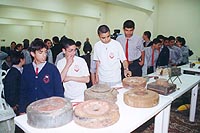 Students
in Qlaya set aside their mathematics and geography books on Wednesday to receive
a lesson that could end up saving their lives.
As part of a national campaign on land-mine awareness, a team from UNIFIL’s
Finnish battalion demonstrated to the students how land mines work and the
precautions that must be taken when encountering them.
The battalion presented two 25-minute sessions of detailed explanations on land
mines to 150 students at the Qlaya Secondary School.
Rusting defused anti-personnel and anti-tank mines, as well as cluster bombs and
explosive charges camouflaged by fiber-glass “rocks,” were displayed on
tables. Signs warning of land mines and unexploded ordinance were also
presented.
Finnish Captain Jarki Polkknuen told The Daily Star that these sessions would be
held every two months.
The school principal, Father Mansour Hakim, told The Daily Star that the
demonstration taught students how to react if they accidentally entered a
minefield and how to recognize the deadly devices.
Hakim said that each student who attended the demonstration session should pass
on their newly acquired knowledge to their families and friends.
He added that some of the mines planted in Marjayoun dated back to World War II,
when the German-allied Vichy French fought Free French and Australian troops.
The Finnish officer showed students “Israeli”, Russian, Yugoslav, American,
and French land mines.
“If we see these land mines, we should not get near them, nor touch them,”
Polkknuen warned students.
Since “Israel” withdrew its forces from the South last May, at least 10
people have been killed and 35 wounded in explosions caused by land mines and
unexploded ordinance.
The UN estimates that some 130,000 land mines exist in south Lebanon, 70,000
left behind by the “Israelis”. The bulk of the “Israeli” mines are found
in the 188 separate minefields the occupiers strung along the Lebanese side of
the border.
One UNIFIL officer has estimated that it could take 30 years to clear all the
mines.
In addition to the land mines, “Israel” planted 288 booby-trapped devices,
mainly on the edges of the former occupation zone. In most cases the booby-traps
consisted of ordinance, such as artillery shells, rigged to hidden explosive
charges. But the “Israelis” also used mundane everyday items, including
cameras and flags.
The Finnish expert explained to his audience how they could be deceived by
cluster bombs which resemble small balls.
“If you see such a device that doesn’t belong to you, don’t touch it,”
he said.
He also urged students to replace damaged or stolen warning signs. The army
announced last week that land-mine warning signs are being stolen throughout the
South, posing a risk to visitors unacquainted with the area.
Student Dani Khoury asked the officer what to do if someone stepped on a mine,
but did not lift their foot.
“This happens only in movies,” said Polkknuen. “If you step on a mine, it
will blow up.”
1-
The Daily Star, 12-4-2001.
2-
Same source.
April Friday 13 -2001:
”Israeli” troops fire in the air to ward off students…(1)
About
150 secondary school students from North Lebanon demonstrated at Fatima Gate on
Thursday, throwing stones and lightly injuring one “Israeli” soldier.
“Israeli” troops fired into the air to disperse the students, who had
gathered at the gate and were hurling rocks at an “Israeli” bulldozer
working on the other side.
The bulldozer was being operated by Palestinian workers who were digging a
channel to install cables. The workers were being guarded by four “Israeli”
soldiers.
As the students pelted the men with rocks, the soldiers fired shots in the air.
The workers were forced to take shelter under nearby trees after the
bulldozer’s windshield was broken by rocks. An “Israeli” reinforcement
unit was sent to the gate, after which the workers and the soldiers withdrew.
In Al-Quds, a spokesman for the “Israeli” Army acknowledged that one soldier
was lightly wounded by a rock and that the troops had fired into the air to
disperse the crowd.
Spain
to train Lebanese troops in mine removal…(2)
A
group of Lebanese Army officers will travel to Spain next week to attend a
land-mine clearing course given by a joint Spanish and Russian military team.
The squad of 20 officers and non-commissioned officers are scheduled to depart
for Madrid on Monday for a six-week course involving all aspects of humanitarian
demining.
“They won’t learn just how to remove land mines but other issues such as
topography, communications … it’s an integral program,” said Guillermo
Ardizone, consul at the Spanish Embassy.
The scheme for a joint training program was conceived by the Russian government
which approached Spain as a partner due to that country’s considerable
experience in demining.
The Spanish Army has cleared mines in Peru and Ecuador in South America and
Angola and Mozambique in Africa. Some 1,200 Spanish troops are presently
deployed in Kosovo on land-mine clearing duties.
Russia and Spain drew up a profile of the project which was then presented to
the Lebanese authorities.
“The Lebanese reacted very fast in accepting and choosing the people. It’s
been a very smooth cooperation,” Ardizone said.
Since “Israel” withdrew its forces from the South last year, at least 10
people have been killed and another 35 wounded in land-mine explosions.
The United Nations estimates there are around 130,000 land mines in South
Lebanon as well as 288 booby-trap devices and an unknown amount of unexploded
ordinance.
“The knowledge gained by the Lebanese officers will allow them to act as
trainers when they return,” Ardizone said.
The diplomat said that there were no immediate plans to repeat the course in the
future.
“We will evaluate the project when it is completed and see what is
possible,” he said.
A senior military source said that the demining course in Spain was one of
several overseas training programs on landmines for Lebanese soldiers. Other
countries that have taught demining techniques include the United States, the
United Kingdom, Italy and Syria.
The source added that a Syrian Army demining unit is presently clearing
minefields in Jabal Bir al-Dahr and Kawkaba al-Arab in the Western Bekaa.
1-
The Daily Star, 13-4-2001.
2-
The Daily Star, 13-4-2001.
April Tuesday 17
-2001:
Lebanese
Hizbullah vows to hit back at "“Israeli” enemy"…(1)
“Hizbullah said Monday that it was personally targeted by the “Israeli” raid on a Syrian military position in Lebanon and vowed to hit back at the "“Israeli” enemy" at the right moment.
"We are going to cut off the hand of the enemy who dared to attack our land and our brothers", the movement said in a statement, denouncing hardline “Israeli” Prime Minister Ariel Sharon.
"We will turn the Sharonian dream of terrorizing our people into a nightmare for the routed army of the Zionist occupation forces", said Hizbullah, which spearheaded resistance against the 22-year “Israeli” occupation of south Lebanon, which ended last May.
"The Islamic resistance (Hizbullah's armed branch) knows where, when and how to deliver a thunderous blow to the enemy and how to hurt him", the statement added.
At least one Syrian soldier and five others were wounded during the “Israeli” air raid on the Syrian military position east of Beirut early Monday morning.
Lahoud
Extends Condolences to Assad, Denounces Sharon's 'Blood-Thirst'…(2)
President
Lahoud called his Syrian counterpart Bashar Assad Monday and extended Lebanon's
condolences over the death of Syrian soldiers in “Israel’s” pre-dawn raid
on a Syrian radio position east of Beirut.
"The Syrian martyrs have joined the long list of the martyrs of the
Lebanese army and the resistance," Lahoud said, according to a statement
released by the Baabda palace.
The statement said Lahoud labeled the raid as a "manifestation of the
bloody policies Ariel Sharon has followed since he came to power against the
Palestinians and the Lebanese."
The President said these policies could lead to an all-out confrontation in the
Middle East and asserted that “Israel” would take full responsibility for
the consequences of its spiraling belligerency.
Monday's raid on the Syrian radar station in Mdeirej would not stop Lebanon from
pursuing by all means the full liberation of the Shabaa Farms and the release of
all Lebanese prisoners in “Israeli” jails.
Informed sources said Lahoud and Assad "have reaffirmed the resolve of
Lebanon and Syria to persist in confronting “Israel”, without submitting to
its conditions and pressures until a comprehensive Middle East peace is
accomplished and all occupied Arab territories are restored."
Lahoud later held crisis talks with Premier Hariri over the ramifications of the
first direct “Israeli” air strike on a Syrian military target in Lebanon
since the 1982 invasion. No statement was issued after the meeting.
Hariri, who has earlier denounced the raid as a "grave aggression," is
due to leave for a visit to Qatar Monday and then to Saudi Arabia Tuesday.
Lebanon holds “Israel” responsable for consequences of raids in letter to UN…(3)
“ Lebanon said Monday in a letter to the United Nations that the “Israeli” raids on Syrian targets on its territory were "an attack on its sovereignty" and that it held “Israel” "responsible for the dangerous consequences of this aggression".
In a letter addressed to UN Secretary General Kofi Annan and made public in Beirut, Lebanon said "this “Israeli” aggression is a blatant violation of Lebanon's sovereignty and an attack on the integrity of its territory".
The letter said Lebanon holds "“Israel” responsible for the dangerous consequences of this aggression" and adds that the policies of “Israeli” Prime Minister Ariel Sharon's government "do not serve the fair and comprehensive peace which the region needs".
But the letter also said "this new aggression will not stop it from claiming its rights and from pursuing legitimate measures to recover the Shibaa Farms".
"These farms are not, as “Israel” itself admits, “Israeli” territory and “Israel’s” presence there is therefore illegitimate and amounts to an occupation", the letter went on.
Syria:
"“Israel” Will Pay Heavy Price at Proper Moment"…(4)
Syria
has pledged to exact a heavy price from “Israel” "at the the proper
time" for its air assault that levelled a Syrian army radar position east
of Beirut, calling the attack a "dengerous escalation" in the Middle
East.
This stance was outlined by Syrian Foreign Minister Farouk Al Sharaa when he
arrived late night Monday in Moscow for talks with Russian officials about
spiralling Middle Eastern tensions in the wake of the radar-devastating air raid
and the worsening hostilities in the Palestinian territories.
"“Israel” will pay a heavy price at the right time for its attack on a
Syrian military position in Lebanon," Sharaa told reporters as he climbed
down from the plane at Moscow airport. "The attack is a violation of
international laws. It has creating a dangerous excalation that widens the scope
of violence in the Middle East."
"Sharon's “Israel” is killing the peace process exactly as it is
killing Palestinian children in Gaza and the West Bank," Sharaa concluded.
In Damascus, a high-ranked Syrian official was quoted by the official Syrian
news agency SANA as saying the attack on the Syria radar site was a
"dangerous escalation bound to shake the security and stability of the
region."
In the first official Syrian version about the attack, the unnamed official was
quoted as saying the raid was a "manifestation of the aggressive policies
of the “Israeli” government under Ariel Sharon."
He said the attack was in line with "the barbaric and racist crimes against
the Palestinian people in the occupied territories."
The official gave this version of the air assault:
"Formations of “Israeli” warplanes violated Lebanon's airspace 20
minutes after midnight (early Monday) and rocketed one of our positions in the
Lebanese territory. Our air defense systems intercepted the raiding jets and
forced them to retreat.
One of the Syrian radar station was hit and one of our elements was martyred and
four others were wounded."
Earlier, several Arab television stations quoted an anonymous senior Syrian
official as saying, "Syria reserves its right to self-defense." But
the SANA report made no reference to the self-defense notion.
“Israeli”
violation of blue line with Lebanon "serious": UN…(5)
“ “Israel’s” raid Monday on a Syrian target in Lebanon was a "serious" violation of the UN "blue line" dividing the two countries, the UN representative in southern Lebanon said.
"What happened overnight is serious," Staffan De Mistura said after a meeting with Lebanese Foreign Minister Mahmud Hammud.
"It's once more a violation of the blue line, which we are trying to protect because it remains, despite all, a guarantee for everyone," he said.
The blue line marks the line of “Israel’s” retreat from southern Lebanon last May, ending 22 years of occupation.
"All this pushes toward an escalation and we judge that dangerous. We insist on the fact that it's the moment, in the Middle Eastern context and the Lebanese situation in general, to continue to control the situation and not proceed toward an escalation," he said.
Egypt
condemns “Israeli” raid on Lebanon…(6)
“ Egyptian Foreign Minister Amr Mussa on Monday condemned “Israel’s” air strike on Syrian positions in Lebanon and accused the Jewish state of creating "turmoil" in the region.
"We strongly condemn this aggression ... against a sovereign state," said Egyptian Foreign Minister Amr Mussa during a visit to the United Arab Emirates.
"This aggression robs the “Israeli” withdrawal from Lebanon of its substance ... and amounts to a confirmation of the occupation of the Shibaa Farms," he said, referring to “Israel’s” withdrawal from south Lebanon last May after 22 years of occupation and the continuing dispute over the Shibaa Farms region on the border between Lebanon and “Israel”.
Mussa, in a statement to the Emirati daily Al-Ittihad to be published Tuesday, a copy of which was obtained by AFP, accused “Israel” of stirring "turmoil amongst the Arab peoples of Palestine, Lebanon and Syria".
He pledged Egypt's "total solidarity" with the Lebanese people and said “Israel” had no right to interfere in the issue of Syria's military presence in Lebanon, something which concerned only Beirut and Damascus.
Arab League says “Israel” trying to "set region ablaze"…(7)
“ “Israel” has chosen "the path of bloodshed" by launching a deadly attack on a Syrian position in Lebanon Monday, the Arab League said, calling on the international community to prevent the Jewish state from "setting the region ablaze."
"This aggression constitutes a dangerous escalation in “Israeli” policy and shows the path of bloodshed, which destroys the peace process, that has been adopted by “Israeli” Prime Minister Ariel Sharon," the 22-member Arab League said in a statement.
The League called on the international community to take action against "“Israeli” attempts to set the region ablaze and force it into a circle of violence and instability."
"Sharon is an advocate of escalation who will lead the region to the edge of the precipice," the League said, saying the situation "threatens not only the security and stability of the region, but also the interests of all countries of the world."
It said the raid will boost Lebanon's will to "defend its legitimate rights and to regain its sovereignty over its territories with the withdrawal of “Israeli” forces from the Shibaa Farms," the “Israeli”-held area where Hizbullah attacked.
"“Israel” will never succeed in materializing its illusions of separating the Syrian and Lebanese fronts," it added.
Palestinians
denounce “Israeli” raid on Lebanon as "dangerous escalation"…(8)
“ The Palestinian Authority on Monday condemned “Israel’s” deadly bombardment of a Syrian military target in Lebanon as a dangerous escalation that risked provoking a regional conflict, saying it was appealing to the US, Europe and the UN to intervene quickly.
Palestinian leader Yasser Arafat slammed the “Israeli” raids on a Syrian radar station east of Beirut, which left at least one soldier dead and five wounded.
"The “Israeli” aggression against the Syrian radar in Lebanon represents a serious violation which puts the region in an extremely dangerous and critical situation," Arafat told the press on his arrival in Amman for a short visit for talks with King Abdullah II.
Separately, Arafat's top advisor Nabil Abu Rudeina branded the raids a threat to regional stability and demanded international intervention.
"The Palestinian Authority ... calls on United States and the international community to act to halt the “Israeli” aggressions against the Palestinians, the Syrians and the Lebanese," he said.
Also, in a statement carried by the official WAFA news agency, the Palestinian Authority said the “Israeli” raids "dangerously threatened security in the region" and affirmed "its solidarity with the Syrian and Lebanese brother peoples faced with “Israeli” aggression."
"The Authority calls on Arab countries to unite and calls on the (UN) Security Council to condemn this dangerous attack and force “Israel” to stop its aggression against the Palestinian people and against Syria and Lebanon," the statement said.
Jordan fm, on rare visit to “Israel”, calls Lebanon raid “unjustified escalation”…(9)
Jordan’s Foreign Minister Abdel Ilah al-Khatib, in “Israel” for talks with his “Israeli” counterpart Shimon Peres, said the Jewish state’s attack in Lebanon was an unjustified escalation that could threaten regional stability and security.
Khatib, speaking at a joint
press conference with Peres following three hours of talks, said
“Israel’s” overnight bombardment in Lebanon against a Syrian position
could affect the overall stability and security in the region. Khatib, the first
high-ranking Arab official to visit “Israel” since “Israeli” Prime
Minister Ariel Sharon took office in March, said the aggression made his mission
more difficult, referring to efforts by Jordan to try and quell the deadly
intifada or uprising raging across the occupied West Bank and Gaza Strip.
Jordan’s Foreign Minister said what “Israel” did overnight east of Beirut
was unacceptable and unnecessary. Khatib had said in Amman he would “firmly
and directly” denounce “Israel’s” raids in Lebanon overnight that left
at least one Syrian soldier killed. Khatib is also the first Arab official to
visit the Jewish state since the outbreak of the intifada or uprising in late
September. An activist in Palestinian President Yasser Arafat’s Fatah movement
was shot and injured Monday by an “Israeli” sniper in the divided West Bank
city of Hebron. In a move likely to increase tensions “Israel” said it will
not ease the crippling siege on Palestinian areas. A hardline Palestinian group
has claimed responsibility for two pipe bombs, which exploded Sunday in
“Israel”, leaving one “Israeli” injured. A little known group called the
al-Aqsa Martyrs claimed responsibility for the blasts in the “Israeli” city
of Kfar Saba, not far from the Green Line separating the West Bank from
“Israel”. In a statement faxed to Beirut, the group said it carried out the
attack to “salute” Lebanon’s Hizbollah resistance movement and it
retaliation for “Israeli” attacks on Palestinian areas and southern Lebanon.
“Israel” violates
Lebanese airspace…(10)
1-
AFP, 16-4-2001.
2-
Nahar Net, 16-4-2001.
3-
AFP, 16-4-2001.
4-
Nahar net, 16-4-2001.
5-
AFP, 16-4-2001.
6-
Same source.
7-
Same source.
8-
Same source.
9-
Future TV, 16-4-2001.
10-
Same source.
April Wednesday 18
-2001:
“Israel” wants Syria to quit Lebanon, says Hizbullah and its
allies…(1)
“ The main political bloc of Hizbullah and Amal, in addition to other parties, charged Tuesday that “Israel’s” recent air raid on Syrian positions in Lebanon was aimed to pressure Damascus to withdraw its estimated 35,000 troops from the country.
"The attack had the goal of changing the balance of power imposed on “Israel” by the resistance and to create pressure to push the Syrian troops to exit Lebanon," Hizbullah and its allies said in a press statement issued at the movement's weekly meeting.
The meeting also brought Hizbullah together with Amal, headed by Parliamentary Speaker Nabih Berri, the Lebanese branch of the Baath party, groups and small Nasserist and Muslim parties.
“Israel” wants "to separate Syria's destiny from Lebanon and make it surrender Lebanon and at the same time revenge its stinging failures at the hands of the heroic resistance," the statement said, alluding to “Israel’s” withdrawal from south Lebanon last May after a 22-year occupation.
Hizbullah, Lebanon and Syria have pledged to continue attacks until the "liberation" of the Shibaa Farms. But “Israel” says it will only return the territory as part of a comprehensive agreement with Damascus.
Assad
issues warning after “Israeli” attack
Beirut asks Annan to ‘deter’ further ‘aggression’…(2)
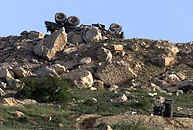 Syrian
President Bashar Assad warned “Israel” on Tuesday that it “alone will bear
the price of its aggressive actions in the region,” as Beirut mounted a
diplomatic campaign to prevent further “Israeli” strikes in Lebanon.
In a telephone conversation with UN Secretary-General Kofi Annan, Assad called
the situation “extremely complicated” and said a solution required
“important efforts.”
He was speaking after “Israeli” planes destroyed a Syrian radar installation
in Dahr al-Baidar early Monday, killing one Syrian soldier and wounding six.
The raid came after Hizbullah fighters on Saturday attacked a tank in the Shibaa
Farms area, killing an “Israeli” soldier.
US Secretary of State Colin Powell said he was “deeply concerned,” urging
all sides to exercise “maximum restraint” and end the violence
“immediately.”
Beirut called for an “emergency” meeting of the Arab League ministerial
council and demanded implementation of resolutions adopted by the recent Arab
summit in Amman.
President Emile Lahoud received a telephone call from Saudi Arabia’s crown
prince, Abdullah bin Abdul-Aziz, who affirmed that the kingdom would provide
“all possible help” for Lebanon and denounced the “Israeli” attack.
Lahoud, who maintained close contact with Assad on the developments, described
the raid as yet another “expression of the bloody course adopted by
(“Israeli” Premier Ariel) Sharon since coming to power.”
Foreign Minister Mahmoud Hammoud conveyed Beirut’s position during talks with
ambassadors from UN Security Council countries.
“We consider “Israel’s” action to be a dangerously aggressive
escalation,” Hammoud said.
He vowed that the government would not drop its demand to recover all
“Israeli”-occupied territory, including the Shibaa Farms, describing the
“Israeli” strike as “aggression against both Lebanon and Syria.”
He also stressed that resolutions adopted at the Amman summit said any
“Israeli” aggression against Lebanon or Syria would be taken as aggression
against all Arab countries.
Hammoud said he sent a letter to Annan, asserting the need for the UN to
“deter “Israel”.”
For its part, Hizbullah pledged to continue resistance operations, saying its
fighters would continue to attack “Israeli” troops in the border zone “at
the time we choose and in the appropriate manner.”
“You may hear of a (new) operation (in Shibaa) very soon,” said Sheikh Naim
Qassem, Hizbullah’s deputy secretary-general. “It may be delayed for a while
due to on-the-ground factors rather than political conditions.”
In a statement issued earlier, Hizbullah also suggested that it might target
settlements in northern “Israel” to avenge the raid.
“We will chop off the hand of the enemy which reached into our land and our
brothers,” said the statement. “We will turn Sharon’s dream of terrorizing
our people into a nightmare.
“Hizbullah knows when, where and how to strike at the enemy,” the statement
said.
The raid was the first direct attack on a Syrian military position here since
1996, and the most serious since “Israel’s” 1982 invasion, when
“Israeli” forces destroyed Syrian anti-aircraft missile batteries in
Lebanon.
“Israeli” warplanes broke the sound barrier Tuesday over eastern Lebanon.
Planes also carried out reconnaissance missions over the South and the Western
Bekaa.
The ambassadors of Russia, Britain and France all expressed concern about the
situation after talks with Hammoud, while Qatari Ambassador Mohammed Ali Nuaimy
denounced the “flagrant “Israeli” aggression.”
In Saudi Arabia, the Kingdom’s second deputy prime minister and minister of
defense, Prince Sultan ibn Abdel-Aziz, said the “Israeli” attack was
“totally unacceptable.”
Gulf states, including Kuwait and Oman, condemned the “Israeli” strikes as
“blatant aggression” and called for international pressure to stop
“Israel’s” attacks.
Jordan’s King Abdullah telephoned Assad to express solidarity with Damascus
after the “provocative” raid.
Palestinian President Yasser Arafat told reporters in Amman that the strike was
a “dangerous escalation,” and Egyptian President Hosni Mubarak denounced
“this aggression against an Arab force that hasn’t attacked anyone and
hasn’t violated the law or international resolutions.”
In Tehran, First Vice-President Hassan Habibi called on all Islamic and Arab
countries to support Lebanon.
The Chinese government expressed concern over the rising tensions in the Middle
East and appealed to “Israel” to “immediately cease its infringement upon
Lebanon’s sovereignty.”
Lebanese
FM calls for "deterring" further “Israeli” attacks…(3)
“ Lebanese Foreign Minister Mahmoud Hammoud started meeting Tuesday with foreign ambassadors to ask the international community to deter “Israel” from repeating attacks into Lebanon, an official said.
“Israeli” warplanes raided a Syrian radar position in eastern Lebanon on Monday, killing at least one Syrian soldier and wounding four others.
On Tuesday, Lebanese and Syrian army troops, as well as Hizbullah guerrillas, remained on a state of high alert, although the situation in the country has remained calm since the raid.
"The foreign minister has invited the ambassadors of the five permanent members of the United Nations Security Council to inform them that “Israel” is attempting to escalating the situation in the region," he said.
"He wants to ask the international community to deter “Israel” from repeating such aggression because it is a dangerous escalation for the entire region," said the official, who did not wish to be identified.
Hammoud spoke with the US ambassador David Satterfield by telephone on Monday, but no details were disclosed on that meeting.
He met with Russian Ambassador Boris Bolotine at the foreign ministry on Tuesday and was also due to receive the ambassadors of France, China, Britain and Arab countries.
"Russia is extremely concerned about the latest developments," Bolotine told reporters after the meeting. "The last (“Israeli”) raid is a dangerous escalation to the situation in the region, and this is unacceptable."
"We call on all sides to observe maximum restraint to avoid increasing the escalation in the region," he said.
Southern Lebanese, not scared by renewed “Israeli” raids…(4)
“ “Israeli” air strikes Monday did not scare the people of south Lebanon who lived with the dual attrocities of both the country's civil war (1975-1990) and a 22-year “Israeli” occupation that ended last May.
Although “Israeli” fighter planes bombarded a Syrian radar station east of Beirut, killing at least one Syrian soldier and wounding four more, in the first direct “Israeli” attack on the Syrian military since 1982, many south Lebanese residents appeared surprisingly calm in the aftermath.
Lebanon's turbulent history with “Israel” of ground invasions and pulverising air raids seemed far away.
"The attacks and counter-attacks were 'messages' and the issue is over now. I don't think that “Israel” is now interested in getting into another long-term military adventure in Lebanon," said Georges Lahoud, 31.
Lahoud is well placed to know about armed conflicts in the region. He lives in the Christian town of Marjayoun, the main locality in the border zone occupied by “Israel” for 22 years until its troop pullout in May 2000.
"It is true, as “Israeli” leaders said yesterday, that these are new rules for the game. During the occupation, we were constantly awaiting the next round of “Israeli” shelling. Now they responded with a very tactical hit," said Ahmad, a resident of Shaqra located just outside the former occupied zone.
But while this usually sleepy southern region was even more quiet during the long Easter weekend, the Lebanese and Syrian army troops, as well as Hizbullah guerrillas, remained on a state of high alert.
"It is all an issue of messages being sent, and this one was for Syria, more than for Lebanon, this is why the general situation is rather normal," said housewife Samia Ayoub, referring to Syria's status as Lebanon's chief powerbroker.
"This is why people are generally not scared, although there is always a fear that “Israel” would want to escalate the situation," she added.
Jiryes Nohra, sitting behind the counter of his pharmacy in the town of Qlaiaa, said "the “Israeli” direct strike against a Syrian target was meant by “Israeli” Prime Minister Ariel Sharon to defuse internal tensions inside “Israel” over the Intifada, or Palestinian uprising."
"We, in the south, are not concerned and we are not scared, because “Israel” is very much worried about Hizbullah's presence on the border, a few yards away from villages in northern “Israel”," said Nohra, 38.
"“Israel” had already been worried about the resistance guerrillas during the occupation when they were relatively far away, so we can imagine how it is now when “Israeli” towns are just a stone's throw away from the arms of the resistance," he said.
Kamal Khreis, 40, a baker from the nearby village of Khiam, said "we are not scared from “Israel” and not from its reactions because it has recently suffered more dangerous blows and it did not respond."
"“Israel” is now scared of the resistance guerrillas and I do not think that “Israel” would dare bombard civilian regions in southern Lebanon because it knows that the resistance's response will be harsh."
But if the Lebanese have their views about Hizbullah, Syria's continuing 35,000-strong military presence in the country and the latest “Israeli” attack, all breathed a sigh of relief when they woke up to see that, this time at least, the country's power grid was spared.
"The “Israelis””, when they couldn't hit back at Hizbullah, they used to unleash their anger at our power stations," said a woman named Fatima, sitting behind the counter of her candy store.
"At least, this time our summer is saved," she said, handing over ice cream cones to a group of young girls.
Iran urges Arab, Islamic states to support Lebanon…(5)
“ Iran's first vice president, Hassan Habibi, called on all Islamic and Arab states Tuesday to support Lebanon in its resistance against “Israel”, the official IRNA news agency reported.
Habibi, in a meeting with visiting Lebanese Economy Minister Bassel Fleihan, urged support for Lebanon, "a country situated in the front line of the war against the Zionist regime," IRNA reported.
He said there were "many great possibilities in various fields to develop cooperation between the two countries," and reaffirmed Tehran's determination to "deepen and develop" ties with Lebanon.
Fleihan, whose arrival and departure dates were not announced, said his country was ready to strengthen relations with Iran in the economic, commercial and transport sectors.
Fleihan also extended to Habibi an invitation by Lebanese Prime Minister Rafiq Hariri for a visit to Lebanon.
Tehran condemned “Israel’s” raids Monday on Syrian positions in Lebanon as a dangerous "adventurism," that are "destined to fail."
Foreign Ministry spokesman Hamid-Reza Asefi underlined Tehran's support for Syrian and Lebanese claims, as well as those of the Palestinians, to territory occupied by the “Israelis””, affirming that “Israeli” raids would fail to "block the Lebanese and Palestinian people from securing their rights."
Arab League to meet Saturday to discuss “Israeli” strike in
Lebanon…(6)
“ An emergency meeting of the Arab League ministerial council will be held Saturday, following a request by Lebanon and Syria, to discuss the recent “Israeli” strike on a Syrian military position in Lebanon, a League source said Tuesday.
Cairo-based
delegates of the 22-member organisation will attend, the same source added.
Gulf states, Yemen, OIC lash out at “Israeli” attacks on
Lebanon…(7)
“ Several Gulf Arab states, Yemen and the Organisation of the Islamic Conference (OIC) on Tuesday all strongly condemned “Israel’s” attack on a Syrian military post in Lebanon.
In Riyadh, the foreign ministry said the Monday air raid, which left at least one Syrian soldier dead and four wounded, "shows a profound contempt and a flagrant challenge by “Israel” of international law and rights."
The Omani foreign ministry said the attack was "a flagrant aggression against Lebanon" and warned that "“Israeli” policy will plunge the whole region into more tension".
In Sanaa, a spokesman for the foreign ministry underlined Yemen's support for Lebanon and Syria in comments condemning the "aggression" carried by the official SABA news agency.
And OIC secretary-general Abdulwahed Belkeziz said in a statement published from the body's Jeddah headquarters that "the new “Israeli” aggression is a violation of the sovereignty and territorial integrity of Lebanon."
In Bahrain, the foreign ministry deplored what it called “Israel’s” "flagrant violation of the territorial integrity of Lebanon" and the "dangerous escalation" in regional tension.
A foreign ministry spokesman in the United Arab Emirates (UAE) warned that the raid was a "flagrant violation of international law" that could "endanger the security and stability of the whole Middle East."
UAE Deputy Prime Minister Sheikh Sultan bin Zayed al-Nahyan, in a meeting in Abu Dhabi with senior PLO official Mahmud Abbas, said the attack "reflects the bloodthirsty policies adopted
China urges “Israel” to end bombing of Lebanon…(8)
“ China expressed concern over rising tensions in the Middle East Tuesday and urged “Israel” to end its raids on Syrian positions in Lebanon and urged all parties to take measures aimed at regional stability.
"China appeals to “Israel” to immediately cease its infringement upon Lebanon's sovereignty," foreign minstry spokeswoman Zhang Qiyue said at a routine briefing.
"China hopes that all parties concerned take effective measures to maintain the hard-won safe and stable environment in the region," she said.
During spring break in 1996, two of Haidar Bitar's sons visited their grandmother in Lebanon.
They never came back.
Five years ago today, an “Israeli” bomb slammed into a United Nations compound, killing them and tearing off their grandmother's arm.
On Tuesday, the Dearborn resident joined more than 150 other concerned Arab Americans to commemorate the deaths of about 100 civilians in a UN camp for refugees in Qana, Lebanon, on April 18, 1996.
"I lost a part of my body when they died," said Bitar at the Lebanese-American Heritage Manor. "My other son keeps asking me 'When are my brothers coming back?' "
“Israel” maintains it launched the artillery attacks in retaliation for attacks from Hizballah guerrillas in northern “Israel”.
But those who attended Tuesday's commemoration say it was an unjustified shelling that killed many innocent civilians seeking refuge in a UN facility.
The commemoration has become an annual event in Dearborn. After the attack, the city became an official sister city of Qana in symbolic support of its people.
State Rep. Gary Woronchak spoke at the event, as did former Dearborn Police Chief Ron Deziel, City Councilman Doug Thomas and Mayor Michael Guido.
"We're here to remember two sons of Dearborn," said Mayor Guido. "We're here to remind people."
The recent turmoil in the Middle East added to the sense of frustration for many who attended, and they questioned the United States' support of “Israel”.
Since violence erupted on Sept. 28 between “Israelis”” and Palestinians, almost 500 people, mostly Arabs, have been killed. On Monday, “Israel” launched an airstrike against Syrian targets in Lebanon -- its first raid deep into Lebanon since its troops withdrew last year.
From Dearborn cafes to local e-mail discussion groups, anger has been steadily growing.
"Qana is just one example of so many acts of “Israeli” aggression," said Imad Hamad of Dearborn, regional director of the American-Arab Anti Discrimination Committee. "It's a reminder to all of us that peace cannot be achieved on the bodies of the innocent civilians."
1-
AFP, 17-4-2001.
2-
The Daily Star, 18-4-2001.
3-
AFP, 17-4-2001.
4-
Same source.
5-
Same source.
6-
Same source.
7-
Same source.
8-
Same source.
9-
Associated
Press, 18-4-2001.
April Thursday 19
-2001:
Beirut
circles the wagons to ward off ‘Israel”
Lahoud: “Israel” will suffer consequences of aggessive anti-Arab
policy…(1)
President
Emile Lahoud said Wednesday that ‘Israel” would suffer the “consequences
of its aggressive” policies toward the Arabs, as the European Union condemned
the weekend ‘Israeli” air raids on Syrian radar positions in Dahr al-Baidar.
“‘Israel”’s aggressive policy toward the Arab world in general, and
Syrian and Lebanon in particular, has not changed, even if the circumstances and
objectives do,” Lahoud said. “The solidarity between Lebanon and Syria will
enable the two brotherly countries to foil ‘Israeli” plans sooner or
later.”
Speaking after meeting with Army Commander General Michel Suleiman and the heads
of various security services, Lahoud contended that “the ‘Israeli”
government is responsible for the consequences of these aggressive plans.”
The president and the heads of security services were marking the fifth
anniversary of the Qana massacre.
The European Union presidency said Wednesday that ‘Israel”’s attack
had been excessive and that ‘Israeli” incursions into Palestinian self-rule
territories were illegal.
“The spiral of violence must be reversed,” Sweden, which holds the rotating
presidency of the 15 nation bloc, said in a statement. “The ‘Israeli”
attack on Syrian objectives in Lebanon, the first in many years, as a
retaliation for the Hizbullah attacks on the Shibaa Farms, was an excessive and
disproportionate reply.”
In New York, the UN Security Council on Wednesday urged all sides to show
maximum restraint in response to the “dangerous escalation.”
It endorsed “an appeal for calm and restraint” made by Secretary-General
Kofi Annan on Monday, hours after ‘Israeli” planes attacked the radar
station.
“Council members condemned this renewed cycle of violence that has inflamed an
already tense situation in the region,” the statement said.
It concluded by calling on “all parties to respect the Blue Line, to exercise
maximum restraint, and to refrain from any action that would further exacerbate
the situation.”
Meanwhile, Foreign Minister Mahmoud Hammoud received a new group of foreign
envoys, urging their governments to back diplomatic moves to head off further
strikes by ‘Israel”.
For the third consecutive day, Hammoud briefed the envoys from Canada, the
Czech Republic, Armenia, Bulgaria, Poland, Ukraine, Romania, and Yugoslavia
on a letter sent by his country to Annan asserting the need for the UN to
“deter ‘Israel”.”
Hammoud had earlier told ambassadors from UN Security Council member states that
Beirut considered ‘Israel”’s action a “dangerously aggressive
escalation” and an “aggression against both Lebanon and Syria.”
He reiterated that the government would not drop its demand to recover all
‘Israeli”-occupied territory, including the Shibaa Farms.
The air strike, in which one Syrian soldier was killed and six wounded, followed
Saturday’s attack by Hizbullah on a tank in the Shibaa Farms area, killing an
‘Israeli” soldier.
Several Arab states, led by Egypt and Saudi Arabia, expressed support for
Lebanon and Syria in confronting ‘Israel”. The attack will be discussed at
an extraordinary meeting of the Arab League council in Cairo on Saturday. The
meeting was convened by Lebanon and Syria to discuss the ‘Israeli” attack.
Meanwhile, diplomatic sources said urgent contacts had been undertaken by
France, Russia, Egypt, and Saudi Arabia with Annan and the US to prevent
‘Israeli” Prime Minister Ariel Sharon from “going ahead with undermining
regional security and stability.”
The sources said the four countries behind the contacts are arguing that the
official US stand “encourages” the Jewish state to “play its new game,
which gives top priority to ‘Israel”’s security.”
They also said that the ‘Israeli” air strikes at Dahr al-Baidar constituted
a violation, not only of the Blue Line drawn by the UN in the southern border
region, but also of Lebanese airspace.
They said the results of diplomatic contacts held so far showed that the US
“adheres to its stand,” namely that the ‘Israeli” air strike was a
reaction to Hizbullah’s operation Saturday in the Shibaa Farms.
The US also wants Lebanon to exercise “self-restraint” or, in other words,
to stop resistance operations, something which is unacceptable both to the
government and the movement until the Shibaa Farms are liberated.
The sources said Lebanon would not hesitate to take its case to the UN Security
Council if ‘Israeli” attacks on Lebanese and Syrian positions in the country
recurred, despite of the prospects of a US veto.
Information Minister Ghazi Aridi accused the US of giving ‘Israel” a green
light to commit aggression, claiming that peace was not the new American
administration’s priority.
“The US allows ‘Israel” to do what it does,” the minister said during an
interview with Al-Sharq radio station on Wednesday. “The American
administration does not have peace nor settlement between Arabs and ‘Israel”
as a priority.”
Aridi said that by giving a free hand to ‘Israel”, the United States had
“abandoned” its role as a “just and honest partner” in the peace
process.
“When America does not talk about negotiations for the peace process but about
negotiations for negotiations,” he said, “it means it’s turning the blind
eye and giving ‘Israel” a free hand.”
“Violence, instability, terrorism, and chaos will lead to more tensions and
more chaos which will threaten many interests in the region, including
‘Israeli” interests,” Aridi added.
The minister also warned against any attempt to claim there was a disagreement
between officials about the role of resistance “as long as the land is
occupied, there are detainees in ‘Israeli” prisons, and continuous
‘Israeli” threats.”
“Lebanon will not abandon its right to resist and use every means to defend
its land and rights,” he said.
'Syria cannot stand idle' after ‘Israeli” raid: Assad…(2)
“ Syrian President Bashar-al-Assad said Wednesday his country "could not stand idle" following ‘Israel”'s raid on Syrian military targets in Lebanon, the official SANA agency reported.
In one of Damascus' most virulent reactions to the pre-dawn strike carried out Monday by ‘Israel”, Assad told leaders of the ruling Baath party that "the Syrian leadership and people could not stand idle in the face of the sustained ‘Israeli” aggression against the Arab nation."
Syrian officials have repeatedly condemned Monday's strike on a Syrian radar post east of Beirut, which Damascus says killed one Syrian soldier and injured four others.
The Syrian president also said he was planning to "meet the requests of Syrians who want to provide help and support to the nearly seven-month-old intifada," or Palestinian uprising.
He mentioned that fund-raising centres had opened across the country to "allow the intifada to face the ‘Israeli” war machine and the blockade starving the helpless Palestinians."
More than 480 people have died in the intifada, the vast majority of them Palestinians.
According to Assad, "‘Israel”'s allegations putting the blame for violence on Arab countries and claiming that its attacks are in self-defence are trickery spread around the world to justify its aggression".
Berri
slams ‘Israeli” raid in China address…(3)
Speaker Nabih Berri,
currently on a visit to China, said Wednesday that Lebanon would not succumb to
‘Israeli” pressure and called for solidarity and coordination among Arab
states.
Speaking during a meeting with Arab ambassadors in Beijing, Berri said Lebanon
would never relinquish the Shibaa Farms, still occupied by ‘Israel”, and
would always stand on Syria’s side in liberating the Golan Heights.
He said the ‘Israeli” air attacks on a Syrian radar position in Lebanon late
Sunday was part of ‘Israeli” Premier Ariel Sharon’s attempts to separate
the Lebanese and Syrian regional peace tracks.
Berri told the envoys that if all Arab resources were utilized they would
constitute a “means of pressure” that would help the Arabs recover their
rights and safeguard their peoples’ interests.
‘Israel” threatens to lead Middle East to war: Beirut
papers…(4)
“ ‘Israel”'s decision to change the rules of the game by hitting Syrian targets in retaliation for attacks by Hizbullah threaten to lead to a war in the region, Beirut newspapers said Wednesday in their first editions since Easter.
"It is the first time since 1982 that a Syrian military position in Lebanon is directly hit. Before then, ‘Israel” used to content itself by holding Syria responsible for Hizbullah attacks," said the French-language L'Orient-Le Jour.
Hizbullah is the group that played a central role in the guerrilla war that helped to drive ‘Israel” out of southern Lebanon last year after two decades of occupation.
"This strong (‘Israeli”) message could provoke an infernal spiral of actions and counter-actions and lead to war in the region," it said of the attack.
The paper also warned that the issue of the Shibaa Farms, a "card" used by Syria against ‘Israel” through the Lebanese, "risked to become a firebrand" for Damascus.
The Shibaa Farms, which ‘Israel” captured from Syria in the 1967 Middle East war, is claimed by Lebanon.
The leading An-Nahar newspaper said "Syria is now implicated in a military confrontation with ‘Israel”.
L'Orient-le Jour said the ‘Israeli” attack came at a "particularly odd time because it will escalate the public debate over the Syrian presence."
The pro-Syrian leftist As-Safir daily however said "‘Israel” wanted ... to increase the dispute among the Lebanese over the Syrian military presence, but the ‘Israeli” attack showed that the fates of the two countries are linked and that they are both threatened."
Saudi
Arabia Says ‘Israeli” Attacks on Any Arab State Unacceptable…(5)
Saudi
Defense Minister Prince Sultan ben Abdel Aziz described ‘Israel”
as an aggressive entity, which perpetrates daily crimes against the
powerless Palestinian people.
Speaking during a meeting with visiting Lebanese Premier Rafiq Hariri, Prince Sultan said the recent ‘Israeli” air raid against the Syrian position in Lebanon is unacceptable and also unacceptable is any ‘Israeli” attack against other Arab countries.
Hariri said he did not expect the United States to call for a Syrian army redeployment in eastern Lebanon during his visit to the White House on April 24 for talks with President George W. Bush.
He clarified Syrian forces are present in Lebanon under a Lebanese accord and not an American one.
Hariri held talks with Crown Prince Abdullah bin Abdul Aziz, tackling bilateral relations and “a comprehensive revision of the situation in the Middle East, topped by the Palestinian issue and events in the occupied territories,” the Saudi agency said.
King Fahd also met with Hariri, who arrived in Saudi Arabia Tuesday as part of a Gulf tour in the aftermath of an ‘Israeli” air strike on a Syrian army radar station in eastern Lebanon that left at least one Syrian soldier dead and four wounded, SPA said.
‘Israeli” jets swoop over south Lebanon…(6)
“ ‘Israeli” warplanes flew Wednesday over the main southern Lebanese city of Sidon and at low altitude over the Shibaa Farms territory, security sources said.
The fighter-bombers swooped over this port city after having flown over the Shibaa Farms and nearby areas, further to the east at the Lebanese-Syrian borders, they said.
At dawn, ‘Israeli” army troops posted on Mount Hermon in the Shibaa area had fired heavy machineguns toward the village of Shibaa, facing the farmlands under the same name.
Four homes were directly hit, according to Lebanese security sources who did not report casualties.
On Monday, ‘Israeli” jets broke the sound barrier over Beirut and southern regions, following an overnight air strike on a Syrian army radar station in eastern Lebanon that left al least one Syrian soldier killed and four wounded.
Women
stage protest at Fatima Gate on anniversary of atrocity…(7)
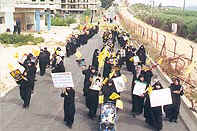 Some
120 women took Wednesday’s fifth commemoration of the Qana massacre protest to
the border with ‘Israel” on Wednesday, demonstrating at the Fatima Gate.
Black-clad women and children who were relations of the victims carried
Hizbullah, Lebanese, and Palestinian flags and a banner reading “With your
backing we will continue our struggle and succeed.”
Others shouted: “Death to ‘Israel”, death to the United States” and
other anti-’Israeli” slogans.
The protest came two days after ‘Israeli” planes blasted a Syrian radar post
in Lebanon, killing one Syrian soldier and wounding six.
Children stomped their feet, raised their fists and shouted “We will not
forget you … We will not forget you.”
The mother of slain resistance fighter Jihad Sayyed urged other mothers to give
their sons in support of the intifada.
‘Israeli” soldiers poked their heads out to watch the march from behind
fortifications, while a UNIFIL helicopter flew over the Blue Line, hovering over
Kfar Kila village, where its crew watched the march with binoculars.
Another mother of a deceased resistance fighter threw a stone at the
‘Israeli” post.
Hassan Ahmad, 11, whose father was killed during an ‘Israeli” attack, said
he came to the gate to tell ‘Israelis” he has begun training to fight them.
“Let them wait for me,” said Ahmad, “I’m coming.”
Suhaila Mohammed Zahwa, mother of a resistance fighter killed in a confrontation
with ‘Israelis”, said “We are here to tell ‘Israelis” that our sons
await martyrdom, my two sons are ready when Hizbullah wants them.”
Officers
leave for demining course…(8)
The first batch of Lebanese
military personnel has left for Spain, where they are to learn demining skills
under a training program jointly sponsored by Russia and Spain.
The Novosti press agency announced Wednesday that the batch includes 20 Lebanese
Army officers who will spend six weeks in Spain and will be able, after their
training, to coach additional troops to help demine the South.
The agency quoted Russia’s charge d’affaires in Beirut, Andrei Poliakov, as
saying that the Lebanese delegation was being trained at the Madrid Air Force
Academy under a joint Russian-Spanish training program whose expenses were being
met by the United Arab Emirates.
Earlier this year, a delegation representing Russia’s Foreign Ministry visited
Lebanon.
Vladimir Vlassenco, who headed the delegation, said at the time that “Russia
and Spain had enough know-how to rid south Lebanon of some 130,000 land mines
left behind by the ‘Israelis”.”
Meanwhile, a military delegation from the UAE met Wednesday with President Emile
Lahoud and Army Commander General Michel Suleiman to discuss the training
program’s progress.
Lahoud praised the UAE’s initiative, which showed “how much solidarity the
UAE’s ruler, Sheikh Zayed Bin Sultan al-Nahyan, feels for Lebanon especially
during these hard times.”
The
‘Israeli” shelling of a UN post at Qana in 1996 left 107 civilians dead.
Today the nation remembers the brutal massacre
Qana left scars that cannot heal…(9)
Five years have passed
since 107 civilians were slaughtered by ‘Israeli” artillery shells at the
Fijian UNIFIL headquarters in Qana, but for the survivors, the massacre could
have been yesterday.
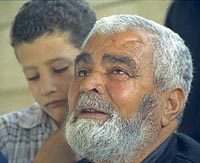 “I
have more of my family here than I do in my home,” said Saadallah Balhas, 61,
gazing blankly at the rows of gray marble tombs where the victims lie buried.
Balhas, from the neighboring village of Siddiqine, lost his wife and nine of his
children in the ‘Israeli” bombardment, from 30-year-old Ghaleb to
four-month-old Hassan. In all, 32 members of his extended family perished. The
same explosion that killed his family also claimed his right eye and today he
wears a glass substitute. He carries a pendant around his neck with tiny
photographs of the dead.
Balhas visits the cemetery everyday.
“It’s not like something you can forget, no matter how many year pass by,”
he said.
The slaughter occurred on April 18, 1996, midway through ‘Israel”’s 16-day
“Grapes of Wrath” air and artillery blitz. An ‘Israeli” commando unit
laying booby-traps north of the occupation zone near Zibqine came under fire
from a Hizbullah mortar in Qana. ‘Israeli” artillery responded by shelling
the location of the mortar before switching to bombarding the Fijian battalion
headquarters, where 800 civilians had sought sanctuary.
Of the 36 shells fired by the ‘Israelis” in the barrage, 13 directly hit the
UNIFIL base. ‘Israel” later apologized and claimed it was an accident.
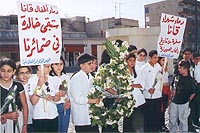 A
UN report into the massacre concluded that it was “unlikely” that the
shelling was the result of “gross technical and/or procedural errors.”
Five years have passed but the passage of time has failed to heal the deep
emotional scars carried by the survivors of the massacre.
Balhas said that even the withdrawal of ‘Israeli” troops from the South last
May had little effect on him.
“For me, personally, it made no difference whether the ‘Israelis” left or
stayed,” he said. “I have no reason to fear them anymore. Most of the people
I loved are dead.”
Two of Balhas’ grandchildren, Saadallah, 8, and Mahmoud, 10, wandered between
the tombs clutching flowers. Saadallah’s mother was killed in the massacre and
Mahmoud, who was badly injured, had to be dragged from beneath a pile of
corpses.
Munira Taki, 46, from the village of Jbal Botom, lost her husband, Ibrahim, and
8-year-old daughter, Dunia.
“My husband was 41 years old and at the beginning of his life. He left me all
alone to look after our 11 children,” she said.
 Her
daughter, Lina, 11, who was severely wounded in the shelling, continues to
recover a little more each year.
She stood by the door of her home, smiling shyly as her mother spoke.
“When they found Lina, they thought she was dead. Her brain was exposed and
they put her into a bag. Then she shivered and they knew she was alive.”
Lina was paralyzed in one arm and was unable to speak due to the extent of her
head injuries. She spent five months being treated in a hospital in London.
“Lina will recover eventually,” Munira said. “The doctors told me that she
may suffer epileptic seizures from time to time as she still has three pieces of
shrapnel in her brain. But so far, thank God, nothing.”
As mourners gathered in Qana during the afternoon for the 4.30pm commemoration,
a few people wandered through the empty halls of the museum devoted to the
massacre beside the cemetery. The museum was built by donations from Syria and
opened a year ago. But there are few exhibits, just a handful of posters and a
gruesome collection of photographs of the carnage wrought by the ‘Israeli”
artillery shells.
Two boys stared wide-eyed at the photographs.
“Look,” said one boy to his friend. “There’s Mohammed, and there’s
Hadi. Do you remember how we used to play with them?”
In the pictures, Mohammed, his eyes expressionless and half-closed, lies in an
unzipped plastic body bag; Hadi is wrapped in a woolen blanket, brain matter
spilling out of his shattered skull.
Maryam Ftouni dabbed her eyes and sighed as she scanned the terrible images.
“This is my brother,” she said pointing at the outline of a corpse hidden
beneath a blanket.
She indicated another picture of a woman lying face down beneath a charred
blanket.
“That woman was on fire and my brother tried to save her when a shell exploded
nearby and killed him,” Maryam said.
But more haunting than all the images of butchered and burnt corpses was one
particular snapshot taken a few minutes before ‘Israel” unleashed its 17
minute bombardment.
Men, women and children were caught by the photographer chatting and laughing
together, sitting on the floor of the Fijian officers’ mess, blithely unaware
that they had just a few minutes left to live. And there, to one side of the
picture, is Saadallah Balhas, hugging his baby son Hassan for what must have
been the last time.
Qana
Massacre: A Tragic Memory Hard to Forget…(10)
Five
years had passed, and the scenes of the Qana massacre will not be forgotten.
Five years had passed and the anguish of missing the loved ones is still
burning.
Tears are still Fatima Bolhos’s inherent companion, after the merciless zionist rockets took away her husband and three precious children, the elder was merely four years in age. Even though she bitterly accepted the idea of her children and husband's parting, but she has yet to understand the guilt her seventeen-day old infant committed.
Friday, April 18th 1999, 900 Lebanese southerners, elder lies, children, and women sought refuge in a United Nation’s compound in the southern village, Qana.
Some were having lunch, not realizing its their last., some were taking a nap, not realizing it’s rather an eternal sleep.
Enemy’s reconnaissance planes were hovering over the UN compound. A moment passed, and Phosphor-bombs turned the scene into human carnage. Bodies scattered all over, and more than 100 people turned into one-flaming chunk.
Lebanon and the Arab and Islamic world condemned this barbaric crime that the so-called peace-pigeon Prime Minister Shimon Peres perpetrated, while former U.S president Bill Clinton arrogantly considered Peres’s crime as self-defense.
11 month have passed since the liberation of most of south Lebanon, the 18th of April is still deemed a rather painful memory which without doubt proves the black history and continuos atrocities comitted currently in Palestine, which will provide an everlasting land mark of the Zionists nature. And Qana will not be forgotten.
1-
The Daily Star, 19-4-2001.
2-
AFP, 18-4-2001.
3-
The Daily Star, 19-4-2001.
4-
Same source.
5-
Manar TV, 18-4-2001.
6-
AFP, 18-4-2001.
7-
Same source.
8-
Same source.
9-
Same source.
10-
Manar TV, 18-4-2001.
April Friday 20
-2001:
Resistance:
“Israel” will pay for attack
South commander warns that “Israeli” PM ‘miscalculated’ with radar
strike…(1)
Hizbullah’s southern
commander suggested Thursday that “Israel’s” air strike against a Syrian
military radar base earlier this week had not been unexpected and warned that
the organization would hit back in a “specific way.”
Sheikh Nabil Qaouk accused “Israeli” Premier Ariel Sharon of “pushing the
region toward a large-scale war for which all the Arab countries should
prepare.”
Qaouk said that Hizbullah had been studying Sharon closely since the former
“Israeli” general took power in February.
“We knew he was a very careless man and does not calculate well.
“We were ready for all possibilities and probabilities … (The air raid) did
not go beyond what we had calculated Sharon capable of,” Qaouk told The Daily
Star in an interview.
“Israel’s” air raid against what was the largest Syrian Army radar
installation on Lebanese soil has raised the stakes in the tit-for-tat exchanges
between Hizbullah and the “Israeli” Army in the Shibaa Farms.
“Israel” appears to have set a new precedent by which Syrian military
positions will be targeted in response to Hizbullah attacks in the Shibaa Farms
or elsewhere along the border.
Faced with this prospect, will Syria pressure Hizbullah to curtail its military
operations?
“This has never happened in any former period and will not happen in the
future,” Qaouk said. “Syria fully supports our right to resist.”
The last time a Syrian position of any importance was attacked was during
“Israel’s” invasion of 1982 when “Israeli” warplanes destroyed
Syria’s anti-aircraft missile system in the Bekaa. The only deliberate attack
against Syrian troops since then was on the second day of the Grapes of Wrath
operation in April 1996, when “Israeli” helicopter gunships fired missiles
at a Syrian anti-aircraft position near Beirut Airport.
Could Damascus really stand back and allow “Israel” to destroy its military
positions so that Hizbullah could continue attacking “Israeli” troops?
“Sharon and his government will discover that Syria is able to resist and
maintain steadfastness,” Qaouk said. “Hizbullah is determined not to allow
the “Israelis” to impose any equation. Sharon committed a very stupid
action. Syria has said through the comments of President Bashar Assad that it
will defend itself and it will not be long before the “Israelis” discover
they have created their own tragedy.”
Qaouk argued that the air raid had backfired on Sharon because it had
strengthened Syria’s resolve and rallied the Arab world against “Israel”.
“The “Israeli” people will soon discover that they have put their faith in
a very stupid man,” he said.
The deadly anti-tank missile attack on Saturday in the Shibaa Farms which killed
an “Israeli” soldier and prompted the retaliatory air raid was indirectly
criticized by Prime Minister Rafik Hariri through an editorial in his
Al-Mustaqbal newspaper. The editorial which questioned the timing of the
operation underlined the continuing rift between the premier and Hizbullah.
Qaouk conceded that Hariri “had opinions” on the wisdom of Hizbullah’s
operations before the “Israeli” air strike, but after the raid “the issue
is different.”
“He has trust in our operations,” he said, “and all Lebanese have the same
opinion in Hizbullah’s ability.”
Should we expect another unfavorable editorial in Al-Mustaqbal if Hizbullah was
to stage a further operation?
“Wait and see,” Qaouk replied.
Hizbullah appears determined to proceed with its hit-and-run operations against
the “Israeli” Army in the Shibaa Farms, regardless of whether Hariri or the
Lebanese in general approve.
Qaouk said that Hizbullah has “decided to make the “Israelis” very sorry
for what they did (by attacking the radar base).”
“Our (military) program was not affected by the “Israeli” raid …
Saturday’s operation was definitely not the last. We will deal with this raid
in a very specific manner,” he warned without elaborating.
He would not be drawn into giving a time-frame for any response to the air raid,
but his comments suggested Hizbullah will continue to confine its actions to
military targets in the Shibaa Farms rather than expand the theater of conflict
elsewhere along the border.
Lebanon
rejects “Israeli” offer in return for constant Syrian presence
Lahoud: Resistance will continue…(2)
President Emile Lahoud said
Thursday “Israel” should know “clearly and once and for all” that it
would not achieve security by using force and disclosed “secret” offers to
barter protection for “Israel” in exchange for a permanent Syrian presence
in Lebanon.
Speaking at the opening of a weekly Cabinet session, Lahoud dwelt on recent
developments, especially “Israel’s” air strike against a Syrian radar
installation in the Bekaa on Monday.
“All this will not prevent us from adhering to our firm position based on
doing away with “Israeli” occupation of territory, a return of Palestinian
refugees to their homes and releasing prisoners held in “Israeli” jails,”
he said.
“Without all of these rights and without resorting to the principles of a
comprehensive and just peace in the region, “Israel” should know clearly and
once and for all that it will not achieve security by force, regardless of its
aggression and escalation.”
The president said “Israel” would be held responsible for its “aggression
and escalation in occupied territory as well as for its attempts to introduce
new formulas which will be rejected by us, through resistance and diplomatic and
other legitimate means.”
Lahoud said that more than two months ago, both Lebanon and Syria had rejected
offers through diplomatic channels proposing a quid pro quo “a permanent
Syrian presence in Lebanon in exchange for permanent Lebanese and Syrian
protection for the security of northern “Israel”.
“We rejected these offers and said at the time that such a presence is linked
to the strategy of confrontation, not with an exchange between “Israel’s”
security and Syria remaining here.
“We say the same thing about an offer made openly by “Israeli” Foreign
Minister Shimon Peres two days ago and affirm that the resistance is continuing
and the exchange is rejected,” the president said.
““Israel’s” interior will not be safe if our own interior is subject to
any aggression,” he warned.
In turn, Premier Rafik Hariri said that since Ariel Sharon came to power this
year, “Israel” was following a “suicidal policy that would not lead to a
solution.”
He added that the “Israeli” air strike Monday had been “denounced by
everyone” and that “Israel” was trying to escalate tension and violence in
the region.
Such a policy will have “negative effects” on “Israel”, he said.
Hariri reiterated the government’s support of the resistance as long as
“Israel” occupied Lebanese territory and committed “aggression” against
it.
The session was preceded by a separate meeting grouping Lahoud and Hariri
lasting about 30 minutes.
Ministerial sources said Economy and Trade Minister Basil Fuleihan told the
Cabinet that he was notified during a visit to Tehran earlier this week of
Iran’s approval to place a deposit with the Lebanese Central Bank, earlier
requested by Hariri.
No amount was set, but some ministers felt the figure would be “a considerable
one.”
It also approved a German government grant to help remove mines from the South.
Assad vows retaliation for “Israeli” attack on Syrian station…(3)
“Syrian President Bashar al-Assad has vowed to retaliate against the strike. Assad did not indicate how Damascus might respond but said “Israel’s” actions have raised a "feeling of anger in the Arab street".
“President Bashar
al-Assad, in his strongest reaction so far to the “Israeli” strike against a
Syrian radar base in Lebanon, said the country would not stand idly by as
“Israel” mounted attacks. Presidential Spokesman Joubran Kourieh said the
President's remarks were made during a meeting of the ruling Baath Party's
Regional Command, the party's highest policy making body, held on Tuesday under
Assad's chairmanship. The meeting was the first since an “Israeli” air raid
early on Monday killed at least one Syrian soldier and wounded six others in
eastern Lebanon. “Israel” claimed it launched the raid in retaliation for
the killing of one of its soldiers by the Hizbollah resistance movement on
Saturday. Official Syrian press had urged the US to quote "put the
brakes on “Israel’s” aggressive drive". The director of Syria's
official radio and television called on Arab countries to "put pressure on
American interests," without elaborating. Official newspapers said Arabs
must use the oil weapons in the struggle against “Israel”, adding Damascus
has quote numerous means at its disposal to make “Israel” regret its Monday
bombardment of the Syrian radar station. The US has been coming under increased
Arab criticism and condemnation for what they say is Washington's support for
“Israel” in its confrontation with Palestinians, Lebanon and Syria. The
Syrian presidential spokesman quoted Assad as expressing an interest in meeting
the demands of the Syrian people, who want to extend support and backing to the
Palestinian uprising against “Israeli” occupation in the West Bank and Gaza
Strip. At UN headquarters in New York, UN spokesman Fred Eckhard said Assad had
a long telephone conversation with Secretary General Kofi Annan to discuss his
concerns about escalating violence. Eckhard said Assad was quote firm in his
views that what the “Israeli” are carrying out is a form of aggression.
Damascus had warned “Israel” it would pay "a heavy price for the attack
at the convenient and appropriate time". More countries have been
condemning the raid. The European Union presidency described it as excessive.
Sweden which holds the rotating presidency of the 15 nation-bloc said the
“Israeli” raid which it stressed was in retaliation for Hizbollah attacks on
Shibaa Farms was a disproportionate reply. The EU urged maximum restraint to
prevent any military escalation.
UN Human Rights group denounces “Israeli” violations of Lebanese sovereignty…(4)
“The United Nations
Commission on Human Rights has denounced “Israeli” violations of Lebanese
sovereignty. At its annual six-week session in Geneva, the UN rights forum, also
demanded “Israel” release at least 19 Lebanese detainees it has been
holding, most without trial or charge. The 52-member state body condemned an
“Israeli” high supreme court decision allowing “Israel” to detain
Lebanese as hostages and bargaining chips for any future negotiations on the
fate of missing “Israeli” servicemen. The UN commission is in session until
the end of April to examine abuses worldwide. It has adopted a resolution
condemning “Israeli” atrocities against Palestinians. Only the US and
Guatemala voted against the resolution.
UAE
delegation visits South as part of demining pledge…(5)
A delegation from the
United Arab Emirates’ army inspected minefields in the South for the first
time Thursday, following the UAE’s pledged support for Lebanon’s demining
campaign.
“Our delegation is touring the South to get a better feel of the effects of
the occupation and evaluate the mission that needs to be carried out on this
level,” said General Obeid al-Kutubi, the head of the delegation.
Earlier this month, the UAE said it would finance mine-clearing efforts in the
South, where an estimated 130,000 mines were planted by “Israel”
“Israeli” proxy.
Accompanied by General George Sawaya, the delegation toured the Maidaneh Plain
in eastern Kfar Roummane, Nabatieh, and visited Beaufort Castle, a former post
manned by the “Israeli” proxy South Lebanon Army militia.
The group then visited the “Israeli” and SLA-run Khiam prison where a
Hizbullah delegation showed it around the former detention camp.
A Hizbullah member and a former detainee then briefed the delegation on
“Israel’s” torture methods on Lebanese and other detainees held in the
camp.
“This visit has enabled us to form a realistic idea of the extent of
destruction” in all previously occupied areas in the South, Kutubi said. He
said the UAE team would start clearing land mines soon after coordinating with
the Lebanese Army.
1-
The Daily Star, 20-4-2001.
2-
Same source.
3-
Future TV, 19-4-2001.
4-
AFP, 19-4-2001.
5-
The Daily Star, 20-4-2001.
April Saturday 21 -2001:
Calls for restraint "useless": Assad…(1)
Syrian President Assad has told his US counterpart George W. Bush the peace process with “Israel” is now at an "intensive care" stage. Assad urged Bush to quote take a courageous stance and consider “Israel’s” attack on the Syrian radar station an aggression.
“ US President George W.
Bush urged his Syrian counterpart Bashar al-Assad to show restraint amid rising
Middle East tension, but Damascus said Assad told the US leader such calls were
"useless." Bush's call to Assad, placed as the US Assistant
Secretary of State for Near Eastern Affairs Edward Walker visited Damascus, came
after “Israel’s” raid on Monday on the Syrian radar station. The White
House said Bush telephoned Assad to discuss the situation in the region,
particularly in Lebanon, and "both agreed on the urgent need to restore
calm to the area," as well as "the need for all parties to use
restraint." But Syria's official news agency said Assad told Bush the
"repeated calls for restraint have become useless," and quote "it
is necessary to diagnose the problem to find effective solutions." Assad
reserved the right to respond to the “Israeli” strike at the appropriate
time and held “Israel” responsible for the consequences of its attack on the
radar post. “Israel’s” Monday attack was the first on a Syrian target in
Lebanon since 1982. “Israel” held Damascus responsible for the Hizbollah
operation in the Shibaa Farms, which was occupied by “Israel” in 1967 and
was not included in the Jewish state's pullout from southern Lebanon last May.
Beirut and Damascus have rejected UN and “Israeli” claims that the Lebanese
region belongs to Syria and can only be returned as part of a peace agreement.
Beirut ‘disappointed’ by Security Council’s treatment of air strike…(2)
A government source said
Friday that Lebanon was disappointed with the weak statement from the UN
Security Council regarding the “Israeli” air raid on Dahr al-Baidar.
The source explained that officials were upset at the Security Council’s
statement treating “the aggressor” (“Israel”) and “the victim”
(Lebanon) alike.
“While the resistance operation took place in Shibaa, a Lebanese land occupied
by “Israel”, the “Israeli” air raids targeted an area deep within
Lebanon proper,” the source said. “Moreover, the Security Council’s
statement omitted any allusion to the fact that the “Israeli” air raid
breached Lebanon’s sovereignty and the Jewish state used the resistance
operation as an excuse to attack the radar positions in Dahr al-Baidar.”
The source recalled that UN Secretary-General Kofi Annan was upset at the
“escalatory “Israeli” response” in targeting the Syrian radar position.
UN protests “Israeli” violations of Lebanese airspace…(3)
“ The UN representative in southern Lebanon called Friday for “Israel” to stop violating Lebanese airspace, as “Israeli” warplanes broke the sound barrier over the country for the fifth consecutive day.
Staffan de Mistura said the overflights Friday were the 342nd time the “Israelis” had violated its northern neighbor's airspace since August.
He said the flights violated the UN "Blue Line" which separates Lebanon and “Israel” and said they "are particularly unhelpful at this time of tension in the region."
"Such actions cause unfair concern among the population and should be stopped," De Mistura said in a statement.
Lebanese Foreign Minister Mahmud Hammud praised De Mistura's statement, calling it "the first time the United Nations has clearly noted the “Israeli” violations and aggressions."
Hammud told AFP he hoped the violations would figure into UN Secretary General Kofi Annan's report on the Lebanese-”Israeli” border situation due out at the end of the month.
The UN envoy reported two sonic booms over Beirut on Friday, while security sources said “Israeli” planes broke the sound barrier throughout the country, including over southern Lebanon and the main northern town of Tripoli.
“Israeli”
troops fire across border…(4)
“Israeli” soldiers
fired machine guns on Friday at a group of stone-throwers near the Fatima Gate
in Kfar Kila without causing any casualties, witnesses said.
They said that one of four “Israeli” soldiers positioned in an observation
post near the gate started firing at nine young men who were throwing stones and
a handful of workers carrying out reinforcements near the border.
Members of Hizbullah who had been watching the site instructed the group of men
to leave the site, which they did immediately after the shooting.
Earlier Friday, “Israeli” workers reinforced the border from Hamames Hill
south of Khiam to the “Israeli” settlement of Misgav Am on a hill above
Addaisseh. A Hizbullah member who refused to be identified said “Israelis”
have been carrying out reinforcement works for two days.
He said “Israelis” workers always started their work at nightfall and went
on until sunrise, to avoid the stone-throwers.
“ Thousands of Syrians turned their independence day Tuesday into a mass protest of “Israeli” airstrikes that killed three Syrian soldiers posted in the Lebanese mountains, and Hizbullah guerrillas in Lebanon promised to retaliate.
Hizbullah's deputy leader, Sheik Naim Kassem, vowed to retaliate against “Israel” at an "appropriate time and manner . . . contrary to “Israeli” expectations."
Speaking in Beirut, Kassem said Hizbullah will continue to fight “Israeli” troops in the Shibaa Farms until “Israel” vacates the area, where Lebanon and the “Israeli”-occupied Golan Heights meet.
“Israel” said the raid Monday -- its first deep inside Lebanon since its forces withdrew from southern Lebanon in May 2000 and the first on a Syrian target since 1996 -- was a signal to Syria that “Israel” would not tolerate Hizbullah attacks.
Syria and Iran back Hizbullah, “Israel’s” toughest opponent during its 18-year occupation of Lebanon.
Syria has not indicated how it might respond, though Syrian Foreign Minister Farouk al-Sharaa vowed Monday during a visit to Moscow that “Israel” "will pay a heavy price . . . at the convenient and appropriate time."
Thousands of Syrians rallied Tuesday on the Syrian side of the Golan Heights, demanding “Israel” return the rest of the plateau it has held since the 1967 Middle East war. "The [“Israeli”] aggression will not frighten us!" they chanted.
The Syrian government had lifted its normal restrictions on travel to the Golan Heights because of a holiday celebrating the 55th anniversary of Syria's independence from France.
At a rally in Damascus, Suliman Qaddah, a regional official of the ruling Baath Party, said “Israel” alone "bears responsibility for this aggression and its adverse consequences."
In an editorial Tuesday, the official Syrian newspaper Tishrin said the strike heralded an era of "provocation, extremism, and racism led by the terrorist [“Israeli” Prime Minister Ariel] Sharon."
Iran's official Islamic Republic News Agency said Sharaa told Iranian Foreign Minister Kamal Kharrazi in a phone call Tuesday that “Israel” was seeking a pretext for a confrontation.
On the streets of Damascus, Syrians expressed concern about the possible consequences of such a confrontation. Salim al-Ahmad, a 45-year-old merchant, called the airstrike a "provocation . . . and an attempt to drag the region into a new war."
Meanwhile, Egyptian President Hosni Mubarak told reporters in the Egyptian resort of Sharm el-Sheik that the strike on the Syrian army reminded him of the climate during “Israel’s” 1982 invasion of Lebanon, when Sharon was defense minister.
"If “Israel” thinks that it can stop violence by this policy, I am saying that it won't and, to the contrary, it will backfire and violence will increase everywhere," Mubarak said after meeting with Palestinian leader Yasser Arafat.
"I urge Sharon to be realistic because the policy of strikes is useless and . . . all the people of the region, including the “Israeli” people, will suffer more."
1-
Future TV, 20-4-2001.
2-
The Daily Star, 21-4-2001.
3-
AFP, 20-4-2001.
4-
The Daily Star, 21-4-2001.
5-
Herald World Staff, 20-4-2001.
April Monday 23-2001:
Hizbullah MP vows to extract steep price if Israel launches new attacks…(1)
Baalbek-Hermel MP Hussein Hajj
Hassan said Sunday that Hizbullah will attack Israeli settlements in Northern
Palestine if the Jewish state continues to target Lebanese infrastructure.
“The resistance is ready to turn the Israeli settlers’ lives in northern
Palestine into hell,” said Hajj Hassan, who said Hizbullah, not the Israelis,
would “choose the time of the attack.”
The Hizbullah MP made the comments while attending a UNESCO Palace ceremony
marking the 23rd year of the detention of Samir Qantar.
Qantar, the longest-serving detainee still in Israel, was given a 542-year
sentence in 1979 after being convicted of killing five Israelis in the town of
Naharya.
More than 400 attended the ceremony, which was organized by the Follow-Up
Committee for the Support of the Lebanese Detainees in Israeli Prisons.
“We are equipped with the right weapons,” said Hajj Hassan, vowing that the
resistance would liberate the Shebaa farms.
Hajj Hassan also praised the Palestinian resistance, especially Sunday
morning’s suicide (martyrdom) bombing which killed one person and wounded
dozens in Tel Aviv.
He also warned US President George W. Bush to be wary of the resistance’s
capabilities.
“We say to President Bush you should read and analyze the resistance well.
We are neither weak nor afraid.
“Sharon should also understand that resistance will struggle for the return of
the Palestinian refugees in Lebanon,” he continued, pointing out that
“Sharon is afraid of their return.”
To relatives of detainees, Hajj Hassan said: “I can assure you, it won’t
involve too much time before you see your detainees arriving ... (home) because
the rules of the game have changed.
“In the past, liberating our detainees was a tenuous demand,” he added,
“but today it has become an attainable possibility since our enemy has
detainees, as we do.”
He also admonished authorities here for poor treatment of ex-detainees, saying
Israeli prisons “would be better than living with unfulfilled promises.”
Aley MP Akram Chehayeb echoed the call, arguing that the state should treat the
liberated detainees as heroes.
“The state should take good care of them,” he said, “so they don’t feel
they were first imprisoned by occupation and then by their own country’s
negligence.”
In a letter to his brother, Qantar said the detainees issue should not be
separated from peace negotiations, saying the two were linked by
“necessity.” The letter also urged all Arabs to defend the Palestinian
intifada.
“We have to support the Palestinians ... and defend Palestinian refugees’
human rights in Lebanon,” it said.
Social Affairs Minister Asaad Diab, who spoke on behalf of President Emile
Lahoud, said Israel did not respect international agreements and violated them
at will, accusing the international community of failing to “distinguish
between an attacker and its victims.”
Diab also promised to continue working to free both the detainees and all
remaining Lebanese territory.
Mohammed Safa, the head of the follow-up committee, said he hoped that UN
Resolution 425 contained provisions for the release of all detainees, rather
than leave the issue up to international “promises.”
Safa spoke of the families of three Israeli soldiers captured by Hizbullah last
fall, saying they are traveling the world in an attempt to enlist support for
their cause, asking Lebanon, Syria and Iran to allow International Committee of
the Red Cross delegates to visit their relatives.
“I ask the government to resist this campaign,” said Safa, urging the
authorities to create their own campaign to seek the release of Lebanon’s 19
detainees.
1- The Daily Star, 23-4-2001
April Tuesday 24
-2001:
Arab ministers will appeal to stop attacks…(1)
A Foreign Ministry source
said Monday that a delegation representing Arab foreign ministers would be
formed this week in compliance with an Arab League recommendation.
The league convened Saturday in Cairo to discuss the “Israeli” attack on a
Syrian radar position in Dahr al-Baidar.
The source said that the league’s secretary-general, Esmat Abdel-Meguid, was
expected to contact Lebanon, Syria, Jordan and Egypt to talk to them in his
capacity as chairman of the regular Arab League session, which has been devoted
to discussing last week’s “Israeli” air raid.
According to the source, the delegation’s main task would be to contact US
President George W. Bush, UN Secretary-General Kofi Annan, and the European
Union, to ask them to exert pressure on “Israel” to halt its attacks on both
Lebanese and Syrian positions.
1-
The Daily Star, 24-4-2001.
April Wednesday 25
-2001:
Nasrallah puts
“Israel” on notice…(1)
Hizbullah’s
secretary-general warned “Israel” on Tuesday to expect attacks from
Palestinians, a declaration that won applause at a conference in Tehran.
“The fully armed Zionist military should wait for surprise attacks by
Palestinian resistance groups,” Sayyed Hassan Nasrallah told an audience that
included Iran’s top leaders as well as Khaled Meshaal, a leader of the Hamas
movement, and Abdullah Ramadan Shalah, the head of Palestinian Islamic Jihad.
“Victory is ours. I confirm to you that the resistance in Lebanon will
continue its operations,” Nasrallah added, asserting that Hizbullah would not
submit to pressure.
He said his group would prove that Palestinians were not alone in their fight
against “Israel”. “I say to the Zionists and I mean it wait for us,
we’ll come to you from everywhere,” he warned.
Parliamentary leaders from over 30 Islamic countries are attending the two-day
conference Iran is hosting on the intifada. Iran’s supreme leader, Ayatollah
Ali Khamenei, opened the conference Tuesday by declaring that combat, not
dialogue, was the language understood by “Israel”.
Khamenei called on the rest of the Muslim world to support the Palestinians,
even if that meant defying the United States and the West.
“Supporting the Palestinian people is one of our important Islamic duties,”
Khamenei said.
Also in attendance was Speaker Nabih Berri, who cautioned that “Israel” was
still determined to occupy parts of Lebanon, notably the South.
““Israel” is working hard to re-enter parts of the South that it left
after 22 years of occupation,” he said. ““Israel” has launched a
substantial provocation campaign aimed at blaming the Lebanese for any attacks
launched on their territory.”
“Israel” claims Lebanese resistance forces have received a fresh batch of
long-range rockets from Tehran and other weapons aimed at undermining the
security of northern “Israel”.
“The recent air raids against Dahr al-Baidar weren’t a reply to the Lebanese
resistance activities,” the speaker argued, “but were aimed at intimidating
both Lebanon and Syria.”
Berri added that “the resistance is a consequence of the “Israeli”
occupation of our land. Hence, this resistance will remain as long as the
occupation continues. The resistance forces have already launched attacks
against the Shibaa Farms and will continue to do so.
““Israel” also aimed, during its latest air raid on April 16, to cut the
supply route for the Lebanese resistance from Syria,” he said, “and prevent
further attempts to normalize relations between Damascus and the Palestine
Liberation Organization.”
He stated that “the raids were also aimed to achieve another “Israeli”
objective halting the Syrian peace initiative in Lebanon after it
successfully stopped fratricidal bloodshed in our country. “Israel” won’t
end its attacks on Lebanon until it succeeds in breaking Lebanon’s solidarity
with Syria and launching an international diplomatic campaign to force the
Beirut government to deploy the Lebanese Army to the southern border.”
He predicted that “Israel’s” next objective was to “disarm the
resistance forces as a prelude to making south Lebanon a free-for-all once
again.”
Berri and Nasrallah were chosen to be part of the conference’s presiding
committee, along with five other members.
Former Prime Minister Salim Hoss told the conference that supporting the
intifada was “an historic responsibility,” adding that the uprising’s
failure would be a “disaster” similar to that of “Israel’s” 1948
creation.
1- The Daily Star, 25-4-2001.
April Friday 27
-2001:
Lebanon:
'Sharon fabricates report of Iranian missiles to wage massive onslaught'…(1)
The Beirut government has
accused “Israeli” Prime Minister Ariel Sharon of "fabricating" a
report about an Iranian missile base in south Lebanon to set the stage for a
large-scale offensive against Lebanon.
The charge came in a statement released by a foreign ministry official in Beirut
Wednesday evening, denying Sharon's claim that the projectiles and long-range
Katyusha missiles in the alleged base could hit central “Israel”.
Iran's foreign ministry spokesman Hamid-Riza Assefi has also put out a denial
reported by start-run Radio Tehran. "These charges are baseless. They are
all wrong," Assefi said.
Sharon's claim was reported by the Al-Quds Post newspaper. "The most
dangerous factor in the region is terror and the center of terror is the area
between Afghanistan and Lebanon," Sharon said.
"Iran has started building a base in Lebanon from which they can rocket and
long-range Katyushas that can reach the center of the country," he said.
Sharon said he had discussed "ways to combat this threat" with US
President George W. Bush and his senior aides when Sharon was in Washington last
month.
When he returned from the US capital, Sharon opened up a barrage of claims that
Iran was airlifting massive missile supplies to Hizbullah in Lebanon via Syria
to strike at Haifa, Nahariya and the Galilee.
1-
Nahar Net, 27-4-2001.
April Monday 30 -2001:
Two killed, one wounded by “Israeli” mines…(1)
Two people were killed by
abandoned “Israeli” ordnance in the South this weekend, while another person
was wounded.
Sixteen-year-old Mohammed Shartouni died Saturday after a land mine detonated at
6.30pm in the town of Meiss al-Jabal where he was hunting. It took Civil
Defense, Red Cross and local volunteers several hours to retrieve the body, as
it lay in a known “Israeli” mine field.
The young man had come with his parents from Beirut to spend the weekend in the
town. Shartouni’s father, Musa, is a former “Israeli” detainee.
In Boueida, west of Marjayoun, an 18-year-old shepherd, Yacoub Nabaa, was killed
when a bomb exploded as he was tending his sheep. Some reports said Nabaa, who
was from Shibaa, was holding an “Israeli” 155 mm shell when it exploded.
Also on Saturday, a 28-year-old farmer was wounded when an object believed to be
a mine exploded in a field where he was working.
Mohammed Baalbaki was planting onions in Kfar Roummane when he touched a
“strange object,” causing it to blow up. He was taken to the Nabatieh
government hospital, where doctors amputated three fingers.
At least 12 people have been killed and 35 others injured by land mines and
unexploded shells since the occupation ended.
Qanso blames
“Israel”, US for slump…(2)
Labor Minister Ali Qanso
says the country’s economic crisis is due to “Israeli” aggression and a
political-economical blockade by the United States.
Qanso, who was addressing a conference on the region’s economic and
political future in Mseileh on Saturday, also criticized the growing number of
people calling for an end to the Syrian presence.
Qanso said the recent election of “Israeli” Prime Minister Ariel Sharon,
combined with a new American administration which is apparently reluctant to
play a central role in the Middle East, means that Arabs must now “design a
comprehensive and clear nationalist vision to face the challenges ahead.”
“Any threat to this (Syrian-Lebanese) front could lead to disaster for the
entire Arab nation,” he warned.
Qanso also argued that Syria remains “committed” to Lebanon’s independence
and criticized the “Hanoi-Hong Kong theory,” saying that neither option was
the right choice.
Rebutting Chouf MP Walid Jumblatt’s claim that the country must choose between
becoming an investment center like Hong Kong or resisting “Israel” at the
expense of the economy, like Hanoi, Qanso said it was in Lebanon’s interest
“to provide ground for both investment and resistance.”
Qanso, the ex-president of the Syrian Social Nationalist Party, said the
resistance was “fully backed” by the president, the speaker and the prime
minister, whom he described as considering it a “strategic necessity.”
1- The Daily Star, 30-4-2001.
2- Same source.