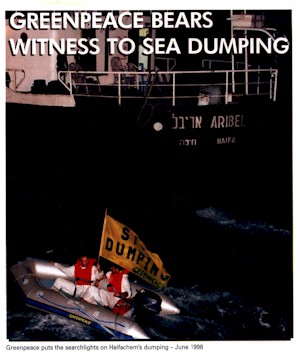
Time and time again, the "Israeli" authorities promised to end the dumping of toxic sludge in international waters in the Mediterranean. Greenpeace has been campaigning on the issue for the past four years always hoping that promises would be kept. It looks like the pressure is reaching the "Israeli" company. They have recently taken to dumping at night to keep things away from the public, and Greenpeace's eye.
One night last June, Greenpeace struck again, literally putting the dumping under the searchlights. Activists intercepted the dump ship "Aribel" at sea documenting the blackened waters as the Aribel discharged its load.
Greenpeace activists using inflatables, and the sailing vessel "St. Nicholas", intercepted the "Israeli" ship in international waters off the city of Haifa.
They called on it to stop with banner-bearing inflatables making the message clear as they swarmed around it in the churning waters. The "Aribel's" captain just repeated a laconic "negative" to the ecologists radioed eager appeal to him to stop and return to Haifa port.
Only last April, Greenpeace took two samples from the tank of the "Aribel" at its berth in Haifa Port. Scientific analysis of the ship's cargo of sludge, coming from the US owned Haifachem factory, showed that it contained a cocktail of heavy metals including zinc, cadmium and mercury above acceptable levels.
A similar but more concentrated cocktail was found in mud from the Kishon River where many industries, including Haifa Chemicals, dump their wastes. According to UNEP's Barcelona Convention, sea-dumping them is prohibited.
"Israeli" Environment Minister Rafael Eitan promised to stop dumping
by the end of 1997. But last December, he permitted Haifa Chemicals to
dump more toxic sludge until October 1998.
Meanwhile the "Israeli" Electricity Company (IEC) was allowed to dump
an additional 15,000 tons of ash contaminated with toxic heavy metals until
September 1998. Greenpeace calls on those responsible to stop the dumping.
"Israel" is the only country known to be permitting routine dumping
operations of industrial wastes at sea in the world although the London
Dumping Convention (1992) has banned sea dumping globally.