
Contents
From the Editors
So No One Can Say "We Didn't Know"
-Robert Fisk
Rebels and Martyrs: The Mobilization of Kabyle
Society and the Assassination of Lounes Matoub
-Paul Silverstein
Update: The Political Roots of Famine in Southern Sudan
-Interview with Jeff Drumtra
The Containment Myth: US Middle East Policy
in Theory and Practice
-Stephen Hubbell
The Rise and Fall of the "Rogue Doctrine": The Pentagon's Quest for a Post-Cold War Military Strategy
-Michael Klare
"Praise God and Pass the Ammunition!": The Changing Nature of Israel's US Backers
-Phyllis Bennis and Khaled Mansour
Oil and the Middle East: The End of US Hegemony?
-Simon Bromley
Avoiding the Obvious: Arab Perspectives on US Hegemony in the Middle East
-Georges Corm
Between Clash and Co-optation: US Foreign Policy and the Specter of Islam
-Steve Niva
Points of Difference, Cases for Cooperation: European Critiques of US Middle East Policy
-Volker Perthes
Short-Circuiting the Media/Policy Machine
-Sam Husseini
Interview: Protesting Sanctions Against Iraq: The View from Jordan
-with Aida Dabbas
From Alliance to the Brink of All-Out War: Explaining the Eritrea-Ethiopia Border Crisis
-Dan Connell
Historical Road Maps for the "New World Order"
Review of Beyond Eurocentrism: A New View of Modern World History
-Christopher Toensing
Editor's Picks: New and Recommended Reading
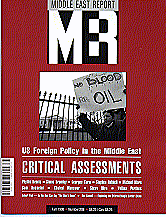
Critical Assessments
US Foreign Policy in the Middle East
From the Editors
Five years ago on the White House lawn, President Bill Clinton assumed he had achieved a monumental Middle East policy coup. Since then, the overall situation in the Middle East has worsened, largely due to the ignorance and arrogance that characterize US policy making in the region. In the face of growing crises in the Middle East, critical assessments of flawed US policies in the region are long overdue.
As we go to press, daily news reports announce US retaliatory attacks on alleged terrorist bases in Sudan and Afghanistan, warn of rising tensions between UN arms inspectors and the Iraqi Government, chart the growing malaise in the West Bank and Gaza, and speculate on Jordan's future in the wake of King Hussein's serious illness. Seldom reported in the mainstream media are the stories-and the US policy failures-behind these dramatic news bulletins. The alternative press offers more substantive reporting on child malnutrition and death resulting from inhumane sanctions in Iraq, the continuing disenfranchisement of Palestinians by an Israeli government that flagrantly violates international laws, the increasing corruption and repression affecting nearly every Arab country, and the back-room deals between Washington lobbyists and legislators that ensure that the Middle East will only see more of the same.
The articles in this issue of Middle East Report illustrate how US foreign policy exacerbates the disastrous state of affairs in the contemporary Middle East. Although the political contours of the world have changed radically since the collapse of the USSR and the Gulf War of 1991, US goals in the region have remained remarkably consistent: to control the flow of oil, to prevent the growth of Arab nationalist and leftist movements and to protect Israel. An important foreign policy objective enunciated by former National Security Advisor Anthony Lake in 1993, the promotion of worldwide democracy, rings hollow in the Middle East. Encouragement of social and economic justice and participatory politics is not on America's Middle East agenda, much to the relief of the autocratic leaders of the region's monarchies and republics. At a conference on the establishment of an International Criminal Court held this summer in Rome, the US found itself in unusual company when it cast a vote against the creation of an independent court capable of prosecuting war crimes across borders. In addition to its usual ally, Israel, others opposing a mechanism of international justice included two arch-enemies of the US: Iraq and Libya.
Ostensibly committed to peace in the Middle East, the US is in fact the chief arms supplier to rival countries in this volatile region. An alarming report recently published by the Council for a Livable World, "Foreign Aid and the Arms Trade: A Look at the Numbers," indicates that half of all US foreign aid in 1997 was military in nature. Egypt and Israel, the two largest recipients of US aid, are also America's best arms customers, having received 15 percent of all US arms shipments in 1997. Saudi Arabia, a leading arms buyer, has become a major US military base in recent years, angering many throughout the region and beyond, including Islamists armed by the US during the Cold War.
US policies and practices in the Middle East have set the stage for instability, injustice and violence. Turning a blind eye to rising tensions in the region, US policy makers blithely assume that US military and market might will conquer all. As the articles in this issue of Middle East Report indicate, however, US military and market forces are a big part of the problem, not the solution.