
 Palestinian
Astronomical Society
(PAS)
|
Palestinian
Astronomical Society
(PAS) |
The Leonids storm occured
as it was expected on Thursday , 18th 1999. The asttronomers in all the
world observed the great storms from dark places like the deserts and dark
beaches . In Palestine seven students , mostly students of
Astrophysics class at from Al-Najah university observed the storm
from Mount Altur, Near Nablus City ,under clear sky and with naked
eyes only.
Results :
The ZHR at the peak recorded by the eight students was as follows:
|
|
|
|
|
|
|
|
|
|
|
|
|
|
|
|
|
|
|
|
|
|
|
|
|
|
|
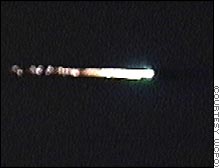
Leonid Over Palestine

In Jordan and after the end of the Leonids 99 Conference about 50 astronomers from around the world including Paletsinte observed the storm in the freezing cold of Jordan's desert . The participants went to Al-Azraq Desert to observe meteors.At the first night 16-17 very few Leonid meteors appeared (around 20-30 the whole night ) and this expected .
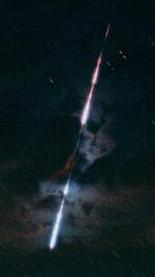
The storm occured at the expected time , but with a higher rate from the expected one. The expected ZHR was 500-1500 , but the storm's ZHR was 7000-10000 and occured 0204 UT as the Earth passed through the dust stream of comet Tempel-Tuttle. This storm occured as a result of the dust trail from the comet when it passes by the earth's orbit in 1899 , that it before three revolutions .
In all the countries of the world , the astronomers went to the beaches and deserts and dark beaches , but most of them found the skies full of cloud . For example , Over Great Britain clouds blanketed some skies , dimming the display which disappointed the stronomers, and in Nothern Ireland it was cloudy and the astronomers could were not able to see anything at all . In spain the Peak was 1,688 meteors per hour .
Although astronomical calculations had forecast the
best view was in the Middle East and Europe, professional and amateur
sky watchers in the United States also took up positions on mountain tops,
in fields, and just about anywhere away from city lights.
 |
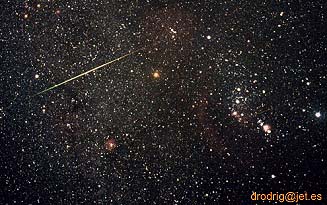
This beautiful photo of a 1999 Leonid streaking by Orion was captured by Diego Rodríguez in Toledo Spain. |
Ballon to Observe the Leonids:
NASA scientists launched a weather balloon from The Marshall Space Flight Center to monitor the shower from an altitude of 105,000 ft, far above any obscuring clouds or bad weather . The ballon carried a CCD video camera to record images of Leonid meteors for a live webcast of the shower from the stratosphere. At that night Millions logged on to a NASA Web site to watch a live Webcast of the Leonids as the shower was monitored by a weather balloon.
Most satellites appear to have weathered the meteor storm intact. There had been concern that the tiny fragments hurtling through the heavens at 150,000 mph (240,000 km/h) would smash their mirrors. There were no reports of any damage or problems for the sattellites for any satellite or for the hubble space telescope.
The report of the IMO shows that visual observations said that the ZHR was about 5000 on November 18 . Ten minutes earlier, a secondary peak occured with of ZHR of about 3500. the report also shows that the ZHR levels were above 1000 from roughly 1h20m UT to 2h45m UT and the peak occured between 2h00m UT and 2h10m UT. This report is compatible with the Paletinian Observations in Nablus where the ZHR was 6000 and compatible with the observations in tyhe Jordanian deserts where the ZHR was 7000-10000 .


All Rights Reserved , Copyright © 1999 Palestinian Astronomical
Society .
Jerusalem - Palestine.
