
 Palestinian
Astronomical Society
(PAS)
|
Palestinian
Astronomical Society
(PAS) |
The Millennium's Last Total
Solar Eclipse Over Syria & Iraq
AND
Partial Eclipse Over Palestine
Wednesday, August 11, 1999.
By : Eng. Ayman Tirhi


Introduction:
There are
several types of solar eclipse. The type of eclipse which can be seen from
a given location depends on whether the Moon passes directly, or only partly,
between the Earth and Sun; but also on where on Earth you stand to observe
it. Also, because the Moon's orbit around the Earth isn't exactly circular,
but elliptical, it is not always the same distance from the Earth during
an eclipse; and sometimes it is too far to completely cover the Sun from
the Earth's point of view. The following are the types of the solar eclipse:
1. Total Eclipse:
A total solar eclipse is when the Sun is completely covered by the Moon. This diagram illustrates in more detail what happens during a total eclipse:

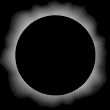
and the sun will appear in the sky as follows:
2. Partial Eclipse:
A partial
solar eclipse is when the Moon covers only part of the Sun, taking a "bite"
out of it.the sun will appear in the sky as follows:

3. Annular Eclipse:
An annular eclipse occurs
when the Moon covers the centre of the Sun, but not its edges, leaving
a ring (or annulus) of the Sun visible around its edges. This image illustrates
how an annular eclipse can occur:

and the sun will appear in the sky as follows:

4. The Hybrid Eclipse:
A hybrid, or annular/total, eclipse is an eclipse which is seen as annular by some parts of the Earth, and total by others (and also as a partial eclipse over a much larger area). This image illustrates how a hybrid eclipse can occur:
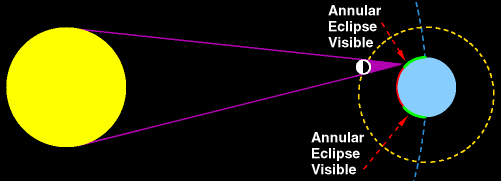
Here, the Moon is just far enough from the Earth that
the umbra can't reach the "sides" of the Earth, so as the eclipse begins,
the western portions of the Earth see an annular eclipse as the day begins.
In the diagram, observers in the "outer" parts of the eclipse track, coloured
green, see an annular
eclipse.
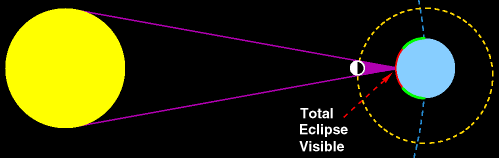
As the eclipse path moves on, the umbra has less far to travel to reach the Earth, and is just long enough to reach the "centre" (ie. the part most directly facing the Moon); so observers in the area coloured blue above see a total eclipse. People standing near, but not in, the annular/total eclipse track, would see a normal partial eclipse.
The Last Eclipse In the Century:
The last total solar eclipse will occur this
year on Wednesday, August 11, 1999.
This solar eclipse will be viewed by tens
of millions of people throughout Europe, Asia , Africa and northeastern
North America .The Moon's shadow will cross the Earth starting in
the Atlantic Ocean and lift away in the Indian Ocean.The path of the solar
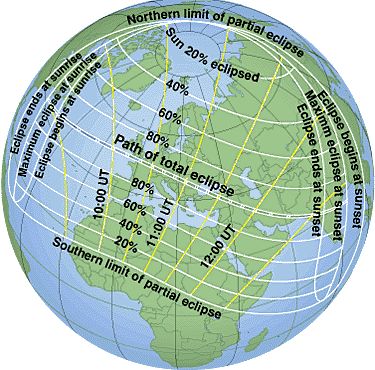
eclipse across the world is shown in the following image:
What is special about this eclipse is that it will cover a large area of land and not a large area of the water in the seas .Also ,beacuse it is nearly four decades have passed since a total eclipse of the Sun was visible from Europe and the first total eclipse visible from britain for over 70 years (since 1927 ).And the last reason is that the sun is advancing through its 11-year cycle toward solar maximum , expected in 2001 .
Path of the eclipse:
According to NASA the the path of totality begins when the dark central part of the Moon's shadow, called the umbra, will first touch down at 9:30:57 Universal Time in the North Atlantic Ocean about 700 kilometers east of New York Ciry before racing eastward to Europe.Quickly traversing the English Channel, the 112 km (69mile) wide path of totality running across the Earth at velocities of 0.91 km/s or more (around 3200 km/hour) , passes through France, Germany, Austria, Hungary, Romania and Bulgaria.London will miss the total phase but experiences partially with a maximum magnitude of 96.8 % . After crossing the Black Sea, the Moon's shadow reaches Turkey's northern coast at 11:29 UT, the umbra reaches Turkey's southeastern border at 11:45 UT and then continues southeast bisecting the country diagonally. Although Ankara lies 150 km south of the track it still experiences a deep partial eclipse of magnitude 0.967.The umbra will then enters northwestern Syria as it crosses into Iraq .
The center line duration is now 2 minutes 5 seconds with the Sun's altitude at 50°. Baghdad lies 220 kilometers south of the path and experiences a 0.940 magnitude partial eclipse . Arriving at Iran's western boundary at 11:52 UT, the shadow spends the next half hour crossing sparsely populated mountain ranges and deserts . Tehran lies north of the path where its eight million inhabitants witness a 0.943 magnitude partial eclipse. At 12:22 UT, the shadow enters Pakistan and skirts the shores of the Arabian Sea . Karachi is near the center line and experiences 1 minute 13 seconds of total eclipse with the Sun 22° above the western horizon. The five million residents of Karachi will experience a late afternoon total eclipse of 1 minute 13 seconds. Entering India, the track passes just south of Ahmadabad where a partial eclipse of magnitude 0.997 occurs. By the time the shadow traverses the Indian subcontinent, the duration falls below 1 minute and the eclipse occurs shortly before sunset. The path width has shrunk to 85 kilometers while the shadow's speed has increased to 2 km/s.Sweeping out over the Bay of Bengal, the umbra leaves Earth's surface at 12:36:26 UT. Over the course of 3 hours and 7 minutes , the moon's umbra travels along a path of 14000 kilometers long and covering 0.2% of eath's surface area .
No place in North America
will experience a total solar eclipse on August 11th , since the largest
fraction of the Sun's diameter covered (the eclipse magnitude) will be
in the range of 0.90 to 0.95 , but this moment arrives before sunrise.For
example at New York City, the calculated greatest magnitude of 0.95 occurs
at 9:33 UT or 5:33 a.m. Eastern Daylight Time with the Sun nearly 6°
below the east-northeast horizon. By the time the Sun finally comes up
at 6:02 a.m. the magnitude is only 0.46 and the Moon is rapidly retreating
off the Sun's disk.That is , predictions of eclipse details along the U.S.
coast show that the eclipse is in its final stages by the time the
Sun rises that morning.
The following image shows the path of the total eclipse across the earth surface wit the different shapes of the eclipse over different countries of the world:
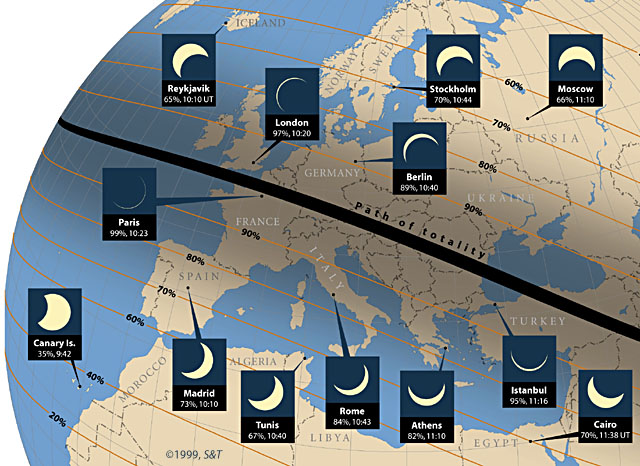
Hundreds of kilometres on either side of this narrow path of the total eclipse observers will see a partial eclipse.
The follwing is a great animation of the Total Solar Eclipse
:
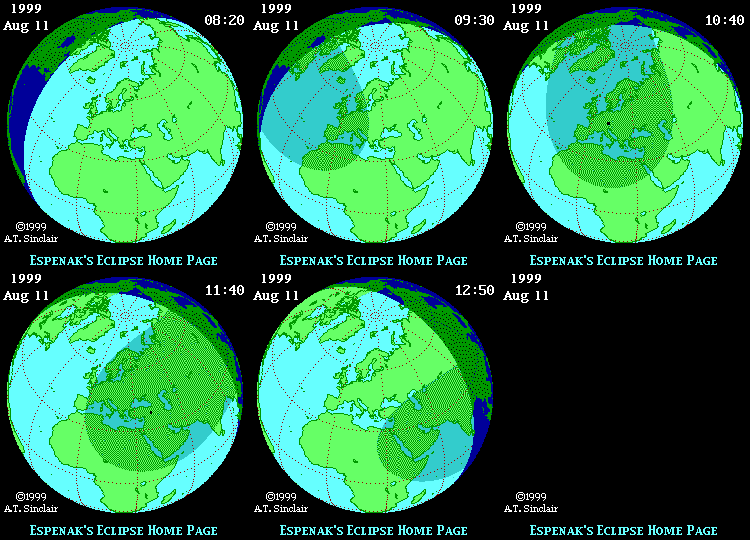 |
This animation shows the path of the Moon's umbral and
penumbral shadows during the total solar eclipse of 1999 August 11. The
Universal Time is displayed in the upper right corner as the animation
runs.
This animation was generated from a program written by British astronomer Andrew Sinclair . |
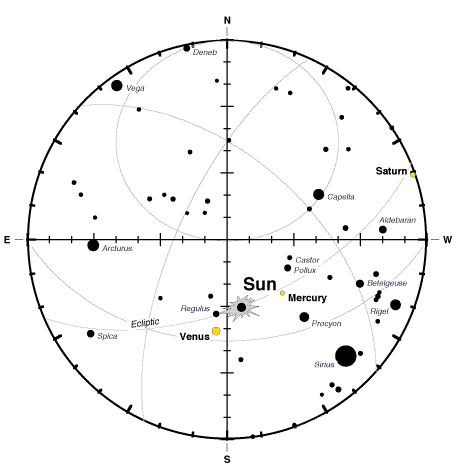
During the total eclipse , the sky will become dark as in the night and many objects will appear in the sky as shown in the folloiwng image:
Eclipse Over The Arab World
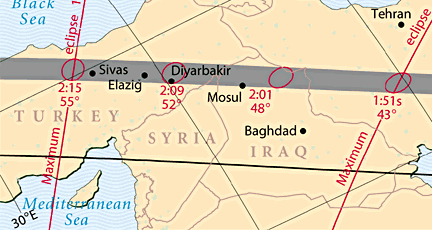
The eclipse will be partial over all the arab countries except for northern Syria and Iraq at which is will be total .The following image shows the path of the eclipse over Syria & Iraq with the time of occurance (local time):
Because of this the University of Al-Mosul will organize
an astronomical & astrophysical conference and observation activities
in the period of 9-12 August.
The conference has two parts as follows:
* In the period 09-10 August , the main conference will occur , that will dicuss many issues including the Ancient Iraqi Astronomy and the contributions of Arab scientists to astronomy , The solar system , Astronomical ephemarides ,Astrophysics and Cosmology .
* On the last day (11 August) the observational activities will occur and the participants will travel to the northern part of Mosul for the solar eclipse observations.
It is clear from the above image (eclipse across the world ) that the shadow of the moon will go over the middle east .The following image shows the perecentage of the eclipse over the countries of the middle east.
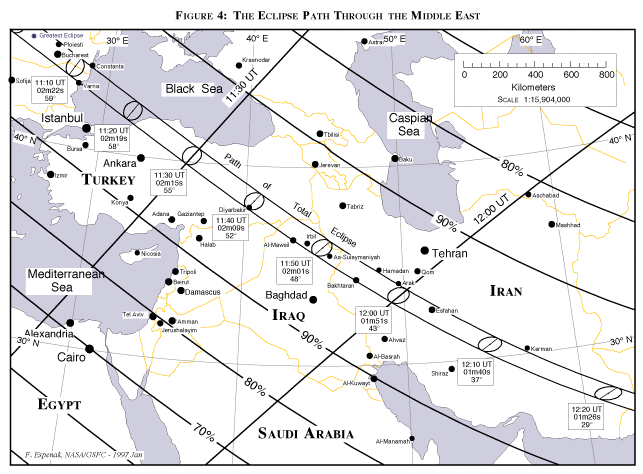
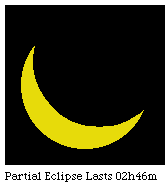
There will be a partial solar eclipse over palestine that reaches a maximum of 79.6 and will start at 10:15:06.4 and it will last up to 2h 44min .The following is the solar eclipse shape that will appear over Jerusalem:
Eclipse's Table
Location First
Contact Maximum Eclipse MAG
GMT
GMT
h m s
h m s
Al-Mawsil 10:23:29.0
11:46:53.7 1.027
Baghdad
10:30:41.0 11:53:50.2
0.947
Gaza
10:14:00.4 11:41:32.6
0.778
Haifa
10:12:40.5 11:40:13.3
0.817
Yafa
10:13:34.5 11:41:06.9
0.796
Jerusalem
10:15:06.4
11:42:27.7 0.794
'Amman
10:16:13.5
11:43:22.2 0.808
Beirut
10:11:55.5 11:39:18.9
0.850
Al-Riyad
10:51:50.8
12:11:46.0 0.770
Makkah
10:48:02.2
12:07:52.1 0.595
Damasces 10:14:14.1
11:41:20.5 0.851
Abu Dhaby 11:03:52.3
12:19:40.7 0.862
Dubai
11:03:34.5 12:19:07.1
0.893
Al-Manameh 10:55
12:14
0.853
Cairo
10:10
11:38
0.699
Tunis
9:16
10:40
0.675
Algeria
9:04
10:24 0.633
Eye Saftey
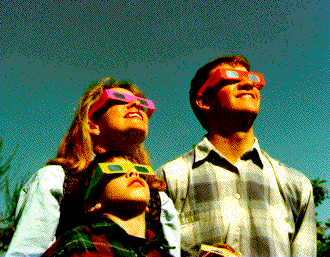
The Sun can be viewed safely with the naked eye only during
the brief two minutes of a total solar eclipse. Partial eclipses,
annular eclipses, and the partial phases of total eclipses are never safe
to watch without taking special precautions. Even when 99% of the Sun's
surface is obscured during the partial phases of a total eclipse, the remaining
photospheric crescent is intensely bright and cannot be viewed safely without
eye protection .
The
eclipse will take two and a half hours from start to finish, and special
filters or projection methods must be used during the partial phases. Thousands
of people have, most likely, suffered eye damage because they were unaware
of the dangers of looking at the Sun, and because the proper protective
devices have not been available. Devices such as smoked glass, darkened
film, and sunglasses must not be used, as temporary or permanent eyesight
damage can result. The Sun can be viewed directly only when using filters
specifically designed for this purpose. Such filters usually have a thin
layer of aluminum, chromium or silver deposited on their surfaces that
attenuates both visible and infrared energy.
 |
Solar radiation reaching the surface of the Earth ranges from ultraviolet light at wavelengths longer than 2900 angstroms to radio waves in the meter range. Environmental exposure to high levels of solar ultraviolet radiation is an established contributor to accelerated aging of the outer layers of the eye and skin and the development of cataracts. But more immediate damage takes place from directly observing the Sun with inadequate eye protection. |
For additional information , updates, maps, and diagrams regarding the eclipse , check the following two links:
* NASA's 1999 Solar Eclipse Bulletin
* NASA's
official 1999 total solar eclipse Web site


All Rights Reserved , Copyright © 1999 Palestinian Astronomical
Society .
Jerusalem - Palestine.
