'Allamah Sayyed
Muhammad Husayn al-Tabataba'i
(1892-1981)
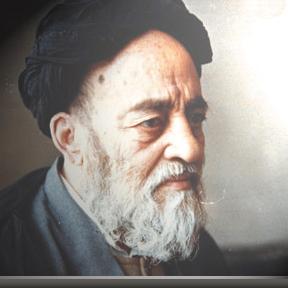
Allamah Tabataba'i was born into a
family of scholars in Tabriz in 1271 A.H. solar/1892 A.D. He lost his mother when he was
five years old, and his father when he was nine. To provide for their support, their
guardian (the executer of his father's estate) placed his one younger brother and
himself in the care of a servant and maidservant. Shortly after their father's death,
they were sent to primary school, and then, to secondary school. Eventually, their
schooling was entrusted to a tutor who made home visits; in this way they studied Farsi
and primary subjects for six years.
There was in those days no set program for primary studies.
Over a period from 1290/1911 to 1296/1917, he studied the noble Qur'an, which
normally was taught before all else, Sa'di's Golestan and Bustan,
the Illustrated Nesab and Akhlaq, the Anvare-e Sohayli,
the Tarikh-e Mo'jam, the writings of Amir-e Nezam and the Irshad al-Hisab.
In 1297/1918, he entered the field of religious and Arabic studies and was occupied with readings of texts until 1304/1925.
Over this same seven-year period, in the field of grammar, he
studied Ketab-e Amsela, Sarf-e Mir, and Tasrif; in syntax, Ketab-e
`Avamel, Enmuzaj, Samadiya, Soyuti, Jami, and Moghanni; in rhetoric, Ketab-e
Motavval; in jurisprudence, the Sharh-e Lama'a and Makaseb; in
principles of law, the Ketab-e Ma'alem, the Qavanin, the Rasa'il, and
the Kafaya; in logic, the Kobra, the Hashiya and the Sharh-e
Shamshiya; in philosophy, the Sharh-e Esharat; and in theology, the Kashf
al-Murad. This concluded his reading studies in areas other than philosophy and spiritual science.
In 1305/1925, he travelled to Najaf to attend classes given
by the late Ayatollah Shaykh Mohammad Hosayn Esfahani. Under his guidance, he undertook a
course in principles of law that occupied about six years and a course in jurisprudence of
about four years. He studied jurisprudence for about seven years under the late Ayatollah
Na'ini and undertook a course in principles of law under him. He also studied
jurisprudence under the late Ayatollah Sayyed Abu'l-Hassan Esfahani. He studied
Islamic biography under the late Ayatollah Hojjat Kuhkamari.
In the area of philosophy, he had the good fortune to be able
to study under the most renowned philosopher of the time, the late Sayyed Hosayn Badkubi.
In the course of the six years he was his student, he studied Sabzavari's Manzuma,
Molla Sadra's Asfar and Masha'er, Avicenna's Shifa, the Ethologia, Ibn
Tarka's Tamhid, and Ibn Maskuya's Akhlaq.
Out of the very great concern the late Sayyed Badkubi took
for his education, in order to back up his enthusiasm for philosophy with an acquaintance
with a rigorous style of thought, he ordered him to study mathematics. To comply with this
order, he attended the classes given by the Sayyed Abu'l-Qasem Khansari, a master
mathematician. He also studied analytical reasoning and plane and solid geometry under
him.
Because of difficulty subsisting, he was obliged to return to
Tabriz, his birthplace, in 1314/1935. He live there for ten-odd years, years he counted as
a period of spiritual bareness in his life, because he was held back from scholarship and
reflection by the unavoidable involvement and social contacts entailed in making a living
(by farming).
In 1325/1946, he left behind his situation in Tabriz and
settled in Qum, where he resumed his work in scholarship.
Naturally everyone has tasted the sweet and bitter of life in
terms of his own experience. He in his turn found himself in varied environments faced
with all kind of vicissitudes, especially since he spent most of his life as an orphan or
a foreigner, or far from friends, or without means, or in other difficulties. He always
sensed, however, that an invisible hand had delivered him from very terrible precipice and
that a mysterious influence had guided him through a thousand obstacles towards the goal.
"Though I be a thorn, and though there
be a flower to grace the meadow,
I grow by that Hand which nurtures me."
(Allamah Tabataba'i)
When he began his studies and was occupied with grammar and
syntax, he took little interest in them and failed to comprehend very much. He spent four
years this way. Then divine favor suddenly reached him and changed him, so that he grew
excited over his studies and impatient to learn all there was to learn. He never felt
weary or discouraged from his studies or philosophical reflections from that time until
the conclusion of his schooling about seventeen years later. He forgot all that was fair
and foul in the world and thought the sweet and bitter events equal. He withdrew from
social contact with any except scholars; he cut back food and sleep and life's other
necessities to the bare minimum and devoted the rest of his time and resources to
scholarship and research. He would always spend the night in study until sunrise
(especially in spring and summer), and he would always research the next day's lesson
in advance, making whatever exertions were called for to solve any problem that arose, so
that, by class time, he would already have a clear understanding of the professor's
topic; he never brought any problems or mistakes before the professor.
Short compositions that he prepared while studying in
Najaf:
Resale dar Borhan (Monograph on Reasoning)
Resale dar Moghalata (Monograph on Sophistry)
Resale dar Tahlil (Minograph on Analysis)
Resale dar Tarkib (Monograph on Combination)
Resale darE'tebariyat (Monograph on Ideas of Human Origin)
Resale dar Nobovvat va Manamat (Monograph on Prophecy and Dreams)
Works he composed while living in Tabriz:
Resale dar Nobovvat va Manamat (Monograph on Prophecy and Dreams)
Resale dar Asma' va Safat (Monograph on the Names and Attributes)
Resale dar Af'al.(Monograph on Divine Acts)
Resale dar Vasa'et Miyan-e Khoda va Ensan (Minograph on Intermediaries Between God and Man)
Resale dar Tarkib (Monograph on Combination)
Resale darE'tebariyat (Monograph on Ideas of Human Origin)
Resale dar Nobovvat va Manamat (Monograph on Prophecy and Dreams)
Resale dar Asma' va Safat (Monograph on the Names and Attributes)
Resale dar Af'al.(Monograph on Divine Acts)
Resale dar Vasa'et Miyan-e Khoda va Ensan (Minograph on Intermediaries Between God and Man)
Resale dar Ensan Qabl ad-Donya (Monograph on Man Prioi to the World)
Resale darEnsan fi'd-Donya (Monograph on Man in the World)
Resale dar Ensan Ba'd ad-Donya (Monograph on Man After the World)
Resale dar Velayat (Monograph on the Vice Regency)
Resale dar Nobovvat (Monograph on Prophecy)
Kitab-e Tabataba'I dar Azarbayjan (Geneology of the Tabataba'is in Azarbayjan)
Works he composed in Qom:
Tafsir al-Mizan Published in 20 volumes. In this work, the Noble Qur'an is expounded in an unprecendented manner, verse by verse.
Osul-e Falsafe (Ravesh-e Re'alism) (Principles of Philosophy; The Method of Realism) The Philosophies of the East and West are surveyed in the work in five volumes.
Annotations to the Kifayat al-Usul
Annotations to Molla Sadra, al-Asfar al-Arba'a Published in nine volumes.
Vahy, ya Sho'ur-e Marmuz (Revelation, or Mystic Consciousness)
Do Resale da Velayat va Hokumat-e Eslami (Two Monographs on Islamic Governance and Government.
Mosabeha-ye Sal-e 1338 ba Professor Korban, Mostashreq-e Faransavi Interviews in 1959 with Professor Corbin, the French Orientalist. Recently published in one volume under the title Shia (Shi'ism).
Mosabeha-ye Sal-e 1339 va 1340 ba Professor Korban, Mostashreq-e Faransavi Published in one volume as Resalat-e Tashayyo' dar Donya-ye Emruz (The Shi'I Mission in the Today's world).
Resale dar E'jaz (Monograph on Miracles).
`Ali wa'l-Falsafat al-Elahiya (`Ali and the Divine Philosophy).
Shi'a dar Eslam (Shi'ism in Islam).
A Shi'ite Anthology.
Qor'an dar Eslam (The Qur'an in Islam).
Majmu'e-ye Maqalat, Porseshha va Pasokha, Bahsha-ye Motafarge-ye 'Elmi, Falsafi, va.... (Collected Articles, Questions and Answers, Assorted Scholarly, Philosophical, and other Discussions.
Sunan an-Nabi (Ways of the Prophet).
* Allamah Tabataba'i died in Aban 1360/November 1981. |
