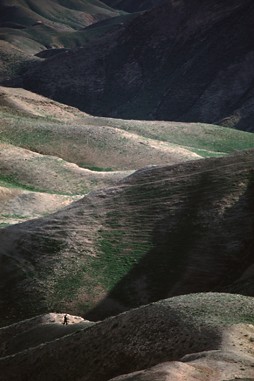
Nebi Musa
Near Ariha (Jericho)
A lone shepherd - Nebi Musa
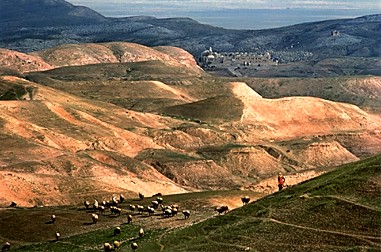
Nebi Musa
According to the traditions of Islam, Nebi Musa is the burial site for Moses; it is a holy place. The Torah says that Moses died without entering the Land of Canaan and that no one knows the place of his burial, but according to the Muslims his body was carried across the river to be buried here in the "Promised Land." Judaism, Christianity, and Islam have all at one time or another considered themselves to be the legitimate heir to a promise given by God to Moses. In The Bible, the promise of the land was never merely a deed of property given to a favorite tribe but a conditional contract with the promise of expulsion from the land in the event of misbehavior. Over the last three thousand years, there have been repeated occasions when new religious factions, seeing decadence around them, read again old texts and decided that the promise could apply to them if they upheld the laws. By this time we have many groups who believe themselves to be at home here, in the promised land.
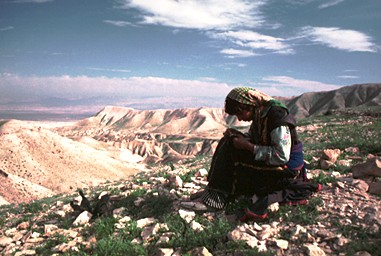
A young woman sewing - Nebi Musa
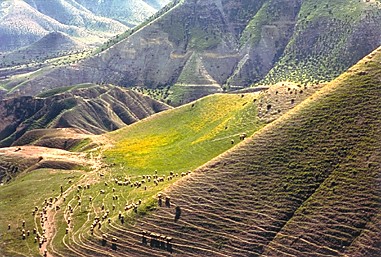
Sheep trails - Nebi Musa
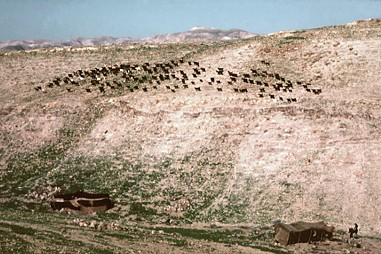
A flock of sheep at morning - Nebi Musa
Jericho is one of the oldest towns of which we have archeological evidence. Sheep have been herded on these slopes for at least five thousand years. This is the area near Jericho known as "the wilderness," where Jesus is said to have wandered for forty days and nights. One would assume he did this during the winter when brief rains turn all but south facing slopes of the hills green, and the weather is mild. In that season, such a wander is a delight -- not a great ordeal.
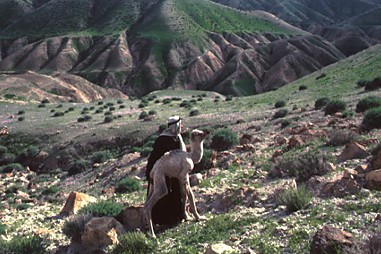
A baby camel - Nebi Musa
The photographer writes: "One morning near Nebi Musa I was shooting near a deep escarpment when a large camel began pestering me. She became so persistent that I went over the edge and clung to the steep slope for a few minutes until she went away. Camels have a hard time with very steep places. This was unusual, for despite their reputations, I have rarely found camels to be aggressive toward me.
Some time later I was in the same general area when I heard a sheep bleating somewhere far below. Sheep are like Japanese tourists; they almost never occur alone but travel in flocks. Then I spotted it and had a look with my longest lens. On closer inspection it was not a sheep but a baby camel. Then I began to understand the behavior of the adult camel earlier in the morning. I climbed down the cliff and found that this was a new born with its umbilical cord still bloody. It was a bit banged up, but it was very much alive, and nothing seemed broken.
I set off across the hills looking for its likely owner, but I tired after a time and lay down in the middle of nowhere and took a nap. When I awoke there were sheep all about and one puzzled shepherd standing over me. As soon as I jumped up and explained as best I could about the baby camel, the shepherd began calling with amazing volume for someone else whom he said was the concerned owner. After fifteen or twenty minutes the owner of the camel appeared, thrilled to find out what had become of the baby camel. He had noticed that the mother was no longer huge, but he had searched in vain for a body, and she had no baby with her.
When my new friend and I reached the precipace from which the baby camel could be seen, it became obvious that my eyes were better than those of this shepherd, and he had to take my word that the camel was in fact way down there. He practically ran down the slope, and soon we had the creature on its feet. I insisted on a picture, though I only had time for one quick one. "
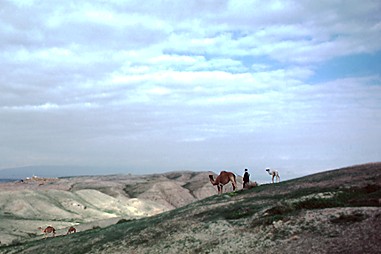
Camel - Nebi Musa
The photographer continues: "The camel's owner was not much larger than I was. I probably weighed about one hundred and twenty pounds at the time. For the two of us a baby camel was a handfull, and when he said that we were going to carry the thing back up to the top of the cliff, I said that he was joking. In the end we did it, and he gave me not a moments rest all the way to the top. I have never before or since felt my heart pound like that, fast and hard, thud, thud, thud, thud.... Then a strange thing happened. I got over it very quickly. At a high altitude one gets out of breath rather easily, but here we were well below sea level, and in that thick air I was back to normal in a short time. "