The Rock River flows fast and free between Hononegah Forest Preserve
and Roscoe, fueled by the Pecatonica River and Rockton Millrace which dump
into it upstream, not yet impeded by the pool above the dam in downtown
Rockford.
People living near the river depict both suburbia and tradition. Most
houses on the hill are dry and modern.
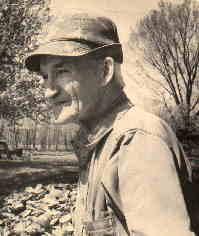
Don Keister, 71, a wiry man with a whiskered face always ready to break
into a natural smile, lives in a home tucked against the base of the hill.
Water laps against the foundation every spring. Three years ago the water
was five feet deep in the basement.
For his neighbors, fishing is a warm weather sport and the river is
for recreation when the sun is shining. Their boats are colorful fiberglass.
For Don Keister, better known in these parts as "Catfish,"
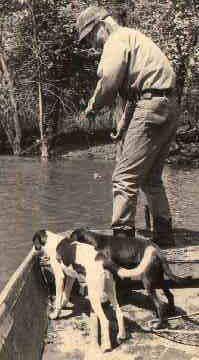
fishing is a way of life and the river is a life-support system. His flat-bottomed
wood boat is heavy, nearly waterlogged.
Keister has lived here 40 years. He retired from Gunite Foundry in Rockford
after 22 years as a core maker. His parents used to live in a small house
up the hill, but after they died he sold it to pay back taxes and medical
bills.
He lives alone now with the river, a garden and seven dogs that chase
butterflies, ride in his boat and bark at visitors. Above the garden a
homemade flag flies, identifying the place as the "Don Keister Dog
and Fish Ranch."
Keister earned the nickname "Catfish" from his friends, because
he catches so many channel cats. He runs three trot lines on the river,
checking them every two or three hours when fish are biting, running them
just twice a day when they aren't.
Standing on the front seat of the boat, he pulls the lines across. "I've
fallen in so many times the river can't drown me," he said.
He checks the lines for the last time just before dusk, then usually
heads for the Rockton Inn for beer or brandy and a few games of pool. One
night recently, he said, "the balls went in like they had eyes on
'em." On those nights his friends forget he's a river fisherman and
call him "The Roscoe Hustler."
His needs are few. Generally they are taken care of by monthly pension
and Social Security checks, supplemented by selling catfish and smoked
carp.
There was a time when button manufacturers bought mussel shells, but
now the shells are in a large pile on the bank because plastic has taken
over the button market.
Some of the shells are placed in mud to provide firm footing, others
are used under gravel on his driveway and last summer two men who make
jewelry picked up two gunny-sacks full of the shells from the fresh water
clams.
The clam meat is used for bait on trot lines. "I sold a quart jar
full of clams to Bill Goodsell for bait and forgot to tell him to punch
holes in the lid," Catfish said. "It exploded when he was fishin'
in the hot sun and they got rotten clams all over them."
Keister gathers clams with a clam rake. Last year he lost a rake, a
tool box and a tackle box when the flooding river ripped his boat from
a tree it was tied to.
"It (the boat) must have turned over several times but the motor
was still on it when I found it in a bottomland field near the Roscoe bridge,"
he said.
High water can be beneficial as well as destructive. Keister is re-building
a shell of a boat he pulled from the river. A picnic table in his yard
came from somewhere upriver. In April he thought he had hit the jackpot:
a like-new aluminum boat full of good fishing tackle caught on one of his
lines.
It was windy and cold that day but he managed to drag the boat to shore.
He locked it up - knowing that it would be his if the owner didn't claim
it for 30 days - and put the tackle in his car for safekeeping. But he
kept a long-handled dip net; he didn't think it would hurt for him to use
the net until the owner claimed the boat.
Three weeks later the owner arrived with the police. He took his boat
and tackle without thanking Keister. Neither did he say anything when Keister
told him what happened to the dip net.
The net had been in Keister's boat three days before, tied up under
the Rockton bridge while he shopped for a chain saw blade and groceries.
When he came back the boat was gone - and not by accident.
Catfish recovered his boat later. Two holes had been punched in the
bottom, which he was able to plug, but his motor, the "borrowed"
net and his tackle box were gone. He could not replace those because the
chain saw blade and a new fuel pump for his car had taken more money than
he had planned.
For the next week, Catfish couldn't fish until a friend loaned him a
boat motor.
However, during that week while he couldn't fish, his car's engine caught
fire as he pulled away from a Rockton service station. Attendants put out
the fire and pushed the car into the station's lot. Keister has new ignition
wires to put on the car but no way to get it home to work on it. It will
sit at the station until his checks come the first of June.
Through all of this, Catfish remains philosophical and optimistic.
"The big companies cover their losses by passing it on to consumers,"
he said, "so I guess I'll just have to do the same and raise the price
of fish."