 |
Birzeit's Student Council 1999 Election  |
|||||||||||||
| . | The Debate
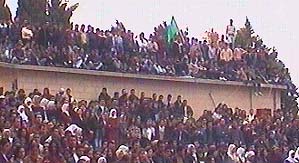
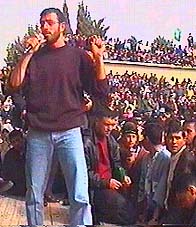
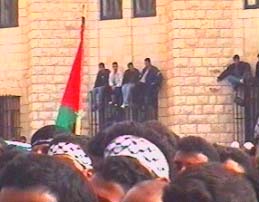
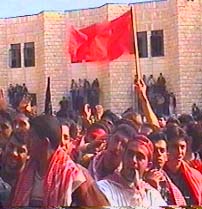
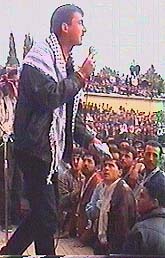
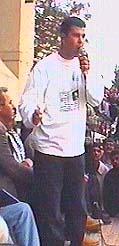
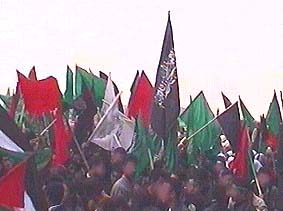
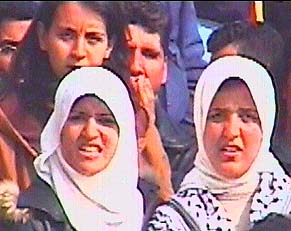
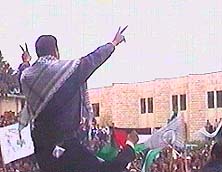
On Tuesday 23 March, 1999, Birzeit University cancelled lectures and classes to listen to the election debate. Thousands of students gathered in front of the stage, hung out of windows and sat on top of buildings to watch the debate between the four student blocs. The debate was opened by Ziad Izzat, Director of Student Affairs, who welcomed everyone and explained that the debate would start with an introduction from each of the blocs, followed by each representative taking two minutes to answer questions posed by members of the Elections Preparatory Committee.
The Change Bloc began the debate by introducing themselves as a bloc that aimed to unify the student movement. They explained that they believed the student movement needed to be independent if the student movement was to succeed. "We are proud to say that we are an independent bloc. We were formed three years ago because we felt that the university was infected by a routinism, the reality which we are living in assumes that students are mindless and obedient. We, the students of Birzeit, are the conscience of our society and the basis for defending Palestine. We should assume our role so that we can declare our independent state based on a common vision, the common effort of the various streams and our common belief in the right of return of refugees."
Change were followed by the Islamic coalition, An Nahdah bloc, who began by reading a verse from the Koran. They dedicated this verse in memory of martyrs of the Palestinian struggle. Nahdah portrayed their bloc as the bloc of martyrs and prisoners, "The roots of my bloc were fed by martyrs and Iyad Habib [1998-99 student council president who has been detained by the Israeli military since 26 January] is the fruit of its branches.", said the An Nahdah speaker.
The Democratic Student Pole began by presenting a framed picture of a jigsaw map of Palestine, their election symbol, to each member of the Preparatory Committee and the other blocs. The Pole described their bloc as an alternative to what they see as the dominant streams within Palestinian society, the Palestinian Authority and the Islamic bloc. "We formed as an alternative to the current reality, we believe we are the nucleus of a critical and active opposition" The Pole member also reiterated their campaign focus of Palestinian identity and the need to prevent its continuing dismantlement.
The Jerusalem bloc began their introduction by responding to claims by other blocs that they were the party of the Palestinian Authority. They urged the Palestinian Authority to release Ghassan Adassi [a Birzeit student imprisoned by the PA since 29 March 1998]. "We salute the martyrs of Palestine, we salute the prisoners in the jails of occupation, we carry the name of Jerusalem as our capital both present and future. In the land of the holy prophets and the cradle of Jesus, we seek an independent state where the rule of law prevails and individual rights are respected and where there is freedom of speech and not the state of the security forces, the state security courts, political arrests and limitation of freedoms."
Following the introductions, members of the Election Preparatory Committee asked questions to which each of the blocs were given two minutes to respond. Question 1 "There are now negotiations taking place with students from universities throughout Palestine to create a unified list of student needs and demands. What is your bloc's opinion about this." The Change Bloc responded that they had no objection to such a unified list, but on the condition that it must be written by the students themselves, without interference from political forces outside the university, and that such a list should reflect the individual needs of each university. The Democratic Student Pole also agreed with the creation of such a list, but emphasized the need to reflect the needs of all the universities and colleges in the West Bank. In addition to answering this question, the representative attacked the Jerusalem Bloc's stance on political arrests and interference in student politics by outside political forces. The Jerusalem Bloc responded to the attacks by stating that they are not affiliated with outside political forces, but should be viewed solely on their student politics. They agreed with the idea of a unified list of student demands, but asked of their colleagues in An Nahdah Bloc if they agreed that such a system would be possible in universities in the Gaza Strip which are pro-Islamic. An Nahdah Bloc did not directly answer the question, but addressed the issue of a unified student list by asking the Jerusalem Bloc if such an idea would be possible in universities in Gaza which are pro-Fateh. The student representative also accused the Jerusalem Bloc of being run by outside political forces.
Questions #2"You are all running to represent the new student council. What will your student bloc do to improve the academic and student life on campus?" The Jerusalem Bloc candidate stated that he had wished that the debate would focus more on student issues, rather than political issues, which would bring greater benefits to students. He then addressed the accusations by both the Democratic Student Pole and An Nahdah blocs concerning political influences, stating that they were always being accused by the other blocs of not struggling for Palestine on the same level, but that they suffered in their struggle as much as everyone else.
An Nahdah bloc candidate responded by offering examples of activities they held the past year as head of the student council, including a computer week, Palestinian prisoner's week, Student Guidance day, a graduation party, Palestine Week, Jerusalem and Identity week, as well as making a yearly agenda book for students. He then attacked the Jerusalem Bloc, asking "What did your last student council president do in comparison?". He also promised that if they were elected to head this year's student council, it would be a very active year. "My brothers in all the student blocs, I want you to give me your united hands so that we can together achieve our goals," stated the candidate, "and all can participate with whatever skills they have to fight against the occupation". The Democratic Student Pole candidate stated, "Firstly, in regards to academic programs, I will not go into detail about what we plan to do, but I will give you an example of what we have done. We organized a week devoted to academic problems faced by students to discuss a number of issues, and sent our recommendations to the administration to be studied and taken into consideration." Addressing both the Jerusalem and An Nahdah bloc, the candidate asked why they were only focusing on fighting against each other and ignoring the activities of other student blocs. The Change Bloc again emphasized the need for independence, "Historically Birzeit has been a liberal place where the student blocs have interacted on the basis of their concerns and interests. Historically the blocs have pursued policies somewhat independent of outside political forces. We need to continue this tradition if we are to play our role as the vanguard of the Palestinian people and the Change bloc is the continuation of that tradition."
Question 3: "Birzeit University is known for its democratic values as an institution and being a place where differences of opinions were respected and freely expressed. What is your bloc's opinion regarding this statement? " An Nahdah candidate stated, "Thank God that all the student blocs at Birzeit University understand this and accept this". But again, he stressed the need to be free of outside interference on campus from outside political forces. He questioned the idea of democracy held by the Jerusalem Bloc. He stated that Birzeit was the 'university of martyrs' and that he respected all of Palestine's martyrs regardless of which political faction. "We consider ourselves the representatives of their sacrifice," he continued. "An Nahdah promises all students that if elected, we will continue to offer the student council as a place where all different opinions can meet, and will keep the doors open for all students who wish to state their opinions or criticisms." "We in the Democratic Student Pole," stated the Qutob candidate, " support the idea of respecting all others opinion, and urge the other student blocs on campus to do the same. We are always the first to keep Birzeit University as an oasis of democracy, and today is evidence of this democratic feature at Birzeit." The candidate then went on to attack the Jerusalem Bloc's concept of democracy and asked the Islamic bloc, "What do you think about the opinions of others as Islamicists? Do you think that there is a place for the others in your strategy, or policy, or are you just using this to gain legitimacy?" The Jerusalem Bloc responded to the attacks on their independence by pointing out that parties of the left were also represented in the Palestinian Authority and even held ministerial positions. They then reiterated their support for democracy and respect of pluralism. The Change bloc stated, "All the blocs claim they are independent but we are really the only independent force at the university. We were formed in this tradition and we have stuck to it. In brief the independence of the student movement is the demand and it's the way for unification and for being effective and the message of Change."
Question 4: "Why don't the students themselves form the preparatory committee to follow up the elections?" The An Nahdah representative didn't answer the question directly but instead defended their record on freedom of opinion "We are with pluralism in the student council that's why we didn't mind the Democratic pole and Jerusalem Bloc alongside us in the council under our leadership. Once again we state that we don't mind that the council is constituted from even representatives of the Change bloc - why not?". The bloc representative also referred to a coalition between the left and the Jerusalem Bloc representatives at Hebron University during the recent elections (election results from Hebron University were announced yesterday with the Islamic Bloc winning all seats in the Student Council).
The Pole responded by saying they are not against raising this issue for discussion but were still concerned that the committee would not be representative of students because of interference by outside bodies in the affairs of the Jerusalem Bloc. The Pole also said they were independent from left forces outside the university and presented leaflets they had issued which condemned the participation of left parties in the Palestinian Authority. The Jerusalem Bloc stated, "If the other blocs are genuinely opposed to the role of the security forces then it's us and you together against their practices. We fight alongside you for the abolishment of excessive practices of the security forces. Concerning the role of the student council, we've always called for national unity and the best proof of that is the quota system which we pioneered."
Change responded, "Once again only two minutes are devoted to the answer but the answer should be more than yes or no as regards the ability of the student movement to form a preparatory committee for the elections independent from the university. If the student movement at Birzeit were able to hold our elections without the help of another committee that would be good but it is not a necessity. The precondition for this is the independence of the student movement." |



Reported and Presented by Birzeit
99 Elections Team.
Contact: webmaster@birzeit.edu