 BIRZEIT UNIVERSITY STUDENT COUNCIL BIRZEIT UNIVERSITY STUDENT COUNCIL Election 98: Commentary |
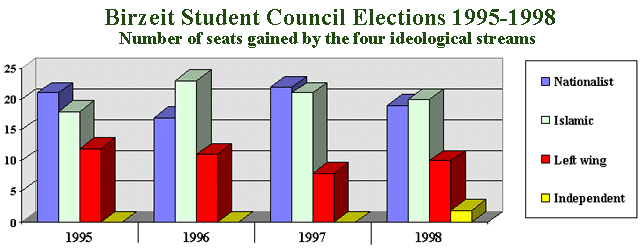
IntroductionFor the last four years, almost all media reporting of the Birzeit University student council elections has claimed that either the Islamic or nationalist movements at Birzeit have "won". In reality, no bloc in the last four years has aquired the necessary majority of 26 out of 51 seats to form a homogenous political cabinet. The above chart depicts the number of seats won by the various student blocs during the last four years, separated into ideological trends. 1995 was chosen as the beginning of the study simply because it was the first year of the council's new proportional representation electoral system. Prior to 1995, the elections operated on a 'first past the post' principle. Overall trendsThe race has generally been between the nationalist and Islamic streams, closely tied with local developments. In the first two years studied - 1995 and 1996 - there were no significant changes in left wing support. After forming a single left-wing coalition in 1997, support for the left-wing stream initially dropped but has been increasing steadily back to its former level. To some extent, the gaining of seats by the independent stream in 1998 can be seen as a new development in campus politics. Contrary to media reports, the last three years have seen a gradual decline in support for the Islamic stream. Turnout has hovered around 85-86 percent over the period, with the exception of the 1996 elections, which showed a turnout of 79 percent. The commentary offers some context for this hiccup in the trend. Legend'Nationalist' refers to the Shabiba Bloc, the Birzeit manifestation of the youth wing of Fatah, which has gone under a variety of names over the last four years: Jerusalem Bloc (1995, 1997-98) and Jerusalem and Return Bloc (1996). This use of the term 'Nationalist' is for convenience of this analysis only and is not intended to imply that other blocs do not have a nationalist political componant. 'Islamic' refers to a combination of the Islamic Bloc (which ran in all years, 1995-98) and the Bloc of the Martyr Fathi Shiqaqi (which only ran in 1997 and 1998). It is not accurate, as many journalists have done to equate the Islamic Bloc with "Hamas". 'Left-wing' refers to a combination of three left-wing student blocs, which formed a single coalition for the 1997 and 1998 elections known as the Progressive Democratic Student Pole. In the 1998 elections, the coalition became known simply as the Democratic Student Pole. Prior to 1997, the blocs ran as the Homeland and Progressive Bloc (Popular Front Bloc when not running in elections), the Progressive Student Union Bloc (pro-Palestine People's Party), and the Student Unity Bloc (pro-Democratic Front for the Liberation of Palestine). The Student Unity Bloc ran in 1995 under the banner the Progress and Democracy Bloc. 'Independent' refers to the independent students and student blocs that have run in student elections for the last four years. 1995 saw an independent student Nadir Christo, and the Independence Bloc (pro-FIDA, the Palestinian Democratic Union) running. 1996 saw another independent student Maher Odeh running. 1997 saw a new party, the Change Bloc running which, in 1998, sucessfully took two seats. ThemesOver the last four years, since the new electoral system was instituted, the elections have run under a series of themes: "A Model for Palestinian Democracy" (1995), "The Palestinian Democratic Tradition Continues..." (1996), "The Democratic Tradition Continues..." (1997) and "Towards a Democratic Future" (1998). These stem from the belief that the university's elections, recognised as being extremely transparent and fair, serve as a positive example of democracy to the wider Palestinian society outside the campus. |
CommentaryTaking the 1995 elections as our base point, by 1996 the nationalist stream was concluding a bad year. Despite the end-1995 redeployment from main Palestinian towns and cities, the coming of the Palestinian Authority (PA) raised other, more sensitive issues. It was believed on campus that many of the leaders of the nationalist stream were also working for security services in the PA. Prior to the elections on 8 May 1996, in the wake of four unprecedented suicide attacks in Jerusalem and Tel Aviv over a period of 8 days, the PA also arrested a number of students from the Islamic stream and detained them without charge and trial. All were released later that year, the longest remaining in detention for ten-and-a-half months. In addition, Palestinian Police raids on the Islamic University in Gaza and An-Najah University, the latter resulting in the injury of some students, did much to encourage an anti-PA atmosphere on campuses. Also prior to the elections, a student march to Ramallah saw the nationalist stream split in its decision to participate, between those who were pro-PA and those who offered more critical support of the PA. The march ended up in Ramallah with students confronting Palestinian President Yasser Arafat. One 1996 election banner from the Homeland and Democracy Bloc (see legend on left) commemorated the occasion. All of these factors undoubtedly affected the election results and the tense climate seems to have negatively affected the willingness of students to vote. During both the 1995 and 1996 elections, the left-wing stream showed no significant increase or decrease in power and no independents gained any seats. By 1997 the nationalists had recovered somewhat, with new leadership that aggressively declared that it was independent from the Palestinian Authority and who were prepared to criticise it. Following the 1996 September clashes that began in the Ramallah area, when Palestinian police confrontated Israeli soldiers, the PA enjoyed a new level of respect among the population. In addition, the crisis prompted a January redeployment in Hebron. On 29 March 1997, before the elections on 9 April 1997, Birzeit student Abdullah Saleh, associated with the nationalist stream, was shot dead by Israeli soldiers during the clashes over the Har Homa settlement project on Abu Ghnaim mountain. No major arrests of Islamic-oriented students took place during this period. This year also saw the launch of the left-wing coalition, something that took place very close to the elections. The decrease in support for the left-wing, which had previously shown little change over the past two years, was largely attributed to this late announcement. All these factors helped gain a strong victory for the nationalist stream at the expense of the Islamic and left wing streams. No independents were successful. In 1998 the political atmosphere on campus looked in some ways like it did in 1996. Three students remained in Palestinian Authority detention without charge or trial for a prolonged period of time and another, an Islamic Bloc candidate for the elections, was arrested during the election campaign. Restatement of the nationalist stream's argument of separation from the Palestinian Authority was not as powerful as it was two years ago, and the left wing had regained some of the former trust of its supporters having worked on campus for a year in the new coalition format. Whereas most bloc presentations are similar from year to year, the left-wing also attempted a fresh presentation, focusing on the 50th anniverasry of the Palestinian Nakba, or "Catastrophe". The securing of two seats by the independent stream in the elections on 2 April 1998 is a very new development in campus politics. In common with the left-wing stream, the independent's two year running presentation seems to have gained it credibility on campus, the latter stream particularly amongst students who have been disillusioned by the ever-present factional disagreements and stagnant national political situation. To conclude, it seems as though the most significant influence on student council election results at Birzeit is the national political climate, particularly when this manifests in events in the Ramallah-Birzeit area, around the university. This suggests that the university's elections continue to play an important role as a political barometer in the country. |
Election Results: 1998 | 1997 | 1996 | 1995