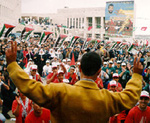
 BIRZEIT UNIVERSITY STUDENT COUNCIL BIRZEIT UNIVERSITY STUDENT COUNCIL Election 98: The Student Blocs in Photos | |
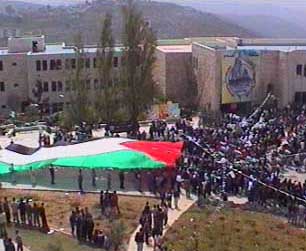 The Jerusalem Bloc ("Kutlet Al-Quds") - At Birzeit, the Shabiba (youth section of Arafat's Fatah party), calls itself the Jerusalem Bloc, a reference to what the bloc and wider Fatah movement considers to be the "main battle" ahead. "Jerusalem," they say, "is the gate to both peace and war." Right, a march takes place as speakers talked about student unity, discussed the role of women in society, and emphasised the bloc's distance from the Palestinian Authority. Visually, their style this year is very similar to last year with a large Palestinian flag carried aloft at the center of the march. The Jerusalem Bloc ("Kutlet Al-Quds") - At Birzeit, the Shabiba (youth section of Arafat's Fatah party), calls itself the Jerusalem Bloc, a reference to what the bloc and wider Fatah movement considers to be the "main battle" ahead. "Jerusalem," they say, "is the gate to both peace and war." Right, a march takes place as speakers talked about student unity, discussed the role of women in society, and emphasised the bloc's distance from the Palestinian Authority. Visually, their style this year is very similar to last year with a large Palestinian flag carried aloft at the center of the march.
| |
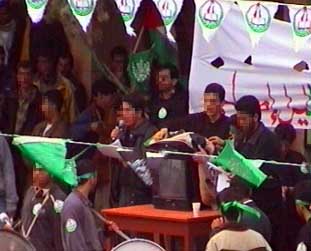 The Islamic Bloc at Birzeit University ("Al-Kutla Al-Islamia fi Jami'at Birzeit") - The Islamic blocs in the various Palestinian universities are actually illegal under Israeli law, the result of a court case in the Hebron area in which secret evidence was presented by a shadowy Israeli security figure that claimed to link them financially to Hamas, evidence curiously unavailable to the lawyer representing those on trial. As a result, this website will only offer altered photos of the candidates faces, in common with the Bloc of the Martyr Fathi Shiqaqi ("Kutlet Ash-Shahid Fathi Shiqaqi"). However, the Islamic Bloc has always maintained its campaign finances are private donations that are open for scrutiny. Although it is true to say that many students in the Islamic Bloc are sympathetic to Hamas, to many students the bloc is seen simply as the mainstream Muslim party on campus. The Islamic Bloc at Birzeit University ("Al-Kutla Al-Islamia fi Jami'at Birzeit") - The Islamic blocs in the various Palestinian universities are actually illegal under Israeli law, the result of a court case in the Hebron area in which secret evidence was presented by a shadowy Israeli security figure that claimed to link them financially to Hamas, evidence curiously unavailable to the lawyer representing those on trial. As a result, this website will only offer altered photos of the candidates faces, in common with the Bloc of the Martyr Fathi Shiqaqi ("Kutlet Ash-Shahid Fathi Shiqaqi"). However, the Islamic Bloc has always maintained its campaign finances are private donations that are open for scrutiny. Although it is true to say that many students in the Islamic Bloc are sympathetic to Hamas, to many students the bloc is seen simply as the mainstream Muslim party on campus.
Islamic bloc speakers highlighted the issue of Palestinian students in Palestinian Authority (PA) jails, the corruption in the PA and, in common with last year, accused the Jerusalem Bloc of corruption. "Our aim is not to win the elections, but just to make the elections a success. Vote not for those with the biggest banners or best campaign. Vote for principles, the bloc that fits you best, and the right group!" said a leaflet on the first day of campaigning. | |
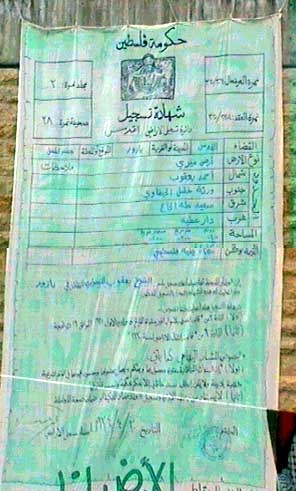 The Progressive Democratic Student Pole ("Al-Qutob At-Tullabi Ad-Dimoqrati At-Taqaddumi") - This year, the Pole worked on a campaign that focused on the 50th Anniversary of Al-Nakba ("The Catastrophe"), the period in 1947-48 when Zionist forces attacked Palestinian villages, condemning their inhabitants to a joyless existence in refugee camps scattered across the Middle East, culminating in the establishment of the State of Israel. The Progressive Democratic Student Pole ("Al-Qutob At-Tullabi Ad-Dimoqrati At-Taqaddumi") - This year, the Pole worked on a campaign that focused on the 50th Anniversary of Al-Nakba ("The Catastrophe"), the period in 1947-48 when Zionist forces attacked Palestinian villages, condemning their inhabitants to a joyless existence in refugee camps scattered across the Middle East, culminating in the establishment of the State of Israel.The Pole banner to the right is an actual land title deed for 4 dunums of land in Jerusalem, that cost the owner 25 Palestinian pounds, and registered on 30 April 1934 by the British Mandate Goverment of Palestine. The Pole speakers presented their fifty-one candidates for the elections and, in an unusual step, had each candidate speak four or five lines about an issue, ranging from student concerns to national political issues. | |
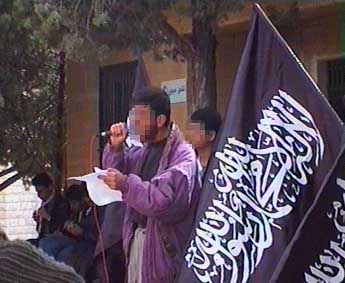 Bloc of the Martyr Fathi Shiqaqi ("Kutlet Ash-Shahid Fathi Shiqaqi") - The Fathi Shiqaqi bloc focused almost entirely on national and political issues, accusing the Palestinian Authority of being collaborators by signing the Oslo agreement, and claiming that its main rival Islamic group on a national level, Hamas, is in a state of disorganisation after the death of Izzadeen Al-Qassam militant Yahya Ayesh. However, the bloc emphasised the unity of all national and Islamic parties in order to confront the result of the agreements with the Israeli government.
"The Palestinian question is an Arab and Islamic problem and the responsibility for its liberation lies on the Islamic and Arabic nations. The Palestinian nation will be on the frontline in leading the struggle," it says in a leaflet. Bloc of the Martyr Fathi Shiqaqi ("Kutlet Ash-Shahid Fathi Shiqaqi") - The Fathi Shiqaqi bloc focused almost entirely on national and political issues, accusing the Palestinian Authority of being collaborators by signing the Oslo agreement, and claiming that its main rival Islamic group on a national level, Hamas, is in a state of disorganisation after the death of Izzadeen Al-Qassam militant Yahya Ayesh. However, the bloc emphasised the unity of all national and Islamic parties in order to confront the result of the agreements with the Israeli government.
"The Palestinian question is an Arab and Islamic problem and the responsibility for its liberation lies on the Islamic and Arabic nations. The Palestinian nation will be on the frontline in leading the struggle," it says in a leaflet.
| |
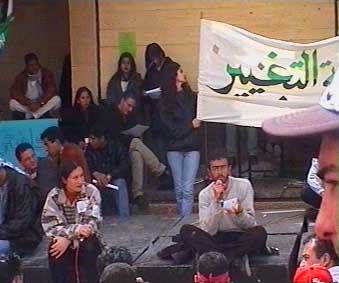 The Changes Bloc ("Qa'imat At-Taghyiir") - The Changes Bloc's position can best be summed up by a quotation from a recent leaflet, "As students representing the youth of Palestine and able to change the future of our nation, our abilities to build and reconstruct should not be determined by following decisions we did not participate in making, but by freedom of thought and by making independent and courageous decisions." The Changes Bloc ("Qa'imat At-Taghyiir") - The Changes Bloc's position can best be summed up by a quotation from a recent leaflet, "As students representing the youth of Palestine and able to change the future of our nation, our abilities to build and reconstruct should not be determined by following decisions we did not participate in making, but by freedom of thought and by making independent and courageous decisions." The Bloc believes that too much time is wasted in student politics by factional infighting and is uncomfortable with the idea that the various student blocs seem to be merely campus versions of the existing national parties, with all the focus on national politics that implies. This does not mean the bloc is not concerned about freedom for the Palestinian homeland, rather that it does not believe the existing factional structure will 'do the job'. Their is campaign is low key and oriented towards convincing students to create a new student reality. | |
|
| |