


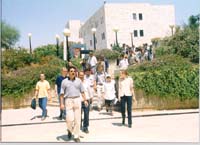
Above: PAS students have many opportunities
to practice their Colloquial Arabic with Birizeit
students both on and outside the campus.
Arabic Courses
Birzeit University has offered courses in Arabic as a Foreign Language (AFL) to non-native speakers for over ten years. The University’s highly qualified professors of AFL have drawn upon their extensive local and international experience to formulate two streams of language courses for the PAS Program: one in Modern Standard Arabic and one in Colloquial Arabic (Jerusalem dialect - Either transliteration or Arabic script is used depending on the knowledge of the majority of students enrolled in a course).
Language placement tests are given at the beginning of the program to ensure that each student is placed at the appropriate level. The levels on offer are according to demand.
ARSK 131 - Modern Standard Arabic I (Fall & Spring - 6 hrs/wk, 3 credits. Summer - 12 hrs/wk, 3 credits) - For students with no previous knowledge of Modern Standard Arabic.
This course is designed for students requiring Arabic for academic purposes. It introduces students to the Arabic script and phonology, and combines training in the four language skills: reading, writing, listening and speaking. Its methodology entails the introduction of basic vocabulary and grammatical structures through oral communication activities, followed by short readings and situational dialogues in which the newly introduced structures are utilized.
Assessment includes:
Course materials:
ARSK 132 - Modern Standard Arabic II (Fall & Spring - 6 hrs/wk, 3 credits. Summer - 12 hrs/wk, 3 credits) - For students who have completed the prerequisite course, ARSK 131, or its equivalent.
Conducted entirely in Arabic, and using a communicative approach, this course continues discussion of the basic structure of the Arabic language. It is designed to develop oral skills, for the purpose of communicating in Arabic with native speakers on familiar topics, and reading and comprehension skills for general texts and select texts on social and economic issues.
Assessment includes:
Course materials:
ARSK 231 - Modern Standard Arabic III (Fall & Spring - 6 hrs/wk, 3 credits. Summer - 12 hrs/wk, 3 credits) - For students who have completed the prerequisite course, ARSK 132, or its equivalent.
This course continues to develop the four language skills by introducing higher level literary and socio-political texts. Students improve their ability to express more abstract ideas and opinions in oral and written forms through the discussion of selected texts, including newspaper articles, and pieces from various literary genres.
Assessment includes:
Course materials:
ARSK 232 - Modern Standard Arabic IV - (Fall & Spring - 6 hrs/wk, 3 credits. Summer - 12 hrs/wk, 3 credits) - For students who have completed the prerequisite course, ARSK 231, or its equivalent.
The focus of this course is media and literary Arabic, using original texts. The course is designed to increase students’ ability to read items related to social, economic, political and cultural life. Texts used as the basis for developing advanced comprehension, discussion, and writing skills include newspaper articles and contemporary Palestinian poetry and prose.
Assessment includes:
Course materials:
ARSK 133 - Colloquial Arabic I - (Fall & Spring - 6 hrs/wk, 3 credits. Summer - 12 hrs/wk, 3 credits) - For students with no previous knowledge of Arabic, or with only a basic knowledge of written Arabic but without any practice in spoken Arabic.
This course is designed to enable students to communicate in Arabic on a basic level in order to deal with situations in everyday life such as introducing oneself and others; requesting and giving information; shopping; talking about food; describing people, things and places; responding to offers; and generally communicating in a courteous manner.
Assessment includes:
Course materials:
ARSK 134 - Colloquial Arabic II (Fall & Spring - 6 hrs/wk, 3 credits. Summer - 12 hrs/wk, 3 credits) - For students with previous knowledge of spoken Arabic, able to conduct conversations described in ARSK 133.
The aim of this course is to develop students’ spoken Arabic skills for everyday situations and courtesy requirements, and promotes discussion skills for more specialized conversations about cultural and social aspects of life. Students’ skills of narration are developed by means of describing past events and daily and routine activities; placing themselves and others in time and space; giving directions; and expressing facts, desires, hopes, obligations, and future plans.
Assessment includes:
Course materials:
Social Science Courses
PAS social science courses are taught by Birzeit University professors who are specialized and have published in the fields on offer. Students are required to: prepare for and participate in class discussions; submit written assignments; and, in select courses, take a final exam. Syllabi are provided at the beginning of each session. All courses are conducted in English. Note: Not all the courses described below are offered every semester. Courses offered are on the basis of demand, need of students and availability of teachers.
SOCI 234 - Palestinian Society - (Spring & Fall - 3 hrs/wk, 3 credits. Summer - 6 hrs/wk, 3 credits)
This course introduces the student to contemporary problems of Palestinian society and its institutions. It deals primarily with Palestinian society in the West Bank and Gaza Strip, adding the perspective of recent historical developments, and the socio-political conditions of Palestinians in neighboring Arab countries and inside Israel. A third of the course deals with the dramatic changes in Palestinian society since the Intifada. The main themes of the course are: changes in the social structure of Palestinian society before and under Israeli rule; the transformation of Palestinian society during the Intifada and after Oslo.
SOCI 233 - Arab Society (Spring & Fall - 3 hrs/wk, 3 credits. Summer - 6hrs/wk, 3 credits.)
This course deals with the main social structures in contemporary society (the family, political systems, class structure) and focuses on instruments and tendencies towards change in these structures. The course studies Arab social reality from the mid-twentieth century until the present and concentrates on the homogeneity and similarities of different Arab societies on the one hand, and the heterogeneity and the crisis that face the society on the other hand. The course also deals with issues such as liberation and its social consequences.
PHIL 234 - Islamic Philosophy (Spring & Fall - 3 hrs./wk. - 3 credits)
This course is an introduction to Islamic philosophy. Emphasis is on the study of the major philosophers such as al-Kindi, al-Farabi, Avicenna, Averroes, and Ghazali, as well as on the major schools of thought, including sufism. Attention will be paid to the pre-philosophical developments, known as Kalam (Islamic Theology). The course will also briefly review philosophical and theological development, after Ibrahim Khaldun (1604).
POLS 333 - The Palestine Question (Spring & Fall - 3 hrs/wk, 3 credits. Summer - 6 hrs/wk, 3 credits)
This course studies the Palestine question from its various dimensions: historical, ideological, national, political, socio-economic, and cultural. It focuses on a number of issues such as: the historical claims to Palestine; the emergence of Zionism and Palestinian nationalism; the British Mandate; the establishment of Israel; developments since 1948; the refugee problem; the rise of Palestinian national movements; the establishment of the PLO and the Palestinian resistance movement after 1967; the evolution of the PLO and the various ideological tendencies; the Intifada; the current Palestinian-Israeli negotiations and the peace process..
GEOG 432 - The Geography of Palestine (Spring & Fall - 3 hrs/wk, 3 credits. Summer - 6 hrs/wk, 3 credits)
This course presents a comprehensive multi-disciplinary regional study of Palestine as a geographic entity, comprising its physical natural setting (geology, relief, climate, water resources and natural vegetation), as well as the cultural landscapes of the country (its history and historical developments, patterns and history of settlements and others). Alongside the theoretical component, the course includes fieldwork in different parts of the country and a 3-4 day excursion (optional, extra cost of approx. $100).
WOMS 232 (Women Studies) - Women in Arab Society (Spring & Fall - 3 hrs/wk, 3 credits. Summer - 6 hrs/wk, 3 credits)
Beginning with an overview of the basic features of contemporary Arab society as they relate to the question of women and gender relations, particular emphasis is placed on the role of women in the family and in production, including participation in the wage labor force. The role of the state in defining the nature and scope of women’s participation in society and their social and economic rights are investigated, as are recent Islamist trends and their focus on the modesty of women and their place in society. Finally, the course examines the history of women’s organized action as it developed within the Arab Nationalist Movement and beyond.
CULS 332 - Modern and Contemporary Arab Thought (Spring & Fall - 3 hrs/wk - 3 credits)
This course deals with the development of modern and contemporary Arab though in the nineteenth and twentieth centuries. It discusses the basic streams of ideology, thought and culture, and concentrates on the interaction between these streams and Arab-Islamic philosophy on the one hand, and the Arab culture/civilization in its different phases on the other. The course also deals with the major challenges that face and have faced the Arab world, such as imperialism and national liberation, the nation-state and pan arabism, the question of democracy, Arabism and Islam, dependency and independence, aspects of Arab-Islamic culture, the minorities, Palestine and the Zionist threat.
ARAB 436 - Modern Palestinian Literature (Spring & Fall - 3 hrs/wk, 3 credits. Summer - 6 hrs/wk, 3 credits)
The various tendencies present in Arab literature in the twentieth century are defined, followed by an examination of the evolution toward the development of specific content in Palestinian literature. For this purpose, literary types and techniques are closely examined, placing them in relation to the political, social and cultural evolution of the Arab east in general and Syria and Palestine in particular. Emphasis is then placed on the period following the Second World War, with a detailed study of the works of several leading Palestinian literary figures such as Ibrahim Tuqan, Ghassan Kanafani, Mahmoud Darwish, Emile Habibi and others. Finally, present tendencies in Palestinian literature are analyzed with respect to their evolution under the joint pressure of ideas and events
POLS 438/1 - The Arab-Israeli Conflict (Spring & Fall - 3 hrs/wk, 3 credits. Summer - 6 hrs/wk, 3 credits)
This course focuses on the root causes of the Arab-Israeli conflict and the evolution of this conflict including: the Arab-Israeli wars; the role of external powers; the evolving Arab and Israeli perceptions of the conflict; and various attempts made to resolve it. Attention in this regard is focused on peace plans and initiatives that were devised by local, regional and international parties to manage the conflict and consequently to resolve it. The current Arab-Israeli peace process is approached in light of previous peace efforts. A comparative approach to the study of current negotiations will indicate why and how this current attempt is different from the previous ones and whether it has better prospects for success.
ENGL 438 - Seminar in Literature : The Image of Palestine in Western Travel Writing (Spring 1999 - 3 hrs/wk - 3 credits)
The course exposes students to a crucial but little studied aspect of western literature: travel to Palestine and the "Middle East". In addition to selected readings from the Renaissance to the present, lectures and discussion provide the background to perceptions about the region as shaped by historical, political. cultural and religious influences -- especially in relation to the present situation. A major paper (required from students taking the course for credit) involves either academic research about travel of fiction or a partial project about local institutions and sites.
Note: This class has an enrollement cap of 15 students, and priority will be given to Literature majors who are required to take this course to complete their graduation requirements.
The PAS Program parallels the academic calendar of Birzeit University, which consists of two longer semesters and a shorter, more intensive Summer Semester. PAS students can begin at the start of any semester and can choose up to four courses each semester, or two in summer. Students can select any course combination suitable for their individual and academic needs.
All courses offered in the PAS Program are part of the University’s undergraduate program and credits are normally recognized by institutions of higher learning abroad. At the successful completion of courses, students may request official transcripts indicating the courses taken, credits earned and grades received. Students planning to transfer credits earned at Birzeit to their home institutions should inform their home university of their plan prior to departure.
In addition to class work, Birzeit University organizes an optional extra-curricular program to enable students to understand the area better by personally experiencing its cultural, political and economic realities, and through discussions with experts in the various fields. The PAS Lecture Series covers a variety of topics presented by Birzeit professors and local specialists.
Students wishing to undertake voluntary work at the University during their free time, particularly on the University website, are welcomed.
Events including trips to Palestinian towns, villages and refugee camps; hiking and climbing excursions; and theatrical and musical performances are arranged by the University.
Students pay for food and transportation and/or entry fees for all extra-curricular activities.
Next Section: Application and Admission Requirements
Contact the PAS Program by e-mail on pas-isp@admin.birzeit.edu