



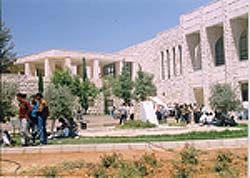
Birzeit University is an independent Palestinian institution of higher learning located in Birzeit, a small town about 26 kilometers north of Jerusalem in the West Bank. It was founded in 1924 as a small school to provide much needed educational opportunities for the boys and girls of Birzeit and the neighboring villages. By 1961, the school had developed into Birzeit College, granting an Associate in Arts and an Associate in Science degrees. After the June 1967 war and the military occupation of the West Bank and the Gaza Strip, the College saw the pressing need for establishing an Arab university in the area and announced, in 1972, the development of a four-year program leading to Bachelors’ degrees in both Arts and Sciences. In 1975, the name of the college was officially changed to Birzeit University.
Birzeit University is governed by an autonomous Board of Trustees composed of educators and professionals from the Palestinian community, and is a member of the Association of Arab Universities.
At present it consists of four faculties, - Arts, Commerce and Economics, Science and Engineering - all of which grant Bachelors’ degrees. In 1995, Birzeit University also offered its first graduate programs, in International Relations and Education, awarding MA degrees.
During the past decade, enrollment has increased from a few hundred to 3,500 students. The student body comes from all regions of the West Bank and the Gaza Strip. A new campus, opened in 1980, accommodates the increasing needs of the University.
Birzeit University is guided by the principles of academic freedom and upholds independence of thought, promoting academic excellence and a cooperative spirit. It strives to prepare young men and women of the country for responsible and useful leadership and citizenship in the community and has continued to do so during times of extraordinary circumstances.
Since the military occupation of the West Bank and Gaza by Israel in 1967, the University has been subjected to frequent harassment and acts in violation of international conventions of human rights. These have included the shooting and killing of students, administrative detention and deportations of students and staff, restrictions on receiving books and periodicals, and frequent military- ordered closures. The longest period of closure started shortly after the beginning of the Palestinian uprising (Intifada) in December 1987, when the University was closed by military order without any explanation for more than four years.
The University challenged this prolonged closure, which threatened the very survival of the University as such, by operating according to make-shift arrangements and holding classes in student and faculty homes and rented premises outside the University campus. Although this could never replace formal classes on the campus, where the library, laboratories and other facilities are available, the University clung to its academic standards and graduated students, albeit with a lot of effort and at great cost.
Following its reopening in May 1992, Birzeit University continued to function as Palestine’s premier institution for higher learning, opening new research units such as the Insititute for Community and Public Health, the Women's Studies Center, The Media Center and the Graduate Studies Program. These joined the existing Institute for Palestinian Archaeology, the Center for the Study and Documentation of Palestinian Society, the Center for Environmental and Occupational Health Science, the Continuing Education Department, and the Engineering Center for Planning and Design in carrying out some of the most distinguished research in the region.
The University has academic relations with a number of universities abroad for the purpose of joint research, guest lectures, and faculty and student exchanges. Among these universities are:
The University of Amsterdam, Delft University of Technology (Netherlands); The University of Paris VII, Montpelier III (France); Indiana University at Bloomington, Villanova University (USA); University of Durham (UK); University of Bremen (Germany); Carleton University (Canada); University of Copenhagen (Denmark); Free University of Brussels, Catholic University of Louvain (Belgium); Umea University (Sweden); and Macquarie University (Australia).
In addition, Birzeit University is linked to more than a dozen European universities through the multilateral PEACE (Palestinian-European Academic Cooperation in Education) program. Students of the above universities may check with their institutions for details of existing exchange agreements with Birzeit University.
Next section: The Palestine and Arabic Studies Program
Contact the PAS Program by e-mail on pas-isp@admin.birzeit.edu