The legal status quo in the West Bank and Gaza is a nightmare of labyrinthine proportions. The West Bank still follows elements of Jordanian law, Gaza following parts of the pre-existing British Mandate legislation. On top of these, there are old, mostly land-orientated laws from the Ottoman Empire; rulings from Islamic shariah courts; the demands of international human rights covenants to which Israel is a signatory that have a bearing on its treatment of Palestinians in the territories; and a multitude of Israeli Military Orders. The maze is further complicated by existing legislation from the Palestinian National Council, the decision-making body of the PLO, that apply to Palestinians both in the Diaspora and in Palestine.
In this complicated legal arena there are significant problems: an absence of Palestinian legislation; the seizure of legislative activity and administration by the Israeli military government; accompanying fetters on the normal activities of the judges and lawyers in the Palestinian courts; three separate bar associations, insufficient control over access to the profession; and an absence of an adequate environment for the training of lawyers and judges.
On Thursday, April 27th, 1995, the Law Centre at Birzeit University was officially opened, after long consultation with a large number of Palestinian jurists, in the light of the situation of the ongoing political process. Birzeit University defined two main objectives for the Law Centre: to contribute to the rehabilitation of the legal professions, and to contribute to the preparatory effort for the Palestinian legislative process.
These goals were officially approved by the Birzeit Board of Trustees on May 6th, 1994 after much work by four members of Birzeit's faculty and administration: then Vice-President Gabi Baramki, who initiated the project; Mr. Raja Shehadeh, who was very much involved in its conceptualisation; Mr. Ghassan Faramand, who organised the start of the Centre's activities; and Mr. Camille Mansour, director of the Centre and professor of political science at the University of Paris on secondment to Birzeit University.
Mansour stated at the opening that, "The work of the Centre has no meaning if it is not in the service of the entire Palestinian society and its structures." The Law Centre is supported by the Palestinian legal community, both individuals and the three Bar associations, and has an advisory council made up of Palestinian jurists from Gaza, the West Bank and Jordan, who have also worked hard for the establishment of the Centre. Mansour further commented:
"The wisdom of Birzeit has been to think about the duties of the university in the legal field without any preconceived ideas. Birzeit has historically based its decisions on the needs of Palestinian society. Instead of deciding to create a prestigious yet premature institution such as a law school, Birzeit has questioned the Palestinian community about its most urgent needs that it could and should fulfill."
The Law Centre will provide an opportunity for training, research, teaching and documentation for Palestinian civil servants, legal professionals, jurists, academics, educators and students. The Centre represents, in the words of President Hanna Nasir, "part of a larger common project, that of building a democratic society, independent nation and productive and prosperous economy in Palestine. The Law Centre has an important mission in this critical period."
In the months and years ahead, the Palestinian Authority will have to face the challenge of passing legislation with the view of unifying, slowly but surely, the law in force in the West Bank and in Gaza. Regardless of the progress of the peace process, it is vital that the Palestinian people prepare for the coming responsibilities of statehood, making the existing legal labyrinth more equitable by revoking or amending the Israeli Military Orders which discriminate and adopting laws guaranteeing human rights, and modernising existing laws through codification in line with the changing conditions in Palestine and the world.
The Law Centre will also contain a library and associated computer-indexed documentation centre, as a depository and an observatory of past and current Palestinian legislative and judicial activities. The need for the library in particular is great as there is currently no adequate library in the occupied territories. As an April 25th Law Centre information sheet points out, "Some individual libraries maintained by practicing lawyers are even better than institutional ones."
The Centre launched its Law Library Campaign in late 1994, asking for local, regional and international legal reference books, statutes and law reports. With generous donations from the families of the late lawyers Shafik El-Assal, Jamil Shalhoub and Hatem Abdul-Hadi, a good portion of the primary Palestinian legal sources are now available. The French Consulate, USAID, the British Council and the Belgian Consulate have also assisted with reference materials on Comparative Law. The Centre aims to collect 12,000 volumes in two years.
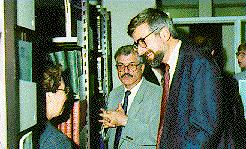
Left: Director Camile Mansour (centre) discusses the Law Centre's work with the Consul-General of France (right), Mr. Jean de Gliniasty, in the Centre's library. Photo by Yasser Darweesh.
The Law Centre was initially made possible by financial support
from the Ford Foundation and institutional support from UNRWA.
The construction of a new building to house the Centre and furnishing
of a temporary Centre has been enabled by the sustained support
and funding of the French Government. At the April 27th opening,
Dr. Nasir emphasised that, "This support is not simply a
matter of a financial donation; it represents the efforts and
commitment of individuals and the strong relations of cooperation
built by these individuals over the years." Both the Consul-General
of France, Mr. Jean de Gliniasty, and the Cultural Attaché,
Mr. Alain Bockel, were present at the opening.
The training component of the Centre's work has progressed rapidly since its work began in 1993. Many seminars have already taken place with topics covering: Administrative Law, The Legal and Institutional Conditions for Economic Activity, The Legal System in the West Bank between 1948 and 1967, The Palestinian Drafts for the Electoral System, Humanitarian International Law, and The System of Co-ownership. These have included the participation of lawyers, judges, high-ranking government officials, businessmen, and representatives from political organisations. A two-day conference was held in Gaza on April 28th, entitled What Legal System for Palestine? and another was held in June on Labour Law. Two are planned for 1996, entitled International Contract and Investment Law.
The research component is proceeding with the projects covering Judicial Organisation in Palestine, Labour Law, Childrens Rights, Banking Law, Administrative Law, and Zoning and Planning Law. The Centre has given priority to creating an inventory of the law presently in force in the West Bank and Gaza, focusing on one area of the law after another and systematically compiling the relevant texts. These areas of research have been contracted to Palestinian jurists, political scientists, sociologists and educators.
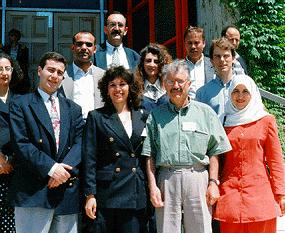
Right: THE LAW CENTRE STAFF. Front row, from left: Ruba El-Shuaibi (researcher), Haitham El-Zu'bi (researcher), Randa Mina (administrative assistant), Camille Mansour (director), Manal El-Ju'beh (research assistant). Back row, from left: Jamal El-Sousi (Gaza representative), Ghassan Faramand (deputy director), Genia Helou (conferences coordinator), Ihab Abu Ghosh (researcher), John MacFarlane (documentation assistant). Photo by Khaled Al-Naji.
With 11 staff employed by the Centre at the moment, including
a director, deputy-director, administrative assistant, librarian,
seminar coordinator, three research assistants, a system analyst,
a coordinator for the Centres activities in Gaza and an information
and documentation assistant sent by Canadian NGO OCSD/Oxfam-Qubec,
one might be tempted to think the Centre was over-resourced. Director
Camille Mansour addressed this issue at the Centre's opening,
pointing out that, "despite the rapid growth in the Centre's
personnel, both what there is to do and what is possible to do
have already largely exceeded the capacities of the Centre."
With a teaching component in the Centre's future, servicing both existing faculties with law courses and with the possible creation of an MA programme in Legal Studies, the Centre has a positive future for Palestinian education itself, as well as society at large. Dr. Hanna Nasir concluded at the opening:
"The development of law and of impartial and professional legal institutions is vital to all aspects of this project. The Law Centre, I believe, has significant contributions to make, as its activities to date already attest. For grand aims are not fulfilled simply by resolution; they are fulfilled through detailed work, careful planning, and integrated projects, conducted by able professionals and supported by adequate infrastructure. None of these activities or facilities would have been possible without the substantial assistance from our international colleagues and the human resources of our faculty and staff. The Birzeit University Law Centre is at the beginning of an exciting and productive process; I invite you to accompany us on our journey."
For more information about the Law Centre or Law Library Campaign, please write to:
Mr. Camille Mansour, Director, Birzeit University Law Centre, P.O. Box 14, Birzeit, West Bank, Palestine.
Tel: +972-2-998-2135 Fax: +972-2-998-2137 E-mail: law@birzeit.edu