Since the beginning of the 1994/95 academic year, the Public Relations Office at Birzeit has noted that over 5,368 visitors have been received by the university.
The office has receieved many groups from Europe and North America, usually providing a campus tour with an introduction to the history and unique nature of the university. Some groups, who represent a particular interest, require special meetings to be set up tailored to their needs. Two groups of Dutch journalism students have this year met with Walid Batrawi, who is a student at the university while also working with the British Broadcasting Corporation, for an introduction to the situation of Palestinian journalists.
This year, many local schools have come on visits to the university, accounting for around half of the total numbers of visitors. The university also regularly holds conferences and exhibitions that draw many visitors.
Since Norway's role in the September 1993 Oslo agreement between the Palestinian Liberation Organisation and Israel, the door has opened to new cooperation between Palestinian educational institutions and their Norwegian counterparts. In late May 1994, a group of Palestinian educationalists visited the universities of Oslo and Bergen. The group was comprised of Dr. Gabi Baramki (then Vice-President of Birzeit), Dr. Abdul Salem Abdul Ghani, Dr. Lily Feidy and Dr. Riyad Amin. The Birzeit group met with administrators and heads of departments from the two universities to discuss future cooperation between Norwegian and Palestinian universities, including the exchange of faculty and students from the two colleges of Arts and Sciences. Nine Palestinian students were chosen to pursue masters degrees at the University of Bergen.
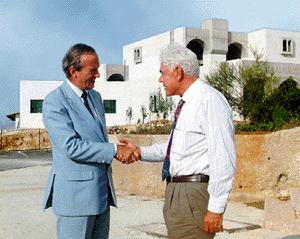
Left: Dr. Ibrahim Abu Lughod meets British Minister Mr. David Hunt at Birzeit in October. Photo by Yasser Darweesh
On 5th October 1994, Mr. David Hunt MP, British Cabinet Minister
with responsibility for Science and Technology, visited Birzeit
with a delegation of British representatives and administrators.
The delegation included Sir William Stewart, Chief Scientific
Advisor to the British Prime Minister and Cabinet, Mr. David Grey
from the British Geological Survey, the British Consul General
Mr. Richard Dalton and the director of the British Council in
East Jerusalem, Mr. Peter Skelton. The group was visiting the
occupied territories to explore ways in which British institutions
could expand links with their Palestinian counterparts.
Birzeit Vice-President Dr. Ibrahim Abu Lughod welcomed the group, noting and acknowledging that during the period of the British Mandate, Britain contributed to the Palestinian educational system, contrasting this with the Israelis, "who have never put one penny into it." Abu Lughod drew attention to the fact that 85% of Birzeit's 450 faculty have been trained in European and American institutions, "making Birzeit truly an international university, as well as a national institution that draws students from all over Palestine."
Minister Hunt responded by saying how delighted he was to visit Birzeit and brought with him the best wishes of the Prime Minister, his ministerial collegues and the European Community. He spoke of how his predecessor and he were the first British Cabinet Ministers to be allocated a portfolio specifically for Science and Technology in over 30 years, underlining the increasing importance Britian is putting on these areas.
Dean of the Science faculty, Dr. Abdul Salem Abdul Ghani, spoke of the needs of the faculty and made an impassioned plea for increased provision of fellowships for Palestinian lecturers and professors to be able to study in Britian. He noted the current disparity between assistance provided by the British Council for Israeli and Palestinian faculty. In the days following the meeting, the British representatives responded positively to this point undertaking to look at new ways of funding fellowships for Palestinian faculty.
The delegation visited the university library and science building and were given a briefing by Dr. Ramzi Sansur from the Centre for Environmental and Occupational Health Sciences (CEOHS). The group was impressed by the work of the CEOHS (see article on page 14) and stated that the British Government "very much supports the work of the Centre", promising to look at the proposal for a food quality control unit currently under consideration by the British Overseas Development Administration.
Marti Passio, Head of International Relations in the Finnish Parliament, and Arto Kanner, Finnish Ambassador, visited Birzeit on 8 October 1994 to discuss plans for a Media Training Centre at the university. The establishment of an independent and pluralistic Palestinian electronic media in Palestine is long overdue. Last year, YLE (the Finnish broadcasting company), the International Federation of Journalists, and the Union of Journalists in Finland agreed to assist Birzeit in establishing such a centre in the belief that, "the dissemination of information, gathered and transmitted according to independent professional criteria, can only enhance peaceful inter-communal co-existence, which in the final analysis will contribute to peace in the Middle East.
Scandanavian countries have made a commitment to donating the equipment necessary for the proposed courses in: journalism in the electronic media; the training of artistic staff such as directors, lighting, sound and camera persons, editors and set designers, technicians in video and sound, media analysts and administrators. As well as providing courses for aspiring professionals in the media, it is hoped that Birzeit will become a centre for new Palestinian radio and television stations. It is intended that the proposed centre be located in the new student building, currently under construction.
The last nine months have been a busy time for the Women's Studies Centre at Birzeit. In the 1993/94 academic year the Centre made significant progress in looking at library aquisitions and translating key texts into Arabic; fundraising and infrastructure development; research strategy and planning; curriculum development and other internal administration. After this year of groundwork and preparation, the Centre received full university approval as a recognised programme in the Faculty of Arts, offering a minor in women's studies.
One of the first such programmes in the Arab world, the Centre has a three-pronged approach to its work, supplementing usual university activities of teaching and research with a community outreach programme aims at developing women's abilities, consciousness and strategies in both the social and political sphere.
In June and July 1994, the Centre held two seminars aimed at providing an overview on women in Arab society. The first seminar was held on June 13th, entitled "Arab women and political life," presented by Jordanian advocate Asma Khader, head of the Jordanian Women's Union and a member of the committee that drafted the Jordanian Constitution.
The second seminar was held on July 16th, involving Judith Tucker, a history professor from Georgetown University and author of "Women in Egypt in the 19th Century" as well as many other articles about women and the family in both Palestine and Egypt in the 18th and 19th centuries. The title of the seminar was, "Methodologies to understand the history of women in the Arab World."
Following these foundational conferences, the Centre brought the timescale forward, holding a workshop from 25th until 26th September 1994 entitled, "Women in Palestinian society: current research and future perspectives." The workshop aimed to identify and evaluate what has been written since 1967 from a women's perspective in the fields of education, economics, culture and social welfare.
The Centre is on e-mail, at: pjohnson@ws.birzeit.edu
Layla Shahid, the Palestinian Ambassador to Paris, made her first visit to the university on 21 December 1994. She met with university president Dr. Hanna Nasir and the University Council, as well as members of the Women's Studies Programme, promising to encourage support for the university through UNESCO in France. Prior to her posting in Paris, Ms. Shahid was Palestinian Ambassador to Ireland and the Netherlands. Over the years, she has been a solid supporter of the aims and objectives of Birzeit University.
Birzeit held its fourth international academic conference from 10th to 12th March 1994, organised by the Mediterranian Studies Unit at Birzeit. The theme of the three days was "Cultural encounters across the Mediterranean: Palestine and Europe," and covered themes including historical and present-day relations between the two areas; the power of gender, citizenship and the media in shaping encounters; and cultural differences and areas of confrontation.
Papers from the conference are expected to be published in a booklet form in September 1995 and can be ordered from Dr. Salim Tamari, Sociology Department, at the university address or by e-mail: stamari@soc.birzeit.edu. For Toine van Teefflen's paper, "Birzeit University through the eyes of the Western media", also published in this newsletter, click here
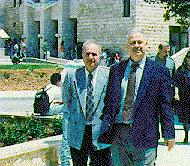
Dr. Hanna Nasir shows UNESCO Deputy-Director General Dr. Adnan Badran around the Birzeit Campus. Dr. Badran has responibility for sciences at UNESCO. Another UNESCO official, Dr. Omar Masalha, also visited the university. Dr. Masalha, ex-Palestinian Ambassador to UNESCO, now works to facilitate UNESCO funding in Palestine. Photo by Yasser Darweesh
Karin McBride and Denis Leclaire, representatives of the Association of Universities and Colleges in Canada (AUCC) visited the university on 27 March 1995. Ms. McBride is manager of policy and liaison at the international relations and programmes department of the AUCC. Mr Leclaire is the director of international activities at St. Mary's College in Canada.
The suggestion for their visit was made by several members of the faculties of Canadian institutions, including Carlton and McGill University. As the national association of Canadian universities, the AUCC was interested in learning more about Birzeit's goals, activities, particular research interests and views on ways Canadian and Palestinian institutions can work fruitfully together. The AUCC will be circulating details of their visit to the university community in Canada to heighten their awareness of developments and specific points of contact at Birzeit.
Academic independence in Palestinian universities was the subject of a lecture given by Sir Michael Atiyah in January 1995. Sir Michael, President of the Royal Society, a prestigious organisation which represents the scientific community in Great Britain, warned that "once a government gets involved in a university's affairs, it doesn't leave."
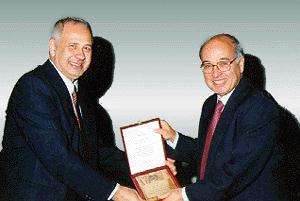
Right: Dr. Hanna Nasir presents Sir Michael Atiyah, a sponsor of Friends of Birzeit University (UK), with a plaque after his lecture visit to Birzeit. Photo by Yasser Darweesh.
Speaking to about 120 professors and students on January 10th,
the internationally acclaimed mathematician asked Palestinian
universities to be "centres of independent thought and critical
analysis." He explained that young people come to university
with ideals and that "they should be encouraged to pursue
their ideals and not be turned into cynics.
He warned that government aid should be taken by universities only after much deliberation and when no other sources of funding are available, "because all money comes with strings attached."
Instead of dependence on the government, there should be some sort of marriage between universities and the private sector, whereby companies pay for services and research and thus cover a large part of university budgets.
However, Palestinian industry rarely carries out market research, management evaluation and product development studies as is the case in the West. This is because: the Palestinian business community is unaware of what universities can offer; universities have not been very active in marketing their services to businesses; and usually the amounts of money invested in local ventures are so small that research is seen as an unnecessary expense, as some local businessmen explain.
Atiyah added that wealthy people have had a major role in the development of Western universities. But the lack of a philanthropic heritage among wealthy Palestinians has left Palestinian universities with no choice but to take as much official aid as possible. "We have no Palestinian Rothschild," as Yasser Arafat lamented in a newspaper interview the week prior to Atiyah's visit.
Since the 1970s, university aid was primarily channeled through the PLO. After the lack of PLO aid caused by the Gulf crisis of 1990, universities started to become more aggressive in fundraising and to move toward a free market system, where student tuition comprises a decent share of income.
The president of Birzeit, Dr. Hanna Nasir, stressed his desire to attain academic freedom and noted that Palestinian universities have suffered much from the lack of the same freedom during occupation. "We hope that the coming authority understands the importance of academic independence, which is the backbone of any educational institution," he said.
Atiyah is of Lebanese origin, although he spent some parts of his life in Egypt and Palestine. Last year he visited Lebanon for the first time in 30 years. "I'm trying to pick up my roots," he explained. Besides being president of the Royal Society, he is a master at Trinity College, Cambridge. His West Bank tour was part of a trip that took him to Jordan and Israel.
While in the West Bank, Atiyah also visited An-Najah National University and the Abu Dis College of Science and Technology. He said his visit was to establish contacts with and discover the needs of local universities.