 A long path to a degree: Basem Sabbah, BSc. in Physics.
Basem began his degree course in 1986, one of a family of four brothers and four sisters, out of which five wanted to pursue a university education. Originating from Qaffin village in the Tulkarem district, Basem chose physics, while his three brothers chose engineering. From 1987 until 1990, Basem was unable to pursue his studies due to the Israeli closure of Birzeit University. When he began to participate in the off-campus teaching, which the university had first concentrated on providing to those nearer the end of their courses, he found there were some problems with this, "I was only able to take a few courses as some of the physics courses required laboratories which we didn't have," he says, "There was also a shortage of books. These were the problems of the Intifada." In 1992, he began studying again after the university's reopening. Now Basem is looking for a position as a physics teacher in a school.
 Scholarship student: Abeer Abu Shalbak, BA in Management and
Business Administration.
Scholarship student: Abeer Abu Shalbak, BA in Management and
Business Administration.
Originating from the village of Lifta near Jerusalem, Abeer is the first graduate amongst her two brothers and three sisters. Beginning her course in 1990, she later took advantage of the academic links between Birzeit and the University of Amsterdam to take part in a scholarship programme in the 1993/94 academic year. "The scholarship gave me more experience, new insights and I had the opportunity to learn about another culture. It gave me better opportunities for the future." Abeer explains: "I had the chance to take courses that weren't available at Birzeit. In Palestine the academic focus is often on the United States. In Amsterdam, I learnt a lot about Europe." Abeer hopes to work for a development organisation in Palestine and perhaps take a masters degree course in the future.
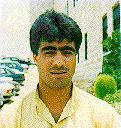 Gazan student: Nasser Shakshak, BA in Economics.
Nasser originates from Khan Younis in the Gaza Strip and began
his Economics degree in 1990. In common with all Gazan students,
he experienced major problems obtaining permits from Israel necessary
to study. "It's a big problem," says Nasser, "The
plan of the Israeli government to separate the West Bank from
the Gaza Strip causes problems. Israel would prefer students to
stay in the same place so it can keep track of them." This
bureaucratic harassment causes profound disruptions to students'
courses. During one blanket cancellation of permits in 1993, Nasser
took refuge with other students in the mountains after raids by
the Israeli military on Gazan student homes. A reflection of the
economic situation in Gaza, Nasser was also forced to suspend
his course for a year due to financial problems. Now, he is applying
to an organisation that helps small business projects, to begin
a library in the Strip, where there is a great shortage of library
services.
Photo credits: Nigel Parry