"Medicine is poised on the threshold of a new era, venturing into a region too small to see, yet too vast to comprehend. For two centuries, doctors have viewed disease at the cellular level, fighting the bacteria and viruses that invade cells. Now, researchers are peering deeper, working with particles invisible or almost invisible even to a microscope. As they unravel the mysteries of life's basic fibre, the DNA molecule, they are finding ways to fix flaws in the genes that shape life. And they are bringing new hope to the fight against cancer and other devistating diseases."
- From "The Gene Doctors", a special report by The Houston Chronicle (2 April 1995) -
Birzeit graduate Elie Hanania (pictured left), 31, grew up in Jerusalem with an early interest in science. When his mother refused to buy him a chemistry set because it was too dangerous, he saved his money and bought one anyway. After graduating from Birzeit he traveled to the United States to study for a Ph.D. in human genetics and molecular biology at the UT Medical Branch in Galverston. At a 1991 meeting of the American Association for Cancer Research, Hanania caused a stir with his work with the retinoblastoma gene and particularly impressed Dr. Albert B. Deisseroth, who headed a lab in the University of Texas M.D. Anderson Cancer Centre in Houston.
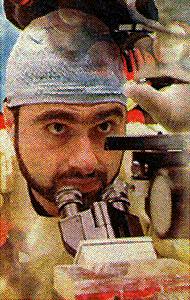
Left: Elie Hanania in the Anderson laboratory. Photo by Carlos Antonio Rios.
Deisseroth realised Hanania was the perfect person to carry out
research for his laboratory, describing him as "a world class
expert in working with mice", and invited him to join his
team at Anderson. For Hanania, who wanted to do gene therapy,
this was a natural step, and he began work with Anderson's scholar
Dr. Siqing Fu on creating a virus that would carry the anti-cancer
gene in the body of ovarian cancer patients.
If discovered early, ovarian cancer can be treated, approaching a 90 percent success rate. The gene used for this treatment at Anderson, MDR-1, acts as a pump to spew anti-cancer drugs out of the bone marrow, thus allowing higher doses that will kill the cancer without killing the patient. The problem existing in existing chemotherapy is that the drug treatment levels necessary to kill the cancer is higher, in many cases, than the patient can bear. Deisseroth wanted to give the patient regular chemotherapy, follow this with a bone marrow transplant that contained MDR-1 genes, and then begin treatment with Taxol, a potent ovarian cancer killer made from the bark of the Pacific yew tree. Usually, Taxol is dangerous to use as it plays havoc with the bone marrow, necessary in the production of blood cells including white cells that protect against disease.
To grow the virus that would carry MDR-1 into the bone marrow of mice took Fu and Hanania six months. The road to produce this virus for use in people would take longer, but the importance of the animal experiments were paramount. Hanania put MDR-1 into five mice and then treated them with doses of Taxol that would normally be lethal. The mice thrived. In fact, one mouse lived so long that Hanania had to soften its food when the mouse got too old to chew. He also discovered that marrow from one mouse could be transplanted into another, and the protection against Taxol would still hold.
Meanwhile, Deisseroth applied in March 1993 to the DNA Advisory Committee of the National Institute for Health for permission to try the treatment on human patients. They were initially refused but after answering the questions posed by the committee, the plan was approved in June the same year.
For the following year, Hanania and others from the lab concentrated on making the virus that would carry MDR-1 into human bone marrow. The Food and Drug Administration (FDA) in the United States requires that a viral vector used in patients is so carefully prepared that it could qualify as a drug under the regulations. By March 1994, they had made nine separate lots of the virus. In May they finished the testing and submitted a 1,100-page document to the FDA for approval. After an exchange of information, the FDA approved the plan on September 13th, 1994.
Since then the treatment has begun on fifteen patients, all considered hopeless cases. In each of the cases the treatment has progressed well, and Diesseroth and his team are witnessing the development of what could work out to be the cure for one if not many forms of cancer.