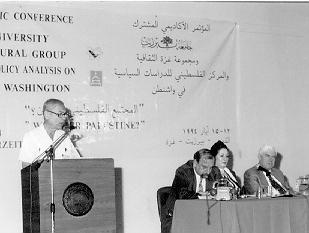
Only a week after the signing of the Gaza-Jericho Accord in Cairo on 4 May, a three-day conference opened at Birzeit University that drew together scholars and experts from local and international institutions for an intensive discussion of the problems and prospects facing Palestinian society in the emerging new era. The conference, entitled "Al Mushtama' Filistini: Illa 'Ein?" (Whither Palestine?) was sponsored by Birzeit University, the Center for Policy Analysis on Palestine in Washington, D.C., and the Gaza Cultural Center and was held from 12-15 May 1994.
Its proceedings will be published in Arabic during the summer of 1994. Throughout the academic year, the University campus has witnessed lectures and seminars analyzing the fast-breaking developments in Palestinian politics, economy and society, including a 17 December study day on "The Palestinian lsraeli Declaration of Principles: Current and Future Trends," a faculty seminar series, and several lectures sponsored by the Student Council. The Newsletter asked Vice-President Dr. Ibrahim Abu Lughod, one of the initiators of the study day and the May conference, how he saw the role of the University in addressing such urgent public issues.
Dr. Abu Lughod replied: "The University is an important part of the institutional structure of society. It is affected and participates in events in public life. The single most significant public event of the last period has been the processing of reaching a settlement with Israel through a negotiating process. This mode of interaction was both new and controversial. It is the responsibility of the university to evaluate and to clarify issues concerning this very significant development in an atmosphere of academic freedom and mutual respect."
In the opening banquet of the conference, held in Jerusalem, Dr. Haidar Abdul Shafi, former head of the Palestinian delegation, called for informed and democratic national dialogue to address the pressing challenges of the new era, including the serious limitations of the agreements themselves, which exclude such key issues as settlements and Jerusalem. Renowned poet Fadwa Toquan gave a moving reading from her work.
Keynote addresses at the first session urged the audience of academics, students and the public at large to address the urgent issues of the day through careful analysis, democratic dialogue, and informed and united action. Dr. Hisham Sharabi, Director of the Center for Policy Analysis on Palestine, affirmed that "the key to changing the situation today is in the hands of the Palestinian people."
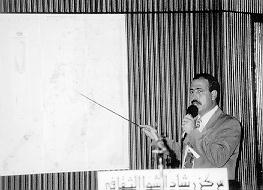
Calling for meeting the new challenge with democracy and political exchange, Sharabi stressed the importance of free and democratic elections, even to a limited authority. The alternative, Sharabi warned, is a patriarchal and repressive state and society. Dr. Ibrahim Abu Lughod noted that Palestinians today had "the second opportunity to build a state on Palestinian land." Palestinian society faces the challenge of transforming "authority into sovereignty," Abu Lughod stressed, after noting the limitations and difficulties of the present period.
Speaking on behalf of the Gaza Cultural Center, Rawiya Shawa urged a frank and honest dialogue among all sectors of society and with the Palestinian leadership, noting that such discussion was an important goal of the Gaza Cultural Center. The Gaza Cultural Center hosted the third day of the conference in Gaza city, thus giving an opportunity for more Gaza residents to participate in the discussion. The current restrictions on movement imposed by the Israeli authorities present formidable obstacles for Gaza residents wishing to attend academic activities in the West Bank.
During the conference, participants in six sessions discussed such vital topics as "New Political Frameworks," "Beyond the West Bank and Gaza: The other Palestinians," "The Relation Between the PLO and Elected Bodies," "Political Parties and Pluralism," "The Future of Jerusalem" and "The Relationship Between the National Authority and Civil Society," among other important topics. A session on "Women and Political Participation" offered a searching examinination of the present limits and future possibilities for a political role for Palestinian women. Themes running throughout the conference included the importance of developing the institutions of civil society and strengthening democracy and pluralism.
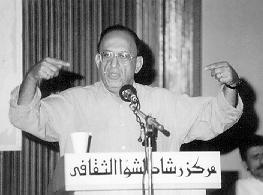
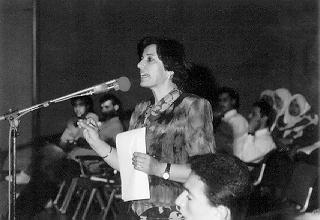
Participants in the sessions included: Dr. Hanan Mikhail-Ashrawi, Raja Shehadeh, Dr. Samir Abdullah, Raji Sourani, Taysir Aruri, Dr. Mamdouh Aker, Dr. Elie Zureik, Dr.Mohammed Jadallah, Dr. Mohammed Shadid, Dr. George Giacaman, Dr. Mustafa Barghouti, Dr. Riyad Al Malki, Dr. Manuel Hassassian, Dr. Sahar Khalifeh, Dr. Zahera Kamal, Islah Jad, Dr. Hisham Sharabi, Mohammed Miari, Dr. Ziad Abu Amr, Dr. Khalil Shaqaqi, Dr. Ghassan Faramand, Sheikh Mahmoud Al Zuhur, Yunis Al Jarro, Dr. Miriam Miari, Dr. Fuad Moughrabi, Khalil Toufakji, Ibrahim Dakkak and Dr. Nazmi Joubeh.
In closing remarks appropriate to a conference that had brought togther local and international Palestinian scholars, Dr. Gabi Baramki of Birzeit University stressed the importance of further exchange and called for the return of Palestinian intellectuals, professionals, and scientists to assist in the building of a new Palestine.