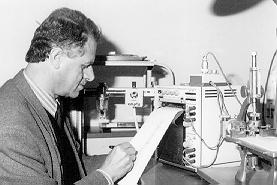
Three years ago, the University's Faculty of Science was finally able to purchase laboratory equipment for work with radioactive materials. After some delay, Birzeit scientists received the necessary permits from the Israeli military authorities to work with these materials. However, the machinery today lies idle -- the University has not been able to secure a license to purchase radioactive material.
When Dean of Science Dr. Abdul Salam Abdul Ghani recounted the above story of the obvious obstacles and difficulties faced by Birzeit scientists to the Newsletter, he did not draw the obvious conclusions: "We can't give up and say 'we're a special case, we're under occupation.' We can conduct successful scientific research. My message is that research is possible at Birzeit University."
The Faculty of Science has recently published a booklet "Faculty Members in Profile: Publications and Current Fields of Research" that gives some positive proof to Dr. Abdul Ghani's message. Despite the obstacles, Birzeit scientists have continued, and in fact increased, their scholarly publications utilizing scientific research conducted both abroad in Birzeit laboratories. Another publication in press from the Faculty of Science will list faculty publications where the work was conducted entirely or in part at the University.
"Our main problem is equipment and instrumentation," Abdul Ghani explained. "We face a series of other problems as well, including a heavy teaching load, the interruptions of curfew and closure, and inadequate library facilities." The Research Committee of the Faculty of Science has managed to acquire a small budget from the University for start-up funds for individual researchers, and is proposing a research appointment in each department that can be used for load reductions for faculty members. "We can't afford the system in some American universities where researchers teach only one course," Abdul Ghani noted. "But we can lighten the load to some extent."
The Faculty of Science has drawn up proposals for heavy equipment and for expansion of facilities, including a herbarium, a zoological museum, electronic and mechanical workshops, and expanded computer lab facilties. The Faculty has also encouraged Birzeit scientists to form research groups to better utilize existing facilities. Abdul Ghani belongs to one such group, along with fellow biologists Dr. Riyad Amin and Dr. Nabil Nahhas. The group's on-going research focuses on herbal medicine and its medical application in diseases such as epilepsy, diabetes and hypertension. The group is also presently engaged in joint research with Department of Chemistry faculty member Dr. Abdul Latif Abu Hijleh on the anti-diabetic and anti-epileptic effects of copper complexes.
"There are some problems we can only solve when we institute graduate studies," Dr. Abdul Ghani affirmed. "We can then balance research and teaching in a more productive way." Until that time, the Faculty of Science is committed to promoting scientific research at Birzeit University "by any means necessary."