Throughout the over long four years when Birzeit University was closed by military order, from 1988-92, a determined committee of faculty members met irregularly to continue their mandate to develop plans for graduate education at Birzeit University. At the time, the Vice-President for Academic Affairs, Dr. Nabil Kassis, commented: "it's a little bit like moving desk chairs on the Titanic."
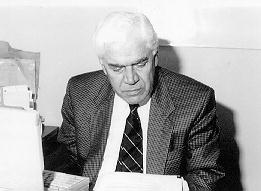
When the University returned to campus, the feasibility of graduate education became an important focus. After over a year of work by a faculty committee headed by Vice-President Dr. Ibrahim Abu Lughod (pictured left), the Birzeit University Council has recently approved general regulations, purpose and structure for graduate education at Birzeit University and plans are underway for at least two graduate programs. Dr. Ibrahim Abu Lughod explained the motivation for developing graduate education: "Palestinian society today needs a higher level of competence and specialization, which is achievable only through education at the graduate level. We cannot depend on the achievements of other societies; we Palestinians need to generate our own specialists on the ground."
The new University policy for developing graduate education, Abu Lughod notes, allows programs in fields which are identified as a clear priority and where the University has the present capability. All faculties of the University have been invited to submit plans for graduate education in their respective areas of competence. Two proposals, for masters' degrees in International Studies and in Education, have been fully developed. The University previously conducted a modest master's program in education from 1979-1981, which was subsequently frozen until a general framework was established. "We have a desperate need for qualified teachers, " Abu Lughod noted, "and we have the human resources in place at the University."
Dr. Othman Abu Libdeh, Chair of the Department of Education and Psychology, told the Newsletter that faculty members in his Department are working long hours to prepare for a master's program in Education to begin next year. "We believe this program is important for our society; education has been neglected for far too long. A master's program will allow us to develop vital and much needed skills in curriculum development, teaching methodologies, and school supervision and administration, among other important topics. We are building our program through systematic discussion combining the priorities of the community with what we are qualified to do."
Commenting on the rationale for International Studies, Abu Lughod said: "We are on the verge of new developments in Palestinian governance; the University is capable of training foreign service officers, experts and other personnel for this new era." The University's approach to graduate programs will be inter-disciplinary, noted Abu Lughod: "It is not feasible to run these programs in one department alone. We need to combine specialists from different areas and maximize the use of existing resources." The University hopes also to draw on Palestinian expertise from outside the Occupied Territories, and to upgrade key facilities, particularly the library. Graduate studies will also improve the quality of undergraduate education by upgrading research and library facilities.
Evaluation of graduate programs needs careful consideration. "We need a inter-university mechanism through our Council for Higher Education," Abu-Lughod said. "In addition, periodic visits of international consultants would be helpful in this transitional phase to ensure universal standards of teaching and research. Our aim is to produce high-level manpower to run the affairs of an advanced state, to compete on an international level. Graduate education can have a tremendous impact, not only on our own institution, but on the society as a whole."