Developing
A Palestinian Internet Backbone
Brief
Analysis and Recommendations for The Palestine Telecommunications
Company
By
Marwan
Tarazi
Director
of IT Unit
Birzeit
University, Palestine
mtarazi@admin.birzeit.edu
Table
of Contents
Introduction *
1
Palestinian Internet
Usage Patterns.
*
2
Existing Internet
Infrastructure in PA areas. *
2.1 Media for Internet
Communications in PA areas: *
2.2 Palestinian Internet service
providers: *
3
Connectivity Options
Analysis: *
3.1 Option 1: Israeli ISP *
3.2 Option 2: Palestinian ISP in Israeli
Telecomm. Areas *
3.3 Option 3: Palestinian ISP in Israeli and
Palestinian Telecomm Areas *
3.4 Option 4: Palestinian ISP in Israeli and
Palestinian Telecomm Areas (2) *
3.5 Option 5: Palestinian ISP in Palestinian
Telecomm Areas *
4
Connectivity Analysis: *
4.1 Who Should PalTel's Clients Be? *
4.2 PalTel's Recommended Internet
Backbone Structure: *
4.3 Impact of the above Model on
Paltel’s Internet Services: *
5
Summary: *
Introduction
The
following report is a brief description of the status of the
Palestinian Internet usage, services and service providers. The
report includes suggestions and recommendation for the Palestine
Telecommunications Company (PalTel) on how to develop the
Palestinian Internet backbone.
This report
is not a study. It does not include statistics or detailed
figures. The purpose of the report is to provide ideas and
guidelines that may be used as a basis for a comprehensive study,
or to shed light on technical issues related to the subject.
1 Palestinian Internet Usage Patterns.
Before one
is to is to begin discussing Internet connectivity in Palestine,
it is important to define the local Internet community, and the
Internet usage patterns.
- Like most developing
countries, the great majority of the Palestinian Internet
traffic is outgoing traffic destined to access
information outside Palestine. Local traffic is
negligible in comparison.
- Electronic mail usage is ever
increasing and is one of the most important Internet
services. There is a large professional and personal
community that has totally integrated electronic mail in
their daily communications utilities.
- A significant percentage of
the traffic is consumed by traffic intensive
entertainment downloads such as images and video.
- File transfers use another
significant percentage.
- List serves and mailing lists
are not very popular yet.
From the
above trends one may draw the following conclusions:
- Direct Internet access to the
Internet backbone is essential and customer satisfaction
will be directly affected by the performance of such a
connection.
- Cashing of Internet traffic
will produce significant savings in expensive
international traffic. Frequently visited sites and FTP
sites will reside on the local cash servers, and access
will be done locally.
- A Palestinian Inter traffic
exchange will not produce a significant savings in
International bandwidth in the near future since local
traffic exchange is small. However this situation is
destined to change as Palestinian Internet usage and the
number of users and services increase.
- The emergence of local
service providers that can capture a large portion of the
entertainment and FTP markets will divert the expensive
international traffic to the local traffic. It is
important to note that there is much to be gained by this
move by all parties involved including the end user, who
will be getting much faster access.
- There is no need for local
high speed links for Internet usage (such as ISDN) in the
near future, as the traffic bottlenecks lie within the
International links and not between the end users and the
service providers.
2 Existing Internet Infrastructure in PA areas.
2.1 Media for Internet Communications
in PA areas:
Internet
users in the PA areas are using the following media for
communicating with their service providers:
- Telephone lines using modems.
This constitutes the greatest majority of Internet users,
whether at home or in their businesses. These users use
regular telephone lines to dial up to their service
providers. Their use of the Internet is usually
restricted by the following factors:
- The general shortage of
telephone lines inhibits users from holding a telephone
line that is used for other purposes for prolonged
periods of Internet time.
- Up to date the greatest
majority of Palestinian service providers are located in
areas serviced by the Israeli Telecommunications
Networks. This implies the clients are forced to make
long distance calls to access these providers. This has a
significant additional expense in telephone bills -
another reason to economize in Internet usage.
- The poor quality of a
significant number of the telephone lines directly
impacts the quality and speed of the Internet connection
and results in frequent loss of connection.
- Satellite connections: This
is a relatively versatile and inexpensive solution which
uses VSAT. It is mainly used for on-line Internet
services in areas that do not have other means of
providing on-line Internet services. The main problem
with this service is speed. Even though the company that
offers this service claims to provide a down-link of
128Kbps (incoming traffic), and an up link of 38Kbps
(outgoing traffic), the actual performance is much
slower. It is very important to note that satellite
technology is expected to play a very significant role in
Internet traffic and services in the coming years. The
Bill Gates project for building a network of low lying
information satellites is just an example of what is to
come at the start of the coming millenium.
- Wireless Technology: This
technology is playing an ever increasing role in the
provision of Internet services in the PA areas. It is
being used both by Internet service providers and
customers that require larger on-line bandwidths (128K
– 3Mbps range). The introduction of this technology to
the PA areas at a large scale came as a direct result of
the unavailability of leased or data communications
lines. The extent of the use of wireless technology in
the PA will largely depend on the quality and cost of the
Internet services that will be provided by PalTel. In
assessing the impact of wireless technology on data
communications in the PA areas one is to consider the
following factors:
- The proximity of areas
serviced by Israeli telecommunications companies will
always provide a backdoor for Palestinians living in the
PA areas and who opt to use providers in the Israeli
service areas.
- The advancement of the
wireless technology is likely to make it’s range of
service bigger, faster and cheaper. At present it is
possible to obtain 256 Kbps at 20-30 Km ranges. This will
make unrestricted access even easier and could cover a
larger territory.
- Many of the wireless
communications equipment use broadband frequencies
difficult to detect or intercept. This will make
regulating the use of this technology difficult.
- Leased lines and dedicated
lines: PalTel has recently finalized developing its data
communications core network, and it is now possible to
link almost all areas in Palestine together whether
serviced by Palestinian or Israeli telecommunications
operators. Internet service providers have not begun to
make use of these services yet. One of the expected
problems with inter-city leased lines at the moment is
cost. The inter-city leased line costs are very high
compared the prices offered by Israeli telecomm
operators. At the same time, PalTel offers a service of
intra-city dedicated (copper) lines at very attractive
costs. Later on in the document, a proposal wibe made on
how PalTel should be using this combination to offer a
very attractive and competitive Internet backbone for the
areas covered by its territory.
2.2 Palestinian Internet service
providers:
The
Palestinian Internet service provider map is illustrated in the
following diargram:
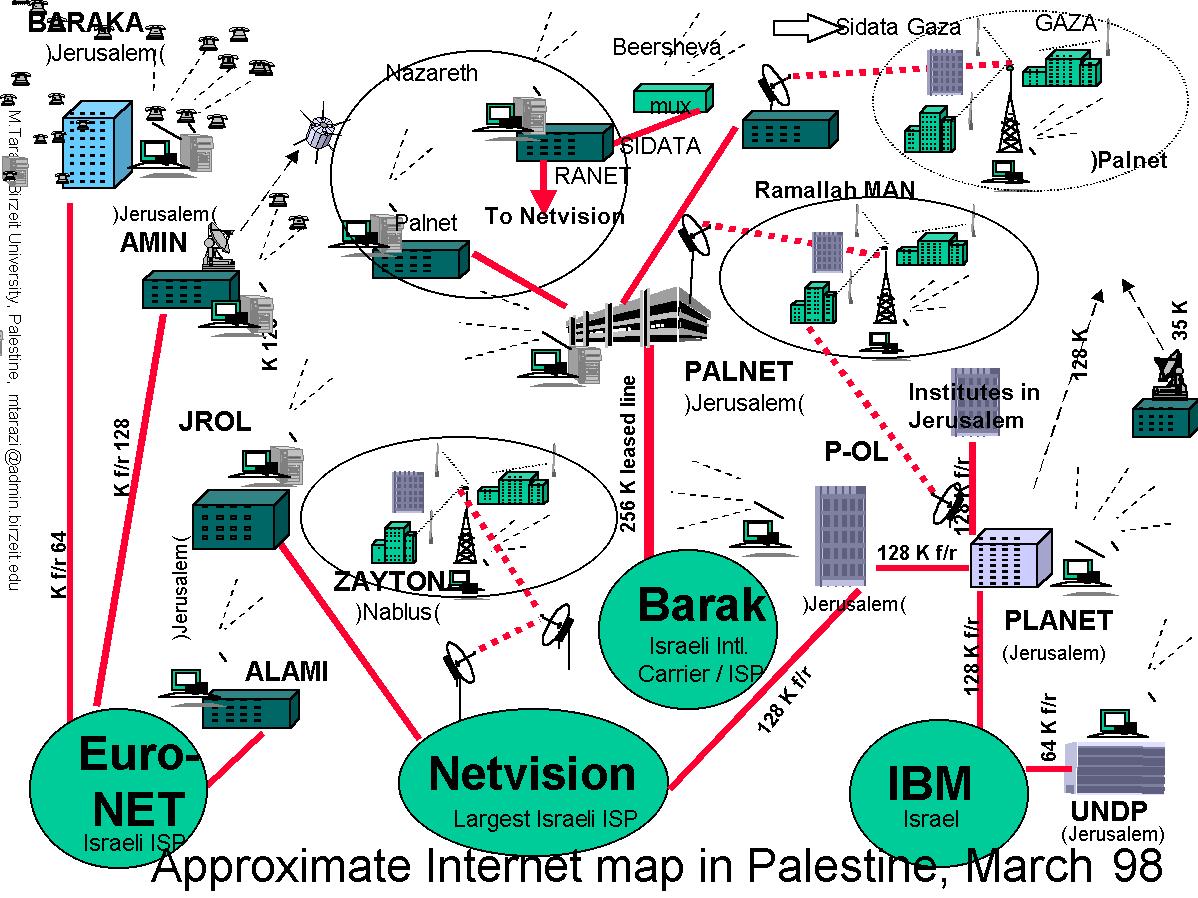
This map
reveals the following information:
- At present, all Palestinian
service providers obtain their services from Israeli
service providers. None of the Palestinian service
providers share resources with the others (e.g. proxies,
ftp sites, cross traffic routers).
- Some ISPs have used wireless
communications to setup servers in PA areas and offer
direct dialup connectivity through these servers.
- ISPs that offer services in
multiple locations use the Israeli telecommunications
network to connect sites together.
- Some ISPs offer wireless
Internet connections to large clients. The majority of
such services are in the Ramallah and Jerusalem areas,
and recently in Gaza.
- The majority of the
Palestinian cities do not have access to on-line Internet
services. Internet usage in these areas are restricted to
long distance dial up Internet access, or to satellite
communications in some institutions.
3 Connectivity Options Analysis:
3.1 Option 1: Israeli ISP
Internet backbone connectivity
|
Israeli ISP
|
Service Provider
|
Israeli ISP
|
Customer’s access in PalTel’s
areas
|
Dialup using Bezek’s and
PalTel’s networks
|
3.2 Option 2: Palestinian ISP in Israeli telecomm.
area
Internet backbone connectivity
|
Israeli ISP
|
Service Provider
|
Palestinian ISP operating in
Israeli telecomm areas.
|
Infrastructure between Israeli ISP
and Palestinian ISP
|
Dedicated lines from Bezek
|
Customer in PA areas Access
|
Dialup using Bezek’s and
PalTel’s networks
|
3.3 Option 3: Palestinian ISP in Israeli and
Palestinian Telecomm Areas
Internet backbone connectivity
|
Israeli ISP
|
Service Provider
|
Palestinian ISP operating multiple
servers in Israeli and Palestinian telecomm areas.
|
Infrastructure between Israeli ISP
and Palestinian ISP
|
Dedicated lines from Bezek
|
Infrastructure between offices in
Israeli telecomm areas and Palestinian telecomm areas
|
Wireless technology
|
Customer in PA areas Access
|
Dialup using PalTel’s network
only or
PalTel’s
and Bezek’s networks (optional)
|
3.4 Option 4: Palestinian ISP in Israeli and
Palestinian Telecomm Areas (2)
Internet backbone connectivity
|
Israeli ISP
|
Service Provider
|
Palestinian ISP operating multiple
servers in Israeli and Palestinian telecomm areas.
|
Infrastructure between Israeli ISP
and Palestinian ISP
|
Dedicated lines from Bezek
|
Infrastructure between offices in
Israeli telecomm areas and Palestinian telecomm areas
|
Leased line from Bezek and PalTel
|
Customer in PA areas Access
|
Dialup using PalTel’s network
only or
PalTel’s
and Bezek’s networks (optional)
|
3.5 Option 5: Palestinian ISP in Palestinian
Telecomm areas
Internet backbone connectivity
|
PalTel
|
Service Provider
|
Palestinian ISP operating in
Palestinian telecomm area
|
Infrastructure between PalTel and
ISP
|
Dedicated lines from PalTel
|
Customers in PA areas Access
|
Dialup using PalTel’s network
only
|
4 Connectivity Analysis:
It is clear
from the above discussion that several options are available to
PalTel's clients for Internet services. It is also clear that
PalTel should develop a business plan that would suit its
business interests. The most important recommendation for PalTel
is to seek a solution that will not require its customers to seek
alternate providers for their Internet connectivity. It is also
very important that PalTel should aim not to resolve to
regulatory or legal issues to prevent its clients from using
backdoor methods for Internet connectivity (e.g. wireless
technology). During the following brief analysis, it will be
demonstrated how PalTel could easily provide strong and
competitive Internet services while follow the above
recommendations.
4.1 Who Should PalTel's Clients Be?
It is very
strongly recommended that Paltel should not move into the
end-user Internet service provision. It should focus its efforts
on providing Internet to service providers and large customers
(50 users and above). End-users require an enormous amount of
support and services that Paltel needs not bother itself with. If
these services are sold to ISPs, then competition will improve
the quality of the services and drive down the prices for the
end-users. This will have a positive impact on the development of
Internet in Palestine, and will reflect positively on PalTel’s
image.
4.2 PalTel's Recommended Internet
Backbone Structure:
It is
recommended that PalTel uses the following structure in building
its Internet backbone:
This
diagram includes the following components:
- Routers are installed at the
main Palestinian cities where heavy Internet usage is
expected. A main router will be installed in Ramallah
through which a connection to the Internet is obtained.
In the future, another connection may be obtained through
another city for redundancy.
- Given that inter-city traffic
is expensive, and Internet traffic is even more expensive
two methods will be used to conserve and optimize this
traffic usage:
- Large proxy servers will be
installed at each router in each city. This will conserve
Internet traffic within the local backbone. Another large
proxy server will be installed at the main Internet
router. This will conserve expensive Internet traffic.
- Advanced routers with strong
matching data compression modules will be used within the
local backbone. This will at least quadruple the traffic
throughput on the standard leased lines within the
backbone. Data compression will greatly increase the
throughput of the Palestinian cross-traffic, and will
prevent it from interfering with the Internet traffic.
This will increase the performance of the network and the
overall bandwidth at almost no additional cost
- Traffic Allocation and
metering system: This will assign Internet traffic and
meter usage on the network
4.3 Impact of the above Model on
Paltel’s Internet Services:
There are
clear advantages to adopting the above model in terms of
efficiency in the utilization of bandwidth, and Paltel has much
to gain from adopting it. However, more importantly, there are
even greater gains to be made from the customer’s point of
view:
- Customers within a city will
not have to use expensive inter-city leased lines. They
will use local dedicated lines (at $40-80/month) or local
leased lines at a fraction of the price of the inter-city
leased line ($860 for 128K). This will significantly
reduce the overall cost of the Internet (cost of leased
line + cost of service), and will attract more customers.
This will also give Paltel the edge over Israeli ISPs. If
properly planned, this setup may make it even attractive
for ISPs that operate in several cities to use Paltel’s
backbone in each city for its Internet services (rather
than using lease lines and building their own network).
- There are several obvious and
not as obvious advantages to a larger number of customers
they are:
- The larger the customer base,
the larger the bandwidth that will be needed, the better
margins that Paltel can make.
- The larger the number of
users, the more effective or efficient the proxy servers
become (even though this may require larger servers).
Traffic generated on the proxy server is pure profit.
- The larger the number of
users the more developed and advanced Internet usage
becomes, the greater the demand on the bandwidth will
become.
- The larger the number of
users, the larger the Palestinian cross traffic becomes,
the higher the profit margins. Cross traffic is traffic
generated between local nodes. Clients are charged
Internet rates for this local traffic.
- A large user base would
provide PalTel with the opportunity to introduce new and
more advanced data communications services.
5 Summary:
Paltel has
a leading role to play in the development and advancement of
Internet in Palestine. It is faced with the cof developing the
infrastructure and providing the Internet services to the
Palestinian population at prices that compete with those provided
with a well-developed Israeli Internet market. With the monopoly
rights over data communications in PA areas, PalTel does have a
great opportunity of meeting these challenges and developing an
advanced Internet environment for the Palestinian community.