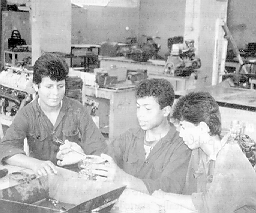
Trainees at the Gaza VTC: Increased Enthusiasm and Discipline
Gaza Vocational Training Center
The Gaza Vocational Training Center began in 1954 as a carpentry workshop. It now offers courses in 13 electrical, mechanical and building trades as well as training in physiotherapy, business and office practice and industrial, radio and TV electronics. It is one of the only centers of this kind for the Palestinian community. The Center has 708 students, 44 of whom are women who follow the physiotherapy and business programs. Students are recruited after 9 years of schooling or after full secondary education. The Center has 82 instructors. Courses are designed by the Amman Center which oversees the five UNRWA centers in Palestine and the Middle East.
The Principal and his Deputy took us on a tour of the Center. The many white-washed buildings housing the workshops, surrounded by well-tended gardens, are maintained by trainees in plastering and decoration. In each workshop we visited we were welcomed by enthusiastic young men, eagerly showing their work. The instructor said that his obvious enthusiasm has increased remarkably since the self-government period began, as has discipline, reflecting students' high expectations of a brighter future. He noted, however, that the Center lacks the instructor training, machinery and computers needed to keep up with modern technological developments. The two principals agreed with him and explained that, previously, instructors or high achievers used to be offered internships or scholarships abroad after which they would return to teach at the Center. However, in recent years these opportunities have decreased enormously, as have job offers for graduates abroad, especially in the Gulf countries. The Center aims to increase its low female enrollment by offering courses that are 'socially acceptable' for women and by providing short-term or technical courses that do not involve heavy physical effort. Girls who take courses at the Center nearly all find jobs very quickly. In September the Palestinian National Authority (PNA) had not yet been in touch with VTC. The principals both expressed their hope for cooperation as the rebuilding of the country will require graduates such as those of the Center.
UNRWA Schools
At the first elementary school we visited in Gaza City, the Palestinian flag now proudly flies side by side with the turquoise UN flag. The school counts 1170 children: 511 boys and 659 girls divided over 25 classrooms enclosing a playground that is simply too small to accomodate all the children. Most of the 20 teachers are female and teach classes of over 50 children who welcomed us with smiles and great excitement. The Headmistress syas that the school suffered relatively little during the intifada as she encouraged her students to come to school even on strike days. Now, the situation in the school is more or less stable, but no new teachers or students have been taken on due to financial restrictions. She has high expectations of the new period: an new baseball field has been built, and this year, for the first time, she kept the small library open during the summer holiday and participated in the Tamer Institute reading campaign.
On the way back to Ramallah we met the headmistress of an elementary and preparatory UNRWA school in Beit Hanun. In addition to the already high number of studnets in her school she had to accommodate 30 children of returning Palestinians this year. Her school does not have enough classrooms now and one class has to use rooms vacated by other classes practising sports. She had no idea what she would do in winter when outside exercise is impossible due to rain and cold weather.
UNRWA teachers we spoke to were aware that they might become government employees soem time in the future. Tehy were afraid that the PNA might level wages of all those working education to the lowest denominator. This fear is reinforced by the fact that 300 UNRWA teachers, employed under the so-called Emergency Program, are only paid $300 per month, do not receive fringe benefits, and have contracts for only one year.
Teachers at an UNRWA shcool in Jabaliya Camp were pleased about the new period, but feel that the enormous workload of over 25 teaching hours per week to overcrowded calsses rpevent them from giving children the extra attention they need. Social workers and counselors are urgently needed in schools to deal with the many social and psychological problems children suffer from. "The good thing is," said one teacher, "that things can only go forward from here. Despite the prevailing problems teachers are willing to suffer some more because they know we are building a nation by teaching its children. But improvements will have to come soon!"
Elaine Clark
Educational Network, POB 66, Ramallah, West Bank
tel: 02 995 6230/fax: 02 995 6231 e-mail: eclark@ednet.birzeit.edu