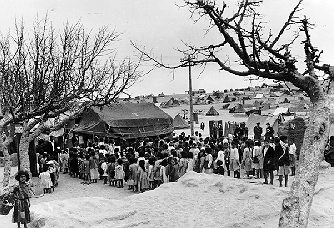
Education under Canvas for Palestinian Refugees in the Early Days: Beach Camp, in the Gaza Strip (UNRWA photo by Hrant Nakachian)
UNRWA was created by the UN General Assembly in 1950 as a temporary agency to deliver emergency relief aid to Palestine refugees, who had lost both their homes and their livelihood as a result of the hostilities in 1948 and 1967. Although initially aimed at urgently-needed humanitarian assistance (food, shelter and relief) and employment creation through public works, the agency gradually shifted its priorities to education and health. This year marks UNRWA's 45th birthday, and the following provides a summary of UNRWA's contribution to the field of education.
Looking at the many UNRWA school buildings dotting the Gaza Strip and the refugee camps in the West Bank today, it is hard to believe that the first UNRWA classes were held in large tents, without a syllabus, textbooks or teaching materials. Some teachers used the canvas side of the tent as a blackboard, and some of the children sat on stones and used discarded bags as writing paper. 'The tents were like ovens in the summertime. Some teachers were younger than their pupils,' says Lily Zahi Saba, a teacher in Gaza. 'Our salaries were often in kind -- fish, figs, grapes, peanuts and rice, not cash.'
The UNRWA department, set up by the late Khalil Oweidah, began with 25,000 students and initially only offered 6 years of elementary education. Parents were very eager to have their children admitted, as education came to be seen as the only way to a secure future. Muhammad Sayyad, who joined the agency in 54 and still teaches mathematics at an UNRWA school recalls that children were so eager to learn that 'they would walk barefoot for five kilometers to get to school'. Soon schooling was offered up to 3rd grade prep. and a vocational training center was opened in 1954. Many of the graduates of the schools and the center went to study at foreign universities or to work in the Gulf countries and elsewhere. They became the main supporters of their families. 'They used to say that Gaza exports two things: oranges and teachers,' says Ahmad Hillis, UNRWA's Chief of Education in Gaza. He studied at Cairo University, which provided scholarships to UNRWA students at the time - 6 Egyptian pounds per month ($2). 'It was a good amount at the time,' he recalls.
In the early 1950's tents were gradually replaced by schools built by simply placing bricks on top of each other, without cement, and with pitched cement tile roofs, which were very breakable. Even a football kicked on the roof by accident could break three to four pieces, resulting in injury to the children in the classroom. In the 60's a start was made with replacing some of the schools by concrete buildings, and during the 1980's all schools were re-roofed with corrugated iron in a scheme funded by 50% community contributions and 50% UNRWA donations. 'They weren't any better, but they were safer,' says Ahmad Hillis. 'The fact that they were noisy and hot was dealt with by installing false ceilings in the classrooms'.
The current Peace Implementation Program (PIP), is in preparation for the eventual absorption by the PNA of all UNRWA fields of activity, and builds on the existing UNRWA infrastructure. It also aims to create visible changes and improvements on the ground, including the building of 28 new schools. 'This does not solve the problem of double-shifting' says Hillis with regret. 'And I try to fight against the demolition of old classrooms if they are still safe. We still have 159 schools in 100 buildings for a total of 118,000 schoolchildren in Gaza, so that they are deprived of extra-curricular activities or even remedial teaching hours. In September we will have a school population of 131,000 due to the natural growth rate of 3.5% and the 4 to 5,000 returnee children we are expecting.'
'One of our victories' says Hillis, 'is the high reputation of our schools and of our teachers. Our in-service teacher training program, started in 1964 with the help of the Swiss government was very successful. The vast majority of our staff is now professionally trained, and we have loaned staff and given advice for similar programs to several Arab states.' UNRWA also succeeded in introducing and maintaining coeducation. Almost 50% of its schools have both girls and boys, and the academic standards of coeducational schools with female teachers are higher. Hillis: 'It's a natural way of life. Children play together, live together, learn together. Moreover, making schools single sex including the teachers (as has been proposed recently) would result in a severe shortage of female teachers.'
'I hope that somewhere in the near future we will have our own curriculum and textbooks and our own tawjihi certificate,' says Hillis. UNRWA always used the host country curricula. 'Children in Gaza (where the Egyptian curriculum is used) have never seen an irrigation canal, or a cottonfield,' says Hillis. 'We tried to bring the material closer to the children by developing enrichment materials about the Palestinian way of life. When we sent it to the teachers one local book shop decided to print the book. The Israeli military found out and caused trouble.'
Israeli censorship greatly hampered the educational work of the Agency, as did other Occupation measures such as school closures. The average learning time lost was 30% but in certain years it was 65%. Hillis: 'During the intifada we developed self-learning materials which were distributed to almost 100,000 children. During school closures, when mothers would go to the market to buy vegetables, they would bring us the completed exercises in their baskets and take new materials to their children. Even during curfews we had a distribution network. Still, this material could never replace classroom teaching.' As a result present levels of academic achievement are very low, although still higher than those in government schools. Since the PNA took over, however, not a single day of teaching has been lost. 'I don't expect miracles,' says Hillis,' - improvement in education is slow and cumulative.'
This article is based on an interview with Ahmad Hillis, Chief of UNRWA Education in Gaza, and the UNRWA publication Palestine Refugees Today, issue no 137, January 1995.
Elaine Clark
Educational Network, POB 66, Ramallah, West Bank
tel: 02 995 6230/fax: 02 995 6231 e-mail: eclark@ednet.birzeit.edu