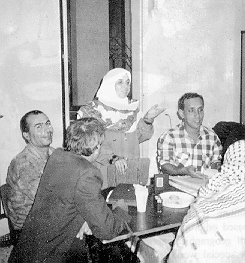
Animated and fruitful discussions during the workshops
The last issue of this newsletter included a summary of the challenges faced by teachers and by their union movement. Clearly, it is a priority to restructure the splintered, factional Teacher Unions into an effective, representative and unified front, able to improve the professional and economic conditions of teachers through employing efficient negotiation mechanisms with the new civil government, thus indirectly benefiting the educational establishment as a whole. The second series of the Teacher Union Workshops organized by the Network aimed to discuss effective strategies to reach this aim.
The second series of Teacher Union Workshops, based on the workshops held by the Network in January 1994, were organized in continued cooperation with the ABOP (General Union of Educational Employees, the Netherlands) and with assistance from the GEW (Union of Education and Science, Germany), and the FNV (Netherlands Trade Union Confederation). The very high number of teachers that applied to participate reflects the high interest in union issues after the transfer of educational authority to the Palestinian National Authority (PNA) and the resulting freedom of union activity. The first stage consisted of three preparatory one-day workshops held in Bethlehem, Nablus, Ramallah, Khan Yunis and Gaza City, in which a total of 160 male and female teachers from the three sectors participated. These workshops aimed to stimulate initial discussion on items which would then be further elaborated on in the main two-day workshops held in Ramallah and Gaza City.
The first item on the program consisted of local lawyers' comments on the Palestinian draft labor law - which has been issued for public discussion by the PNA - followed by a general discussion. Criticism leveled included surprise at the drafting in the current absence of legislative procedures and authorities. A second, repeated remark concerned the lack of a Palestinian imprint on the draft; it was felt that it represents a copy of laws of surrounding countries and that neither the specific nature of Palestinian society, nor its struggle against Occupation have been taken into account. Lawyers and participants noted that this draft is too comprehensive to be applied, and suggested a large number of amendments, including articles on union formation, which are not present in the current draft, as its absence could be a potential cause for a further splintering of the union movement.
Debate on the priorities and mechanisms for union activity in the coming period was very lively indeed. A consensus was reached that unions, to be strong, representative and professional, should no longer be prisoners of political parties, but be democratic and independent. There was, however, much disagreement on how to achieve this and much criticism was aimed by teachers at the unions for the lack of any improvement in economic or professional conditions of teachers. Participants agreed that teachers' union consciousness is weak due to this reason and because of the illegal nature of union activity during the Occupation. Raising this awareness is to be a vital concern during the coming period, and could be accomplished through the exchange of ideas through workshops, conferences and publications, with a strong international dimension. Many suggestions were made on union structure, organization, on methods of negotiation, and on union sustainability, members and leaders. The Network presented a proposal to unify the unions, consisting of a bottom-to-top voting system, including all teachers, in all geographical areas and in all three sectors, based on proportional representation, which is currently being discussed by a special working group.
Unions can play an important role in the development of education: indirectly through the improvement of the economic and professional conditions of teachers, and directly through direct and effective teacher participation in educational planning, including the drafting of a philosophy, curricula and methodology. Teachers work closely with students and are best able to assess their needs and interests. Further remarks made in support of educational development included the promotion of parent councils, and the development of continuing education opportunities for teachers in cooperation with local universities and through centers such as al-Mawrid - Teacher Development Center, which presented a paper on its activities.
In the main workshops, a core group of 70 teachers delegated by the preparatory workshops elaborated on the above topics and recommendations for follow up were drafted. An international delegation (Wouter van der Schaaf, ABOP; Annie van Wezel, FNV and Christoph Heise, GEW) contributed through active participation in the discussions and by presenting interventions on activities and development in their unions. Annie van Wezel presented a paper on women's participation and on union education. The dinner and evening program provided an opportunity for informal exchange between unionists and teachers.
Follow up activities initiated include a working group set up in Ramallah to research and discuss mechanisms and procedures for the establishment of a government teachers union. In Gaza, a committee composed of teachers, lawyers, and unionists is studying the Palestinian draft labor law to present its comments to the PNA. Publication on the workshops and on the labor law will shortly be distributed to teachers in the three sectors.,
Judging from the large number of applicants, the animated and fruitful discussions, and the concrete recommendations, the workshops were a success. Nevertheless there were a number of draw-backs, such as the limited number of available places, restricted time for discussion, and the difficulty of access to the workshops for female teachers (due to traditional expectations of household and family) and teachers in outlying regions. Moreover, participants' heavy workloads, travel restrictions and lack of local networking hamper continuity of the work initiated by the Network. The Network, in cooperation with ABOP, is therefore working on the creation of a continuing series of workshops in eight areas in the West Bank and three in the Gaza Strip to be organized by local coordinators and supervised by the Network to ensure continuity of a vital element of Palestinian educational development.
Elaine Clark
Educational Network, POB 66, Ramallah, West Bank
tel: 02 995 6230/fax: 02 995 6231 e-mail: eclark@ednet.birzeit.edu