This article is based on interviews with Gerry Shawa from Atfaluna Center for Deaf Children, and Dalal Hajjawi, Nadira Muhammad, Akram al-Jamal, Muhammad Sabri and Reem Aliyan from the Total Communication School in Ramallah.
Three children are acting out the shepherd scene they have just read from the blackboard. Marwan is the shepherd, but he falls asleep and does not see the wolf stealing one of his sheep. Haniya, who is acting out the dog, nudges his arm, trying to explain to him what's happened, but he doesn't understand. At her wits' end, the 'dog' resorts to sign language. The other children and the teachers fall over each other laughing: Have you ever seen a dog using sign language? Haniya bows like an experienced actor, a broad grin on her face.
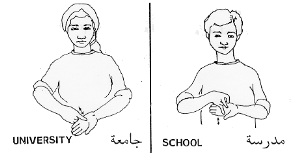
An everyday scene at the Total Communication School (TCS) in Ramallah, one of the very few private institutions providing rehabilitation (including education) for deaf Palestinian children. Reem, the teacher, says: 'These children are fantastic actors. Before they came to the school, acting and physical movements were often the only ways of expressing themselves. They are often wrongly labeled as being hyperactive.' In class, Reem, who is hearing, is always assisted by a deaf teacher. The School offers 'total communication': sign language, spoken language, lip-reading, reading, speech and oral training. It is one of the projects of the Central Deaf Association, founded by deaf Palestinians in 1990, and has five aims: education, teacher-training, family and CBR work, provision of equipment and curricular development. Education is one of its priorities. The Palestinian sign language used in the school (a 'dialect' of general Arabic sign language) has been documented by the organization in cooperation with an American specialist in an attempt to unify usage. The next stage will be a sign language training book.
This Palestinian sign language is also taught at Atfaluna Center for Deaf Children in Gaza City, which was set up by a society of concerned women. 'We concentrate mainly on language,' says Gerry Shawa, the director. 'You have to give a deaf child meaning to words, understanding of his world. When the children first came to us two years ago, they did not have the concept of language. For us, as hearing people, language and speech are one, but for a deaf child language is one thing and speech something else entirely. If you ask a mother, for example, why her deaf child can't speak, her answer would be that he is deaf and dumb. We then ask her what would happen if she was watching TV in Japan and someone turned down the volume asking her to repeat what the presenter was saying. You don't know the language and you can't hear what he is saying, so how can you repeat it? At first these children did not know the concepts of one, two and three, or that things have names, a table, a chair, or a person's name. Language and mathematics are skills that allow the child to be part of the community, and to go on to other things. But our program also includes Arabic, auditory training, art, and science.'
Both the School in Ramallah and the Center in Gaza are well-organized, welcoming places with a comprehensive teaching program and enthusiastic teachers and staff. The children clearly like to come here and learn. Unfortunately these small, private, largely foreign funded schools are exceptions rather than the rule. 'Some people estimate that we may have as many as seven to nine thousand deaf children in the Gaza Strip alone,' says Gerry. 'From our records it seems that many of the cases are genetic, and if the gene is in the family and you intermarry, which is common here, you have a problem. We have 450 children on our waiting list.' Most of these deaf children stay at home without education. 'They have a very lonely life and are very, very isolated, especially if they are the only deaf child in the family' says Reem. 'Of course it depends on the family. Some parents are very frustrated at the lack of communication, and neglect or hit the child. Other parents smother the child out of pity. The children themselves are often very stubborn, will refuse whatever is offered to them, or be frightened of everything around them.'
'People just don't realize how isolated it is to live in a world of silence without understanding what is going on around you,' says Gerry. 'Some fortunate children may have concerned parents who develop a simple system of communication, but in big families nobody has time to develop it further. When the children first came to the school the younger ones had no idea where they were, who we were or whether they were going to be taken back home at the end of the day, because there was no communication between them and their parents. Two little sisters sat here for three months, clutching each other's hands, weeping quietly from the time they came to school to the time they went home. Now you see them coming in chatting away with each other -- in sign.'
There are few other centers offering 'rehabilitation' for deaf children, and the above two only offer a limited number of years. According to Muhammad, a teacher at TCS, there are nine private centers in the West Bank, and (according to Network information) only three in the Gaza Strip. 'They mostly concentrate on reading and writing,' says Muhammad, 'and they have no proper program. Sometimes it is simply a way of parents paying to keep their children off the streets. Often, different disabilities are put together and children are treated harshly.' The teachers may be unprofessional and often do not even have their tawjihi. 'Recently some of these teachers came to visit our school,' says Reem. 'Two of our students had been rejected by their school, and they started crying when they saw their former teachers.' Akram and Dalal, respectively the director and a teacher at TCS, both had their schooling in Jordan, -- seen as the only good alternative.
When Akram returned after studying in Beirut he tried to find work or adult education courses, but was not accepted for either, while people with other disabilities were. 'They laughed at me, especially if I was signing,' he remembers. 'Even if they find work, deaf people are often underpaid. One carpenter only allowed me to sweep up after him. For women, work and study options are even more limited. There are a few vocational centers, where they learn sewing or hairdressing, but most end up helping their families in the household. Self-sufficiency is usually out of the question. Gerry Shawa: 'We hope to keep working with the particularly bright older children until we can perhaps get them a scholarship for a university for the deaf abroad. We try to give the other children enough skills to place them in some sort of trade; we have a small pre-vocational training unit which we hope will grow into an income generating business where our graduates can run their own projects.'
At present both the Center in Gaza and the School in Ramallah, being considered charitable organizations, come under the jurisdiction of the Ministry of Social Welfare. Both feel they should be recognized as schools, and should fall under the Ministry of Education. 'It is very important for these children to feel that they are part of the school system,' says Gerry. Both schools expressed the urgent need for a comprehensive, unified government curriculum for the deaf up to university level. 'There are no standards or regulations at the moment,' says Akram. Financial governmental assistance is another important issue, either to existing private schools or for the establishment of government schools. 'Parents cannot pay high fees,' says Muhammad, 'and most of them are very poor.' Moreover, teacher training has to be provided; in the absence of university equivalents, the two schools have organized their own courses with local specialists.
Would mainstreaming be an option? 'The deaf people I know that were mainstreamed (in the United States) told me they suffered terribly,' says Gerry. 'A moderately deaf person will have a chance, but when you have 50 to 60 children in a classroom, as is the case in Palestine, and only one teacher, even amplification devices are of no use. Moreover, lip-reading is very difficult and will only work if the child starts to learn very early.' Muhammad feels that in moderate cases of deafness mainstreaming would be possible. 'Often a hearing aid, installed early, can solve a lot of problems,' he says. 'Some of our students were thrown out of a local school because they were 'stupid'. In fact they were moderately deaf and are doing exceptionally well with us. We hope to re-integrate them into a regular school in the near future.'
Even though teachers and staff at both schools say that the situation of the deaf in Palestine is gradually changing for the better, they feel a lot still needs to be done. Both schools encourage strong family contacts through home visits, social workers, weekly meetings and sign language classes for parents. Reactions are generally very positive. 'Parents are thrilled to have their children in the school, especially those parents who are deaf themselves and never had a chance to be educated,' says Gerry.
'Society is an important learning place,' says Muhammad. 'Education can help children to integrate and participate fully in society. We must teach society that a deaf child is like any other child.' Atfaluna Center does some community work to help change societal attitudes. 'Hearing aids are real status symbols in the school, but the kids do not like to wear their them outside,' says Gerry. 'They do get teased, so we have held some talks, and have our children appear in ceremonies or conferences to sing the national anthem in sign, and encourage the use of sign translators (especially on Palestinian TV) so that the children will feel confident about signing. We have given deaf adults the chance to be teachers, to be role models. These are our modest attempts at changing people's attitudes.' And Reem gives a positive summing-up: 'We need to give these children confidence in themselves, to be proud of who they are and to realize their dreams.'
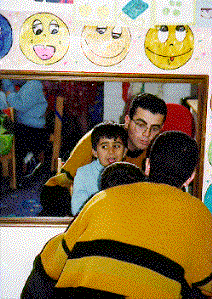 Speech
Therapy at the Atfaluna Center
Elaine Clark
Educational Network, POB 66, Ramallah, West Bank
tel: 02 995 6230/fax: 02 995 6231 e-mail: eclark@ednet.birzeit.edu