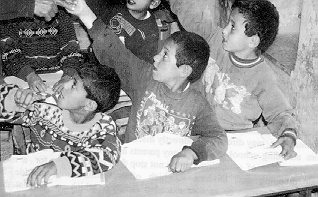
Gazan teachers confirm that students are more able to concentrate in class since autonomy
A recent statistical projection, drawn from a field study conducted by the Palestinian Ministry of Education (*1) indicates that the drop-out rate within West Bank and Gaza Strip schools has reached 5% of the school population. This deplorable situation, which may involve some 30,000 school children and which has been confirmed by several other studies during the past few years (*2-4), constitutes one of the largest challenges to Palestinian education - especially as over 50% of the population is of school age and 20% of the total population is illiterate (*2).
Drop out rates have risen considerably during the past ten years. Whereas they were still at 4% in 1985/86, they were estimated at between 19-24% between 1987-1994. The highest drop-out rates are found in the preparatory and secondary level. Drop-out rates are usually slightly higher among girls, though this is less so in Gaza. Geographically, the highest rates are found in villages in the West Bank (62.5%) and in cities in the Gaza Strip (67%); the lowest rate in camps in the West Bank (7.5%) and in villages and camps in Gaza (19 and 14% respectively *1).
There are many reasons why children drop out of school. Sometimes they finish a certain level, but do not continue to the next one, sometimes they drop out in the middle of a year. They may leave of their own volition, or because they are forced to do so by factors beyond their control. Moreover, students who are registered but do not actually attend classes, and children never enrolled in school are invisible in school registration statistics.
During the intifada, the drop-out rate reached a high water mark. The various activities of the Israeli military, including raids on schools and clashes with students in the school grounds, frequently led to the injury, imprisonment or death of students. Children became fearful and unable to concentrate in class. Further, they were often prevented from reaching school by strikes and curfews - and even by their parents' fears of sending them to strife-ridden schools. This lack of continuity inevitably deprived children of the stability necessary for sustained school attendance - and on the other hand it led to children who, through their pre-occupation with politics and defiance of authority, developed a precocious maturity. Those released from prison scorned a return to their school benches.
With the transfer of education to the Palestinian Authority, many of these problems have diminished (although in the West Bank clashes between Israeli soldiers and students still occur), and teachers in Gaza confirm that students have become more relaxed and able to concentrate in class. However, there are other factors influencing the drop-out rate which have not disappeared.
High inflation, the disastrous economic situation (particularly since the closure of the West Bank and Gaza Strip), large families, and the absence of an effective law against child labor compel many boys (18% *2, 50% *3) to leave school and enter the labor market at a premature age, in particular if one or more of the older males in the family are sick or imprisoned. These boys usually end up selling newspapers or fruit on the streets, or working in their father's business or fields. Seeing their 'freedom, status and money', other boys are inclined to follow their example.
Girls may not go out to work (although some do) but are often expected to help their busy or ailing mothers when they get older. Girls tend to drop out more often than boys when they get older, because of certain social traditions: one headmistress in Gaza saw the number of girls in her preparatory school decrease from 875 to 654 in one year. Many parents, particularly in rural communities, do not see the benefit of educating girls and arrange early marriages for them. Moreover, many parents refuse to send their daughters to schools outside their village or to coeducational-educational schools, which is often inevitable after the preparatory level. Parents' lack of awareness of the need for education, especially if they are illiterate or live in rural communities, may directly or indirectly discourage children from attending school. In fact, many parents acknowledge the importance of education but do not stop their children from dropping out. Divorce - which often results in children's relocation to another extended family on which they are dependent - and decreasing health standards also play a role in dropout rates.
The education system, neglected and obstructed during 27 years of Occupation, is also a contributing factor. Although statistics may indicate failure as a main cause for children leaving school (93.8 of boys, *3), further inquiry often reveals that the reasons for such failure lie not with the child but with the system. It is a well-known fact that the obstruction of educational development during the Occupation period has resulted in an outdated, inappropriate curriculum which has no relation to the everyday life of the student: thus the frequent question: 'Why are we learning this?' is very legitimate. The many problems during the intifada have caused a severe backlog in education, so that many children are routinely pushed up to the next grade without being ready. The lack of active learning activities, sport, art and extra-curricular activities results in an under-stimulated, bored student, further affected by severe overcrowding in classrooms and lack of the most basic facilities.
In all surveys, treatment by teachers and teaching methods were given as other reasons for leaving school. Teachers' heavy workloads and deteriorating economic conditions, the high number of students, and the use of outdated teaching methods result in many problems. 60% of dropouts in a Gaza survey (*2) stated treatment by the teacher as their main reason for leaving school. 'The teacher would give his lesson and leave without having explained anything', said one student, 'so we didn't understand what he had told us. If we asked he would shout abuse at us, so we preferred silence rather than asking and being hit or insulted. We started to hate school and fail. Some of us dropped out'. (*3) 'Teachers tend to focus on the clever children, and often do not (have time to) pay attention to slow learners or handicapped children. Methods of assessment are based on academic, non-analytical and subjective exams. It is therefore not surprising that a large number of drop-outs state as a reason for their leaving school the fact that they are mish shater (not clever) or mushaghib (troublemaker).
The Ministry of Education has made a good start at tackling the problem by its recent survey on drop-outs, and its plan for a more comprehensive, nationwide study which will provide detailed information on the measures needed to combat the drop-out phenomenon, in addition to the efforts the Ministry is presently making to improve the system through curricula development, improvement of school buildings and teacher training. Achieving a steady decline in the number of drop-outs will also require compulsory education and laws against child labor, in combination with awareness campaigns on girls' education, an increase in the number of rural (girls) schools and the accessibility of other schools through cheap and reliable transport and financial assistance to needy families. Schools should be attractive to children, offering sports, arts and extra-curricular activities that supplement and enrich the formal curricula. Other concerns voiced by local organizations include the establishment of kindergartens to prepare children for school, proper programs for the mentally and physically disabled and the review of current assessment methods. This will be combined with literacy and retraining programs for those who have dropped out of the system.
Sources: *1, Ministry of Education, Summary of the Report on Dropouts in the West Bank and Gaza Strip between June and December 1994, January 1995 / *2, M. Hussein: The student drop-out phenomenon in schools in the Gaza Strip, 1987-1994, al-Tuffah Center, Gaza, 1995 / *3 Women's Studies Center and UNICEF, The drop-out phenomenon in Ramallah, June 1993 / *4 W. al-Qadi, Effects of the government schools dropouts on the rise of illiteracy in the OPT's (1987-1993), Education Dept., Al-Najah University, Nablus 1994 / *5 N. Sanduka, Swapping School for the Sweatshop, Jerusalem Times, March 1995.
Elaine Clark
Educational Network, POB 66, Ramallah, West Bank
tel: 02 995 6230/fax: 02 995 6231 e-mail: eclark@ednet.birzeit.edu