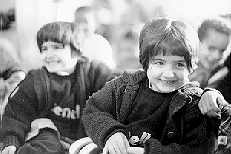
Palestinian Children at a Kindergarten in Jerusalem
'What will become of you, children of the stone? What kind of students are you, and will you ever go to university? What kind of parents will you be, warm and happy, or neurotic and abusive? What teachers will we have, what lawyers and what leaders?'(*1)
The signing of the peace treaty was undeniably a great victory for the Palestinian children who had defiantly confronted the army jeeps. The natural playground of the streets was where they had avenged their father's humiliation at the hands of the soldiers, where they had turned their fear into angry defiance and where they had joined the heroes. Now they had become the core of the peace treaty festivities, cheering and dancing, and proudly displaying the Palestinian flag on their T-shirts and bicycles.
The intifada has been described as a therapeutic process that turned Palestinians from victims to masters of their destiny - but it can also be characteristic as a war against Palestinian children. Thousands lost their education, and a large majority has been physically or psychologically damaged in a childhood of turmoil. A community sample of 1,200 Gazan children between 7 and 15 years of age showed that 92.5% had been tear-gassed, 85% had been subjected to curfews and night raids, 55% witnessed assaults on family members, 42% had been beaten, 23% had been injured and 19% had been detained themselves. Children have had to endure both violence and humiliation; the violence of being shot for flying a kite bearing the forbidden national colors for example; the humiliation of their squalid surroundings and having to witness fathers and brothers queue up for low-paid jobs in Israel.
For the children traumatized by the intifada, the peace treaty indicated that perhaps their suffering had served a purpose. But the effects of past trauma do not disappear overnight, especially when economic and social circumstances do not improve and soldiers and settlers still roam freely in most of the Occupied Territories. Many children suffer from trauma which inhibits effective learning and causes severe behavioral problems in school. Iyad al-Sarraj, of the Gaza Community Mental Health Program (GCMHP) says: 'We have lost a generation of school children because of the trauma and the violence and the deprivation of their schooling during the intifada. We have seen thousands of traumatized children. To give but one example, there was the case of a little six-year old boy who was throwing stones at the Israeli soldiers. The soldiers chased him to his home. He caught hold of his mother and screamed at her not to leave him, but they snatched the boy from her and took him away. She chased them for nearly one kilometer but they disappeared with the child. They released him the same day, but before they took him to the police station they beat him. One of them pierced his skin with a knife, and another put a cigarette out on his skin. Since that time the child refused to leave home, would not leave his mother's side, did not sleep and lost his appetite. When he started to wet his bed, scream in his sleep and have nightmares he came to see us. Now he is much happier but he still suffers from flashbacks and diminished concentration at school. Another little boy told me he wanted to be a rubbish collector. When I asked him why, he said that rubbish collectors can move freely: he wanted the freedom to go and see his father in prison (whom he could only touch through the bars on rare visits.)'
Research has proven that increased exposure to trauma, especially through active participation in intifada activities, results in diminished concentration, self-esteem, attention and memory. Many teachers will confirm that children are restless, hyperactive and easily provoked in class. Many are defiant and aggressive towards the teacher, whose authority has been severely undermined by the intifada, which, to a certain extent, was a defiant cry against all forms of authority, including the authority of the school, and by the fact that children had witnessed the beating and humiliation of fathers and teachers, so that they failed to identify any longer with them but sought out new idols, including the intifada heroes and, in some cases, even the Israeli soldiers.
The problem is compounded by the traditional approach of teaching. Authoritarian and oppressive discipline continues to be the accepted concept in both families and schools. Most teachers do not know how to mold the students' new 'intifada energy' to the benefit of the learning process, and the combination of more than forty troubled, restless children in the classroom taught by someone who is often traumatized himself have resulted in the deplorable use of violence instead of communication to regain authority. In a study of the Palestinian Center for Non-Violence in Gaza it was found that 87% of children are beaten in school and at home. If the teacher is not helped to find ways of democracy and free expression in the classroom, and the children's trauma is not addressed, the teacher will continue to employ physical means of discipline, resulting in terrified children encouraged to lie and be dishonest. Those abused children will be affected in their cognitive development and will, in turn, transmit their trauma to their children in the future, as often happens with the many Palestinian men who were imprisoned and tortured and who find a perfect target for their pent-up anger and frustration in their wives and children.
In addition to the problems of discipline and authority, there are a number of emotional and mental problems commonly found in traumatized Palestinian children that indirectly affect their education and are a contributing factor in low achievement levels and drop-outs. Children are anxious, fearful (in particular of the teacher), they suffer from nightmares. 'Bedwetting is nearly endemic.' Al-Sarraj: 'All the reasons in the world for bedwetting are here: violence at home; lack of harmony between the parents; shouting; beating of the mother; insecurity on the street and at home; widespread stress in the community: you are bound to expect that 60% of the children are bed-wetters. As it is considered very shameful for a boy to be a bed-wetter, you find more girl bed-wetters than boys. In boys the suppressed energy diverts to anxiety, aggression, tics, and stuttering: stuttering is much more prevalent among boys; it becomes a replacement of bedwetting.'
Al-Sarraj: 'The problems have not decreased after the peace treaty. The effects and victimization of torture and trauma will continue to produce more trauma. There is a theory that when you relax, suppressed problems and tension will reappear. The fact that the released prisoners and the children of the intifada are traumatized and suffer makes people very anxious; you have to deny to live, survive.' A so-called delayed grief effect' will inevitably affect a large part of the population as they start to realize their loss: the loss of loved ones, of health and chances, the loss of the dream of the liberation of all of Palestine, and the loss of the enemy, which will results in the discovery of internal enemies.
For the youth who fought the intifada there is also the loss of role of the hero. They have become very bitter as they see that their hopes might turn out, yet again, to be illusions. Becoming a martyr is one way to escape the despair and helplessness which are wide-spread among the young in Gaza. Drug addiction may become another escape from boredom and depression, especially if the intimidation of Hamas drug squads by the Palestinian authorities leads to the reappearance of drug dealers, and once the borders with Israel are re-opened.
Despite the extent of the trauma, there are very few services offered to the public. Mental illness is highly stigmatized due to ignorance, fear of being possessed and denial, resulting in physical presentation of the problems, compounby resistance to mental health issues of the medical establishment. Until the foundation of the Palestinian Counseling Center (PCC) in Jerusalem in 1983 and the GCMHP there were only two mental hospitals, one in Gaza and one in Bethlehem, and a few private clinics in the West Bank. The PCC initially provided counseling to students in schools. and now offers a range of services including group therapy, marriage and individual counseling, career guidance, lectures and training courses and psychological testing. Samir Shkeir (PCC): 'Teachers are often not able to solve students' problems, due to lack of time, or because students feel uncomfortable talking to an authority figure. In the Center we aim to promote students' self-awareness and to help them to discover their potential'.
The GCMHP is based on a community approach and emphasizes training to fill the urgent need for mental health professionals. The center initially delivered services to traumatized children in particular. Later they also started to work with torture victims and women. Al-Sarraj: 'After working in this culture for some time, with the trauma, the violence and the violations of human rights, we came to believe that mental health means harmony, happiness within yourself and with your community, which means dignity, human rights, and democracy, empowering people to take their own lives into their hands. This is why we closely link the question of mental health with the environment and the question of human and civil rights'. The GCMHP has three programs to deal with children's trauma. The first one is play-therapy with a one-way mirror for observation by the mother. 'At home the mother doesn't have enough time for the child, but here she can observe him for one whole hour, and she suddenly starts to understand. We also visit homes and try to engage the family in the therapy'.
The third and innovative method is the formation of teacher groups in schools. 'We want to get teachers to talk about their trauma, about group dynamics, about children and their problems, to try and promote new concepts of communication between teachers and children and to identify problems that need further treatment. We cannot go to individuals and tell them they need help, but teachers that have been tortured can be approached through group work. That way the stigma is gone. After a year of group work, teachers are encouraged to form their own groups. We feel that through this method we can make a real change. I cannot claim that we have a major impact on our culture, but I hope that through this approach we can reach a wider audience and get a new message to the people. Perhaps we will be able to instill some of the principles in people that can carry it on.'
Al-Sarraj: 'On the whole I would like to see the Palestinian authority decrease centralized control because it is undemocratic. They should allow the private sector to flourish, private enterprise, NGO's, schools and universities, and put together a body of experts, including social workers and psychologists, who can decide on planning and follow up for the rehabilitation of teachers and curricula. The Authority should address the human element. Funding should not just be spent on school buildings, on visible improvement. Teachers and children should take precedence over infrastructure and security personnel because they are the cornerstone of the future.'
Iyad El-Sarraj: Peace and the Children of the Stone. This article is based on interviews with S. Shkeir and I. El-Sarraj and the articles The relation between traumatic experiences and cognitive and emotional responses among Palestinian Children: Impact of Peace Treaty on Psychological Well-Being, by S. Quota, RL Punamaki, I. El-Sarraj, and Mental Health and Palestinians under Occupation: Peace the Children of the Stone: Peace and States of Mind; and Palestinians in Transition by I. El-Sarraj.
Elaine Clark
Educational Network, POB 66, Ramallah, West Bank
tel: 02 995 6230/fax: 02 995 6231 e-mail: eclark@ednet.birzeit.edu