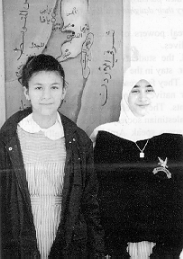
Girl returnees to Gaza: "We have to be patient. Gaza will get better in time."
Thousands of Palestinian families have returned from all over the Arab world to their native land in the wake of the self-government phase in Gaza. What do their children feel about their new surroundings?
The return of Yasser Arafat to the Gaza Strip was a much publicized and celebrated event, not least because he was accompanied and followed by thousands of families coming back to Gaza after long years of enforced economic or political exile owing to the Israeli Occupation. In the Gaza Strip, returnee families have come from all over the Arab world: from the Levant, Tunisia and the Gulf, to Egypt, Iraq, and even Sudan, so that schools have had to deal with an influx of children (*1) from a variety of economic, social and educational backgrounds.
The Network visited a number of UNRWA schools in Gaza to talk to returnee children about their experiences of their 'new' homeland. The girls all spoke about their arrival with smiles on their faces. 'They were so curious about my life in Tunis' says Fatima (12), whose father now works as a police officer. 'I felt a little alienated at first' says Samah (11) who came back from Yemen, 'but my relatives really tried to make me feel at home, and I soon made friends'. Maha (14) says that she prefers Tunis for its beauty, but Gaza for its social relations. Regarding their new schools, Sundus (13) finds that there is a large emphasis on religion in Gaza, but that the teaching is much better than she expected. The school in Iraq had more facilities (a fact expressed by girls coming from most countries) but 'we have to be a bit patient. Gaza will get better in time'. The girls found difficulty adapting to social restrictions. 'I live in my uncle's house' says Maha, 'and they won't let me go out on my own as I used to do in Tunis. They also asked me to cover my head for Ramadan'.
The boys tell a different story. Their new peers were curious, but in many cases they were also downright mean. Umar (9) is so scared to tell us of the teasing that he only talks in a whisper. His father has worked in a Ministry since his return from Syria. Mohammed (11) says: 'I came from the Sudan eight months ago and the boys keep on teasing me and calling me 'Sudani' (peanut) or nigger. I don't really like it here.' Most of the boys we spoke to find school much more difficult in Gaza. Mohammed's class in the Sudan had 136 (sic) children, so that he has problems keeping up, as does his friend who came from Egypt. 'The school in Libya was much easier' says Usama (10), 'I liked it better'.
Teachers confirmed our findings, saying that girls quickly find friends while boys seem to be less easily accepted. Older girls, however, may experience problems if relatives restrict their freedom of movement or expect them to veil. They may also be uneasy with male teachers. Concerning educational problems, the children that come from Egypt, Libya, Yemen, Algeria, Saudi Arabia and the Sudan generally have difficulties in keeping up in school. The focus on French in Tunisia and Algeria has necessitated extra tutoring in English, especially at higher levels. Children that have come from schools in Tunis and Lebanon find difficulty adapting to the stricter classroom atmosphere in Gaza. However, all teachers stressed that the main determinate of the returnee children's educational achievement is the social and economic background of the family, and the interest and support the give to the child.
*1. The Rimal Preparatory Girls School, for example, which has 744 students, received 56 returnee children. The total number of returnee students registered in September in UNRWA schools amounted to 4216 out of the total of 11622 new students.
Elaine Clark
Educational Network, POB 66, Ramallah, West Bank
tel: 02 995 6230/fax: 02 995 6231 e-mail: eclark@ednet.birzeit.edu