 Poverty
in Palestine: Case Studies
Poverty
in Palestine: Case StudiesPublications
Poverty
in Palestine: Case Studies
Ramallah,
Birzeit University, Development Studies Programme, 1999.
Hadeel Riziq-Al-Qazzaz and Nader Said
This study
considers the phenomenon of poverty from the perspective of the poor themselves.
This kind of research approach corresponds with the concept of human development
that encourages the participation of people in defining their own problems. The
book offers an analysis of the different aspects of poverty by focusing on the
factors that the poor believe produce poverty. It analyzes issues relating to
poverty from the point of view of the poor themselves such as unemployment,
child labor, and gender differences. It further attempts to find out the opinion
of the poor as to what produces poverty in Palestine and ways to eradicate it
along with their assessment of their living conditions and their rights and
duties in society. The study includes the views of social workers regarding the
same issues, looks at their role in dealing with poverty, and assesses the
possibilities of advancing a development vision to work with the poor and to
help them overcome their condition.
The book consists of five chapters. The first chapter is about poverty in Palestine-- a conceptual background. The second chapter is about an analysis of poverty from the perspective of the poor, which presents different case studies such as that of a widowed mother, a job seeker, and a mentally ill person. The third chapter is entitled “General Directions”, and it investigates the factors that produce poverty and its various forms, the aid received by the poor, and ways of coping with poverty. The fourth chapter centers on the views of social workers. The last chapter presents some concluding observations.
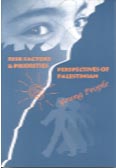 Risk
Factors and Priorities: Perspestives of Palestinian Young People
Risk
Factors and Priorities: Perspestives of Palestinian Young People
UNICEF and Development
Studies Programme. Birzeit University. Ramallah: Development Studies
Programme, 1999
The current study on
“risk factors to physical and mental health and well-being, and
the priorities of Palestinian youth” was conducted jointly by the United
Nations Children’s fund (UNICEF) and the Birzeit University Development
Studies Programme. The goal of the study was to encourage and enable the
participation of Palestinian youth in assessing their needs and priorities.
The study involved interviewing 134 children and youth between the ages of 10
and 22 through a series of focus group discussion. These workshops took place
throughout the areas of the West Bank and Gaza Strip. This study is divided
into three sections. Section 1, concept & methodology. Section 2,
presentation of findings. Section 3, conclusion & recommendations.
 The
Global Human Development Report 1998 : Palestinian Readings
The
Global Human Development Report 1998 : Palestinian Readings
Development Studies
Programme . Birzeit University & UNDP/PAPP. Ramallah: DSP, 1999
This is a report of proceedings of a seminar held on November 2, 1998 entitled "The Global Human Development Report 1998” sponsored by the Development Studies Programme - Birzeit University and the UNDP. The report focused on world consumption according to factors such as : size, trends and concomitant results. The report disclosed that despite the historically unprecedented peak in accumulated material wealth, the numbers of homeless, unemployed and hungry people are on the rise globally, thus suggesting that the gap between rich and poor is increasing. The report presented suggestions for dealing with problems of poverty and the environment in developing countries. Emphasis was placed upon the importance of reviewing trends of consumption and steering it towards human development.
 Human
Development in Palestine: A Participation Approach. A Report on the Activities
of the Development Studies Programme 1998
Human
Development in Palestine: A Participation Approach. A Report on the Activities
of the Development Studies Programme 1998
Ramallah, Development Studies Programme, 1999.
During 1998, two of the main goals of the Programme were conducting studies and scientific research to encourage wide and constructive discussion of development, and encouraging development institutions (both governmental and non-governmental) to include human development among their priorities. In 1998 the Programme prepared scores of studies, reports, and articles and raised issues that had not been discussed before. For example, it dealt with the concept of development in Palestine, its measurement, and the degree to which development concepts apply to the Palestinian context. The Programme organized several workshops on a variety of issues that concern different sectors such as the disabled, job seekers, released prisoners, farmers, women, and social workers. This report’s chapters introduce the general philosophy of the Programme, its studies and research, the Human Development Report 1998, the Center for Development Resources and its main achievements, community outreach and the workshops and training conducted for this purpose, and the media.
 Towards
Alternative and Self-Reliant Agricultural Development
Towards
Alternative and Self-Reliant Agricultural Development
Kerzem, George. Ramallah. Birzeit University, 1999.
This study proposes a popular, approach to agricultural development; amodel of production as an alternative to the official economic plans and policies in general, and to the official Palestinian and international plans and policies designated for the West Bank and the Gaza Strip, in particular. The study intensively analyzes the most important objective and external causes for the weakness of the Palestinian agricultural economy. In addition, it provides a critical analysis of the existing agricultural proposals, policies, and strategies, which are all based on the fact that the Palestinian economy is dependant on the Israeli economy. The study also deals with the role played by subjective factors in increasing the weakness of the agricultural economy. Moreover, it looks at the possibilities of strengthening popular agricultural production through the adoption and implementation of an agricultural strategy focused on the local market. This can be achieved by allowing for popular productive initiatives that are self-sustaining, and by encouraging sectoral integration and unofficial agricultural activity. In the final analysis, the study argues, it is important to put an end to external intervention from Israel and others, to work on guaranteeing productive variety and food security, and to link agricultural strategy with industrial development.
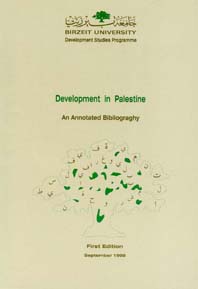 Development in Palestine: An Annotated Bibliography (Arabic and English)
Ramallah : Birzeit University, Development Studies Center, 1998.
The current Bibliography provides the users with titles and summaries of books articles, and reports related to the subject of development in Palestine. In sum, 498 references are listed (235 in Arabic and 263 in English). The Bibliography might be used as a reference for researchers, students and other concerned officials in government and non-government institutions. It includes information on the contents of various publications as well as on their location.

Planning for Development-Economic Planning (in Arabic)
Nader Izzat Said, Ramallah : Birzeit University, Development Studies Center and Ministry of Planning and International Cooperation, 1998.
Planning for development series, 1.
This is a first volume of a series of workshops on planning for development. This study aims at setting forth the theoretical and applied dimensions of planning in a Palestinian development context. This book consists of the following papers:

Funding Palestinian Development (Arabic & English)
Nader Izzat Said, Ramallah : Birzeit University, Development Studies Center and Ministry of Planning and International Cooperation, 1998.
Planning for development series, 2.
This study is in both Arabic and English, constituting the second publication in the series “Planning for Development”, it treats a crucial topic development funding. The subject encompasses many different types of funding such as international funding, local funding through taxes, and private sector funding. It also includes the role of international funding in development or de-developing the Palestinian society. The book consists of the following workshop papers:
The Demand for Palestinian Labor in Israel and the Occupied Territories (in Arabic)
Mohammad Khaliefeh, Ramallah : Birzeit University. Development Studies Programme, 1997.
Originally an M.A. thesis submitted by the author to the Economics Department at Yarmouk University, Jordan, this book is published by the DSP as part of its efforts to encourage scientific research in Palestine. The book looks at the historical development of Palestinian labor in both Israeli and Palestinian markets. It describes labor ‘s social and economic conditions, attributes, and distribution. It also deals with the effects of labor movement on the economy. The study includes comprehenisve statistics of different aspects of labor and offers important recommendations.

Women and Development (in Arabic)
Ramallah : Birzeit University, Development Studies Center and Ministry of Planning and International Cooperation.
This book consists of four papers, submitted in a workshop about women and development held by the DSP in cooperation with the Union of University Graduates (Hebron). The workshop is part of DSP effort to reach all Palestinian areas and to enrich the discussion about development. The papers are:
Human Development in Palestine: Preliminary Perspectives on the Concept and Measurement (in Arabic)
Ramallah : Birzeit University, Development Studies Center, 1998.
This study is the result of research conducted by a group of Palestinian researchers on the concept and methodology of human development in Palestine. Edited by Nader Said, the book consists of four research papers that discuss the United Nations’ concept of human development and the possibility of applying this concept to the Palestinian condition. The four papers are:
Women and Work in Palestine: A Briefing On the Situation of Women in the Employment Sector in Preparation for the ILO Mission (in English)
Nader Said, Anita Vitullo and Hilmi al-A’raj, Ramallah : Birzeit University, Development Studies Center, 1998.
This report has been written to assist an ILO mission for formulate a national plan of action in Palestine for “More and Better Jobs for Women”, part of a global ILO programmes to encourage the integration of women in employment sector.
This paper is an attempt to identify the existing “post-Beijing” institutions and mechanisms for advancing women’s employment status, and to highlight interventions. Recommendations made by the public, private and NGO sectors and unions on how to increase the quality and quantity of work available and accessible to women and to improve their conditions of work are listed and summary statistics drawn from current research identify some gender gaps.
In addition, the study recommends creating new work opportunities for women and training them in non-traditional fields. The bulk of the report is an annotated bibliography on women, work, and development in Palestine.

Palestine - Human Development Report 1996-1997 (Arabic & English)
Birzeit University. Sustainable Human Development Project 1996-1997, Ramallah. The Project. 1997.
This report surveys the main features of development in Palestine. The first section is a theoretical and methodological introduction and a review of the development experience in Palestine as to concept, performance, and environment. The second section considers a number of economic, educational, and health indicators in their relation to the vulnerability of Palestinian society. Indicators relating to the demographic situation and to civil, political, and cultural rights were added, with a special focus on vital groups such as women and children. Section three offers probable scenarios for the future of development in Palestine. The final section consists of appendices, including statistical tables describing the development situation in Palestine. The report’s methodology combines scientific analysis of data with meetings with experts in different governmental and non-governmental organizations. As a whole the report emphasizes sustainable develo, which will be achieved only with the end of the occupation and with the adoption of a unifyinand comprehensive development vision in Palestine.
Human Rights and Human Development (in Arabic)
Mirvat Rishmawi. Ramallah. Birzeit University. Sustainable Human Project. 1997. Development Papers Series (1)
The paper consists of four parts: the first describes the integrated relation between human rights and human development. The second offers a general description of the specificity of Palestinian human rights. The third section defines the obstacles facing human rights in Palestine as a result of the occupation, local laws, and the relationship between the three authorities. The fourth part discusses participation in development planning and accountability, both of which are important aspects of human rights and development. The paper recommends, among other things, passing the basic law and committing to human rights on the part of the executive and national authority.
Environment and Human Development in Palestine (in Arabic)
Jad Ishaq and Violate Qoumsyeh. Ramallah. Birzeit University. Sustainable Human Project. 1997. Development Papers Series (2)
This research paper uses a number of indicators to evaluate the environmental condition in Palestine, including the destruction of land and water, pollution, wastes, climate change, desertification, environmental variety, and energy use. The study concludes that it is difficult to use these indicators to evaluate environment in Palestine because of the political situation and the absence of Palestinian control over natural resources. The study includes important tables and maps.
Gender and Human Development in Palestine (in Arabic)
Liza Taraki & others. Ramallah. Birzeit University. Sustainable Human Project. 1997. Development Papers Series (3)
The book consists of three sections. The first, entitled “The Importance of Gender in Human Development," introduces the main features of Palestinian society and economy and submits data about the opportunities available to women and the main obstacles facing them. The second section, “Gender and Human Development,” evaluates the gender gaps that obstruct development. The third section, “Woman and Poverty: Consequences of Gender Poverty,” sheds light on gender and poverty. It shows that there is a horizontal and vertical division in the Palestinian labor market that makes women’s access to wealth and property much lower than men’s.
Education in Palestine (in Arabic)
Ibtisam Abu Diho. Ramallah. Birzeit University. Sustainable Human Project. 1997. Development Papers Series (4)
This research paper sheds light on the educational structure in the West Bank and the Gaza Strip. It highlights the importance of the demographic, economic, and social factors and their influence on the educational process. It also specifies the main funding sources of education in Palestine.
Palestinian Health Strategy: The Challenges Ahead (in English)
Ziad Abdeen. Ramallah. Birzeit University. Sustainable Human Project. 1997. Development Papers Series (5)
The paper consists of three parts. Part one describes the general health situation in the West Bank and the Gaza Strip and provides details for some health indicators such as life expectancy, birth and death rates, hospital conditions and preventive medicine. Part two describes the close relationship between health, development, and the principles of a long-term national health policy. Part three talks about a strategic framework for primary health care and community outreach care. It also offers a Palestinian health strategy and describes the challenges ahead.
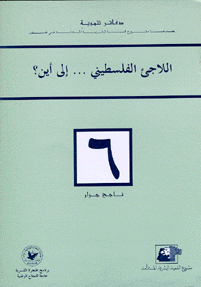
Palestinian Refugees: Where To? (in Arabic)
Najeh Jarar. Ramallah. Birzeit University. Sustainable Human Project. 1997. Development Papers Series (6)
This research paper sheds light on the international, economic, and political dimensions of the Palestinian refugee problem. It introduces and analyzes the validity of various solutions such as improvement of conditions, absorption by host countries, and voluntary return.