Discovering Oslo 2 Diary
5th-18th March 1996
Locked in Ramallah for two weeks, part II
MONTHS!
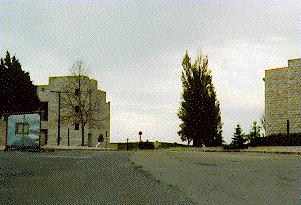
Right: Birzeit University campus, shut down by checkpoints around all Palestinian areas for almost two weeks, disrupting university life from 5th to 18th March.
Yesterday, 5th March, after seeing the mess in Ramallah as students waited fruitlessly for the roads to reopen, I went down to the checkpoint. As I approached it, having been warned by a Palestinian police checkpoint before it that there was no way on earth I was going to get through, an Israeli soldier there started yelling at me. "Effo?!" Effo?!" ("Where?!") and other similar phrases in Hebrew wafted up the valley towards me, as I pretended I really had not idea what was going on, until I had arrived at the jeep. "Excuse me, do you speak English?" I asked, "What's going on?" "Closure! Closure!" he screamed. "Oh," I replied, "and how long will it go on for?" "MONTHS!" he shrieked and began pushing me back up in the direction I had come. I'd never seen them so mad. I walked back up the hill and checked out the Palestinian police again. He read my mind. "Don't try and cross the hills," he said, "They have orders to shoot."
Of course, collective punishment is illegal under international law and Jewish Nazi hunters such as Simon Weisenthal have made a career out of establishing the legal principle that obeying an illegal order is no defence. Plus, the soldier didn't understand - we have a university to run. Consequently, the next day, two friends of mine who work at the university and I took a car across the hills to the university. The sight that greeted us is pictured at the top of this page. Despite a university community of 5,000 people, the campus was a ghost town, with just 20 people present, 10 of them guards that live there. Doug Struck, from the Baltimore Sun turned up to interview us, arriving like a desert traveller at an oasis after convincing the soldiers that a press card was a good enough travel permit. It was more than strange to be talking to him in the silent buildings of the university, usually bustling with life.
We took the car back across the hill roads that evening. I figured that the soldiers would have put a checkpoint there if they really wanted to close it. They had done the next best thing, errecting barriers of earth and concrete blocks, to stop cars. They had obviously been aiming at the larger saloon models though and we slipped, unscarred between two blocks, back into Ramallah. In this case, pragmatism won over principle. After a couple of days of nightmares at the checkpoints during a few short liftings of the closure, I moved my computer to my house and worked at home for two weeks. To work in public relations, you need a public, and believe me: more people visited the moon than Birzeit University during these two weeks.
Meanwhile, in Jerusalem
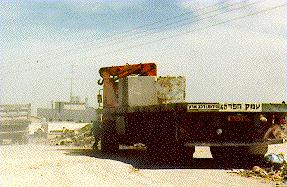 On one trip to Jerusalem, I snapped this picture (left) of a lorry with the aforementioned concrete blocks to seal off one of the smaller roads between there and Ramallah. (Click here for a previous entry on another use of concrete blocks in "Israeli control of the roads"). We had never seen the Israelis so intent on sealing the roads before. The government also announced a six-month jail sentence and 10,000 shekle fine for anyone who dared to disobey. Up to this point, everyone knew that those without permits to travel to Jerusalem, for an extra 2 shekles on the taxi fare, could arrive at the city via the "al-luffa" (the curve) route if they absolutely had to go. It was a very depressing time for all. The seriousness with which the Israelis went about the closure reminded people of the intensity of the Intifada, and made us all jumpy. We were the 3 million peices of hay in Weizmann's haystack, and in the hunt for the seven or eight people that had orchestrated the four bombings, all of us were being burnt. The university academic calendar, for one thing, was up the creek.
Click here for Locked in Ramallah for two weeks, part III
Click Here for DIARY INDEX
Photos: © Nigel Parry. All available.