Discovering Oslo 2 Diary
3 April 1996
"Birzeit students confront Arafat", part IV
Situation recap so far
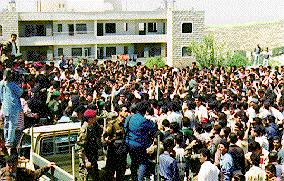
By 1pm, when the students were finally stopped by a barricade of trucks outside the Muqata or District Headquarters of the PA in Ramallah (left), there had been no violence. Police had not attempted to stop the students with any force, bar the attempt to scare them away by firing into the air. Over all, we were relieved. A Birzeit Human Rights Action Project staff member later stated, "The Palestinian Police utilised enormous restraint. They were a model for their collegues elsewhere," most likely recalling the recent police violence of the An-Najah raid. The students, although assertive in their wish to reach Ramallah, similarly had used no violence.
At this point, the Birzeit students were joined by students from Bethlehem and Abu Dis Law College. All were relieved to see each other. Birzeit Student Council President Ibrahim Kreishi articulated the students' demands. "Please listen to us brothers," he said to the police assembled there, "We just want to speak to Arafat and the elected members of the Council. We have a letter of demands and we want to raise them. Our first demand is the unconditional release of all our students who are political prisoners, regardless of their faction. Secondly, we want the results of the inquiry of the events at An-Najah." The students chanted until Kreishi asked them to quiet down and listen to the Police, "now that they have heard our side." A Palestinian Police Commander asked for a half an hour break while they tried to sort something out. The students agreed.
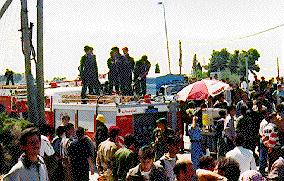
We, meanwhile, noticed the appearance of a fire engine (right) and, noting there was no fire in sight, began to pray to our respective deities that something that would satisfy the students' demands would occur. Police use of a fire engine as a water cannon wouldn't in itself be particularly severe, but this would only signal the first stage in an unwanted escallation. We were pleasantly surprised. As the half hour period reached an end, the soldiers returned in a convoy of cars pulled up and, surrounded by his usually large amount of bodyguards, Palestinian President Yasser Arafat alighted to speak to the students.
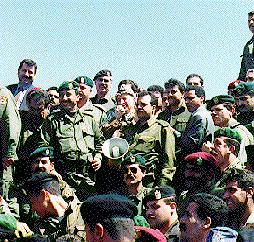
The students confront Arafat
A woman in the crowd shouted, "All we wanted to do was to come and speak with you but the Authority interfered with our buses." Arafat responded, "The second I heard that you were all here, I left the Council meeting to come and speak with you." The students became noisy at one point when Arafat was speaking. Student Council leader Ibrahim Kreishi asked them to be quiet, "This is not democratic," he said, "This is our President. He has heard our point of view. Now we must hear his." The students responded positively, murmering agreement and quietening down.
Arafat spoke about some of the problems of recent weeks and asked for a delegation of students to come and speak with him in the Muqata. Student representatives from Birzeit and the other universities went into the meeting, together with Adli Da'ana from the Birzeit Public Relations Office.
Inside the Muqata
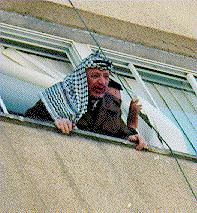
Right: Manon Westenbroek took this rather amusing picture of Arafat looking down out of the Muqata window at the students outside.Inside the meeting, the students repeated their demands to Arafat, explaining their feelings at length. Several times, Arafat interrupted them and began telling 'war stories' about his time in Beirut and Tunis. The students didn't let up. "Just give us a couple of days," said Arafat, "It's not long to wait. I will handle this personally. I will present your demands to the Palestinian Legislative Council this afternoon and to the Cabinet on Saturday." It has since been reported to the author that both the An-Najah raid and the arrests were the direct result of orders originating from Arafat. At the time, this reality was not clear. The bottom line: Nothing happens without Arafat's OK.
Considering this, Arafat's next comments were classic: "Concerning An-Najah, you heard my position through the media. I totally condemned the actions. I will ask the committee of inquiry to get the results very quickly and punish anyone who did not act in accordance with the law." Later, when Arafat transferred the Nablus police chief "responsible" for the raid to Bethlehem, despite reportedly having been the one to order the man to carry out the raid against his wishes, it became clearer that there was a tightrope Arafat was walking: Basically, he is trying to maintain his popular status amongst the Palestinian people, something earned from his years of struggle in Beirut and Tunis, by appearing to be above these crass errors of judgement. Simultaneously, he is trying to earn the approval of the US and Israel, who have been responsible for his elevation to international status as a statesman and peacemaker by keeping a tight, sometimes crushing hold on those Palestinians who don't accept this equation. This path is fatal and, in the end, it will serve to continue to alienate the Palestinians who have truly appropriated the implications of where the responsibility lies and are unhappy about the dynamics of the political realities here. We are not dealing with an Algerian situation here now in Palestine - the Islamic movement is not engaged in a struggle with its own government. Yet, given these dynamics, it may very well end up like that.
Arafat's Dilemma
Arafat is not unaware of his situation. Adli Da'ana reported from the Muqata meeting that Arafat spoke about the "critical times in which we were living." "There are so many restrictions," Arafat told us, "I am not taking to you as a President but as a comrade. We all have to work hard to build the Palestinian state. Please understand the situation." One student present at the meeting later told me that, "Arafat told us: You have 100 doubts about Oslo? I have 1,000 doubts about Oslo!" Indeed, no one on the street still believes the agreement was good. It is clear that Arafat faces enormous pressures and regular embarrassment from the Israeli and US sides. As Adli also reported," Arafat spoke about the closure and the Gazan students. 'This is nothing to do with us,' said Arafat, 'it is from the Israeli side. It is a collective punishment to humiliate us. People in Gaza are starving because of the closure'."
Despite the shortcomings of the day, the overall feeling of the students was that the events were a positive and a necessary step taken to underline to the PA the need for Palestinian democracy. This issue of democracy has been central to campus life recently, and this is the second time that the students have marched to Ramallah to raise their concerns with the PA. The experience of a dealing with an elected authority seems to have brought out a wise and well considered approach from most of the students, who are unlikely to be satisfied with anything less than freedom. Then again, it is unlikely that we have heard the last from those students who had tried to stop the whole thing happening earlier today. How they move to fit in with the campus situation, remains to be seen.
Click Here for DIARY INDEX
Photos: © Nigel Parry. "Arafat leaning" © Manon Westenbroek, is not available. The rest are.