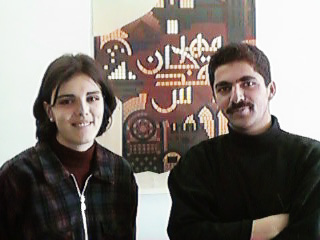
Birzeit University's last student council elections resulted in an unprecedented majority for the Islamic bloc. The current academic year has seen a number of confrontations between the PA and university students. Here, Birzeit University student council head, Khaled Walid, 22, of the Islamic bloc, pictured right, and Abeer Abu Awad, 22, student representative of the Shabiba bloc (Fateh youth wing), pictured left, speak to Palestine Report's Muhammed Najib.
Q: What are your positions on political detentions by the Palestinian Authority?
Khaled Walid: This is a sensitive issue for Birzeit University students, because
of the 15 Birzeit students who were arrested last April and detained for six
months and longer. [Not all the 15 have as yet been released, despite a resolution
by the Palestinian Legislative Council.]
Abeer Abu Awad: In general, we are
against political detention, particularly when it is gratuitous. However, we
support detentions by the PA for good reasons such as [people who want to] harm
Palestinian society. The former detentions [of the students] were unjustified.
Khaled Walid: Our participation in the confrontations in September [1996] helped
to bridge the differences between us and the PA, but although there were then
calls for a national dialogue and the release of political prisoners, nothing has
come of it.
Abeer Abu Awad: We will support the PA to go in the right direction.
The Shabiba movement is independent of the PA; our positions and decisions arise
from the youth movement in Palestinian society.
Q: Are you optimistic about the future of democracy and human rights in the
autonomous areas?
Khaled Walid: Despite the frustrating political situation I am optimistic. My
optimism comes from my belief in God and our people.
Abeer Abu Awad: We are
optimists because we are moving in the right direction. We are confident that the
PA understands us in spite of the differences between the PA and students; it is
the gaps in the [Oslo] accords that have forced them to act in this way.
Q: What means do you propose for pressuring the PA to adopt a democratic
character?
Khaled Walid: As students, our struggles have never been against the PA as an
authority. Our motive is to affirm the future of the Palestinian people, and it is
not merely the Islamic bloc at Birzeit University which participates in this
struggle, but all the political blocs, including Shabiba, because the issue
touches all sectors of the population. We will not leave any method untried for
[achieving] an independent Palestinian society.
Abeer Abu Awad: By dialogue
between students and the PA. And by students involving the Palestinian people in
general in pressuring the PA to allow democracy.
Q: What is your opinion of the state security courts in the autonomous areas?
Khaled Walid: In principle, these courts are unacceptable because they were
founded to satisfy the Israelis. They address only the most basic legal needs.
Q: Are you afraid that the PA security services will go after you because of your
struggle to stabilize democracy and human rights in Palestinian society?
Khaled
Walid: It is possible, but the practices of the Palestinian security services are
not accepted by human rights activists.
Abeer Abu Awad: If we are expressing our
demands using legal means, the PA has no reason to go after us. After the protests
in April 1996, channels of communication were opened between us and the PA. The
Authority asked that we get permits for our demonstrations. We were not happy with
this; our demonstrations are not to offend or attack the PA.
Q: Are you a supporter of the peace process? What is your position on the
[Palestinian] concessions to the Israeli side?
Khaled Walid: We are not against a just peace which realizes our people's
ambitions and returns our rights, but we do not support a prejudicial agreement
which supports Israel and helps Israel to achieve its objectives, something which
has been admitted by those who supported and signed the treaty. This stage is not
the end of the history nor of the conflict.
Abeer Abu Awad: There is pressure from
the US, Europe and the Arab world on the PA to give more concessions. We need
highly skilled negotiators.
Q: Does the Palestinian Legislative Council represent the aspirations of the
Palestinian people? What are its weaknesses and why?
Khaled Walid: There were planned limitations to the role of the Palestinian
legislative council. The council has not been able to perform its task well
because of the Oslo agreement and because of decision-makers in the Palestinian
leadership.
Abeer Abu Awad: We are asking the Palestinian Legislative Council to
carry out its responsibilities well and to follow through on its decisions until
they are implemented.
Q: How would you describe relations between
the student blocs at Birzeit University?
Khaled Walid: Since we formed this student council, we have been working to
foster good relations among all the blocs. Despite differing views, we agree in
our struggle for students' rights. I wish that the model of relations in the
university would be taken as an example by all sectors of the population.
Abeer Abu Awad: Everyone has their own point of view and we respect their opinions. The
events of last September showed the similarities between our positions.
Q: Do you have any comment on the acceptance by a Hamas member of a PA
ministry position, or on the dismissal of some PA officers accused of corruption?
Khaled Walid: Hamas has an official spokesperson who can answer the first
question. On the dismissal of the PA officers, I do not know enough about it to
give an opinion.
Abeer Abu Awad: It is a positive step taken by the PA to find
points of agreement with Hamas and to assimilate the Islamic movement into the PA.
The dismissal of the officers is a step in the right direction, and shows that the
PA is responding to the demands of the public.
Q: Are you a supporter of armed operations?
Khaled Walid: Some people believe that military operations have positive results;
others do not. We are against the killing of innocent people. But the whole
process of violence and counter-violence and the bloody events that have taken
place in this region are the result of the occupation, so the only possible
solution is to end the occupation.
Abeer Abu Awad: It is clear that the Netanyahu
government is an arrogant government striving for the expansion of settlements,
which forces the Palestinian people to resist.
Webpage and digital camera images by Birzeit Webmaster. Comments to webmaster@birzeit.edu