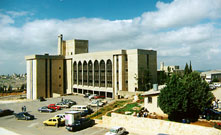
 Brief Information
Birzeit was established as a school in 1924 by Nabiha Nasir (1891-1951). In 1953, it started offering first-year university-level courses in Arts and Science in addition to its high school programme. By 1961, Birzeit College was offering second-year classes, and by the following year, associate degrees were granted for the two-year course, enabling students to transfer to other universities in the Arab world and elsewhere to complete their first degree courses.
In 1967, Israel occupied the Palestinian West Bank and Gaza Strip, thus heralding the beginning of travel restrictions for Palestinians in these areas. This year, the high school programme at Birzeit was eliminated and the college began to focus on the university-level courses. By 1972, the college began a four-year programme leading to Bachelors' degrees in Arts and Sciences. As the college became a university, the founders formed an autonomous board of trustees in 1973 that assumed full responsibility for the institution.
In 1975 the name "Birzeit University" was officially adopted. The next year, the university was admitted into the Association of Arab Universities and subsequently held its first graduation ceremony on 11 July 1976.
Birzeit University was accepted as a member of the International Association of Universities the following year, and 1978 marked the addition of a Faculty of Commerce and Economics. In 1979, the Faculty of Engineering was opened. The University began to offer graduate programs in 1977, and in 1996, the Faculty of Graduate Studies was formally established.
Birzeit University Under Military Occupation
In 1973, just as Birzeit's development into a full-fledged university was nearing completion, Israel closed the campus by military order for two weeks. This was the first of many repressive measures against the University community. Less than a year later, the Israeli military authorities deported the University President Hanna Nasir, who remained in exile for 19 years.
In the ten years between 1979 - 1992, the University was closed 60% of the time. The 15th and last closure lasted for 51 months, from 8 January 1988 until 29 April 1992. During this prolonged period of closure, the University continued to operate underground with small study groups in make-shift arrangements outside the campus. Under such conditions, many students needed as long as 10 years to complete their four-year degree courses.
The University Today
While the University has not been closed in over 7 years, it still faces great obstacles in carrying out its mission in spite of the Oslo peace agreements between the Palestinians and the Israelis; students from Gaza are prevented from "legally" studying in the West Bank; students are continually arrested and detained; human rights are violated and the University is facing prolonged financial crisis due to the stalled peace process and the resulting poor economic situation.
Despite such hardships, existing programs and departments at Birzeit continue to flourish, while the University continues to expand in new and creative ways in order to better meet the needs of Palestinian society and the emerging Palestinian State.
Brief Information Index
Birzeit Homepage