Al-Haqs
Relationship with the International Commission of Jurists - Geneva
Al-Haq,
Law in the Service of Man, the first Palestinian human rights institution,
began its days in April 1979 when a group of West Bank Palestinians established
it to uphold the principles of the Rule of Law and to defend Palestinians
human rights in the Occupied Palestinian Territories. It became officially
registered in 1980. Shortly thereafter, it became the West Bank affiliate
of the International Commission of Jurists in Geneva. For a
period of at least 10 years, Al-Haq was the sole affiliate of the ICJ-Geneva
in the Occupied Territories. This affiliation was particularly important
during the upheaval of the intifada. ICJ-Geneva stood steadfastly
behind Al-Haq offering it protection as a human rights institution in the
Occupied Territories during which time staff members were occasionally
harassed or even arrested by the Israeli authorities. This relationship
fostered over a twenty-year period has strengthened the work of Al-Haq
at the local level and has had considerable effect upon its work.
At the same time, this affiliation has assisted in spreading information
related to the defense of human rights in the Occupied Territories internationally
and raising awareness at the level of the ICJ regarding the rule of law.
This has been particularly important in helping the ICJ identify its priorities
in the OPT.
In
the more recent years, Adama Dieng, Secretary-General of the ICJ, has contributed
significantly to strengthening Al-Haq as a human rights institution.
The
relationship between Al-Haq and the ICJ is a very active one. The ICJ has
co-ordinated with Al-Haq several missions that examined the legal structure
of the Occupied Territories and the judicial system. The outcomes and findings
of these missions were very essential for Al-Haqs work, and are referred
to by many local and international organisations. Also, the ICJ responded
positively to Al-Haqs repeated requests to arrange for jurists with outstanding
experience to observe trials of special significance to Palestinians in
Israeli courts. The ICJ has also intervened with the Israeli authorities
on many essential issues, on the basis of information from and at the request
of Al-Haq.
The
ICJ has also provided an essential facilitating role for Al-Haq in the
UN system. Through the ICJ, Al-Haq could access the UN Commission on Human
Rights, in addition to many of the other specialised bodies of the UN.
The activities of Al-Haq in the UN have been in total co-ordination with
the ICJ, which helped in many cases to advance mutual agendas. The Vienna
World Conference on Human Rights and the appointment of a Special Rapporteur
on the Occupied Palestinian Territories are relevant examples.
Since
the establishment of the PNA, Al-Haq has closely been involved in supporting
the development of an independent Palestinian Judiciary. In
relation to this, Al-Haq in 1993 in cooperation with the ICJ held a seminar
entitled Towards an Independent Palestinian Judiciary. This took
place at the end of a two-week fact-finding mission conducted by the ICJ
and its Center for the Independence of Judges and Lawyers concerning the
situation of civil courts in the Occupied Territories. The purpose
of the mission was to pinpoint the problems and obstacles facing the judicial
system as a whole, in light of the accepted principles of the rule of law.
Following this mission the findings of it were set out in a book entitled
The Civilian Judicial System in the West Bank and Gaza: Present and Future,
as well as recommendations following the seminar. These recommendations
specifically outlined suggestions on the requirements of legal and judicial
functions that would help lead towards an independent Palestinian judiciary.
A
second mission, similar to the one carried out in 1993, was carried out
by the ICJ and its Center for the Independence of Judges and Lawyers from
January 15-25, 2000. This mission specifically was aimed at reviewing
the independence of the Palestinian Judiciary and the legal profession
in Palestine and the role of the Palestinian authorities. It also
examined the role of the international financial institutions with regards
to questions related to the functioning of the judiciary and Israeli infringements
of the administration of justice in the Occupied Territories. The
recommendations that resulted from this mission built upon the initial
recommendations that the ICJ made during its first mission in 1993.
The role of the mission was also to examine whether the previous recommendations
were carried out in the six-year period interim. In addition,
during this mission, Al-Haq in conjunction with the two other Palestinian
human rights institutions affiliated with the ICJ, the Palestinian Center
for Human Rights and LAW, held two workshops in the West Bank and the Gaza
Strip regarding The Role of the Judiciary in Civil Society.
It
is with great pleasure that we begin a new period in Al-Haqs history,
building on our past relationships and entering into new ones. In
January 2000, the United Nations Committee on Non-Governmental Organizations
recommended Al-Haq for Special Consultative Status with the United Nations
Economic and Social Council. This is truly an achievement for Al-Haq
as a human rights institution not only in Palestine but also in the Arab
world. We take this responsibility seriously in continuing to persevere
in our ultimate aim: the strengthening of the Rule of Law and the defense
of Palestinians human rights as an important aspect of reinforcing international
recognition of the rights of all peoples to self-determination.
Workshop
The Role of the Judiciary in Civil Society, Ramallah 25.2.2000
Muhammad
Abu-Harthieh (General Director of Al-Haq), Khader Shkirat (Director of
Law) Adama Dieng (Secretary-General of ICJ) and Mona Rishmawi (Director
of the Centre for the Independence of Judges and Lawyers)
Al-Haq
recommended for Special Consultative Status with ECOSOC
In
July 1996 the Economic and Social Council (ECOSOC) of the United Nations
passed a resolution, that enabled NGOs to gain an official consultative
status with the bodies of ECOSOC and UN conferences, thus acknowledging
the vital and ever growing role of NGOs in supporting the work of the UN.
This arrangement for cooperation between the ECOSOC and NGOs gives especially
national NGOs a wider and more independent access to the ECOSOC and its
mechanisms to address local and regional human rights issues related to
the International Covenant on Economic, Social and Cultural Rights in an
international forum and therefore opens new ways to generate pressure for
improvement at the international level.
Al-Haq
was informed in January 2000 by the Committee on Non-Governmental Organizations,
that it recommended to grant the Special Consultative Status in the field
of human rights to Al-Haq. Though still subject to the approval of the
ECOSOC, this accreditation, as it coincides with Al-Haqs 20th anniversary,
comes as an acknowledgement of Al-Haqs two decades long struggle for Palestinian
human rights, its legal expertise gained in this time and the high quality
of its documentation and analysis of human rights violations in the Israeli
Occupied Palestinian Territories. The ability to submit written reports,
oral statements and, on request, special studies and investigations directly
to the relevant bodies of ECOSOC, will be a great help for Al-Haqs efforts
to draw international attention to and generate international pressure
against Israeli violations of Palestinian human rights in such vital issues
as the denial of family reunification, house demolition and many more,
as well as on matters concerning social justice and development, such as
education and womens rights.
Interview
with Raja Shehadeh, founding member of Al-Haq
Mr.
Shehadeh, you have been one of the founders of Al-Haq, which achievements
did you strive for by establishing such an organization?
Before
the establishment of Al-Haq there was no local organization carrying out
human rights work. Al- Haq was the first organization to do this
kind of work.
We
also strove to create a committed organization that was politically independent.
This too was a first since many of the active non-governmental organizations
working in the occupied territories were politically affiliated and serving
one or the other of the political organizations.
We
also had the conscious objective of creating a truly democratic organization.
One that was fully owned and run by its staff.
The
spirit of voluntarism was also very important. The founding members and
several of the staff volunteered their services free of charge. They strove
for no other benefits other than the satisfaction to see the success of
their work. There was a unique and profound commitment on the part of those
involved in the creation and development of Al-Haq.
This
is as far as the type of organization which the founding members tried
to establish. As to the kind of work done by the organization, the organization
tried from the beginning to fill the enormous gap in the absence of documentation
of human rights violations committed by the Israeli occupation. The advocacy
on behalf of the victims of human rights violations was always a primary
objective as was the promotion of the rule of law. The organization also
established the first public legal and human rights library in the West
Bank.
Do
you think Al-Haq had an influence on other organizations of that kind in
the region?
The
fact, that such an outspoken and active organization as Al-Haq was possible
in the occupied territories had, I believe, a strong influence on the neighboring
countries. They looked up to Al-Haq both because of the fact that it was
able to operate at all. But they also studied carefully how it was organized.
Some of the innovative ideas generated by A- Haq extended also to the legal
approach it was taking to various matters it dealt with. The enforcement
project, for example, produced important literature which had influence
within and outside the region.
It
is important to remember that prior to the creation of Al-Haq the Israeli
Position on the nature and conduct of the occupation was the only one heard
in the world. Al-Haq was able through the approach and kind of work it
did to gain credibility and become an alternative voice which eventually
made a complete shift in the perception of the world about the nature of
the Israeli occupation.
Al-Haq
always tried to enforce the applicability of the Fourth Geneva Convention
concerning the West Bank and Gaza. Do you think it succeeded in that issue?
The
position that Al-Haq took from the beginning was that the Fourth Geneva
Convention is applicable and it used it along with the Hague Regulation
as standards against which to assess the human rights situation. In this
the organization had made many allies. Only a political process could have
succeeded in getting Israel to concede that the Fourth Geneva Convention
Applied. This was beyond the powers of the organization. But the fact that
Israel refused this did not deter the organization from insisting on its
principle position and forging ahead with its work.
Which
impact did the beginning of the peace process have on the work of Al-Haq?
It
is my belief that the organization missed an important opportunity, which
the beginning of the peace process provided for the following reasons:
First
there was the best opportunity to use the strong interest generated by
the political developments to promote the positions Al-Haq had been advocating
for years, and, second, because the organization should have used its good
standing and substantial network of friends and allies in the international
human rights movement to have more of an impact on the course and outcome
of the negotiations.
Rather
than attempt to study the new situation and see what new opportunities
it provided, the organization was paralyzed by the political considerations
of what political position it should take towards the negotiations. This
was a very grave failure which went against the ethos and tradition of
the organization.
As
a result only lip service was paid to human rights and the accords that
came out of the negotiations did not have a human rights component to them.
How
do you see the present role of a human rights organization such as Al-Haq?
The
present situation differs in many fundamental ways from the past. I have
been an outsider to the human rights work since 1991 when I left Al-Haq.
From my previous involvement I realize that only an insider is privy to
all the factors and conditions that must be taken into consideration in
developing a strategy for human rights work. It is difficult and perhaps
not prudent for me as an outsider to pontificate on these matters. What
I can say is that the important feature of the present situation is its
transitional nature. Perhaps this should influence to a large degree the
kind of work that the organization does. Transitional situations can provide
an opportunity for establishing and fortifying traditions as well as institutions
which may become much more difficult to achieve once the situation settles
into a permanent political structure.
Do
you think peoples attitudes towards human rights have changed within the
last twenty years?
The
best evidence that there has been a change in peoples attitude is the
fact that when Al-Haq began no one could understand what human rights work
meant. There was a lot of suspicion surrounding the work and its motivation.
Challenge and suspicion remain. There will always be those who reject human
rights work, but they are now in the minority.
At
the same time the human rights education must be an ongoing activity. Much
of Todays perceptions have also to do with how the past is viewed. One
of the important developments which have occurred, I believe, is that there
is an understanding now that human rights work was not only a feature of
the occupation and should end with the end of occupation.
How
does the fact that the PA came into power influence Al-Haqs work?
The
emphasis in Al-Haqs work has always been the legal aspects. The PA tends
to neglect the legal aspects. There is a lot of work for Al-Haq to do in
developing the rule of law and acting as a watchdog to ensure that the
legal developments are consistent with the human right principles. There
is much work for the organization to do and much ingenuity is needed to
determine where the line should be drawn between human rights work and
political work.
At
the beginning you mentioned that Al-Haq was also established as a new-idea
organization quoting participation of its members and its democratic structure.
Should the way the organization is structured change after this transitional
period? Could a membership model comply with our needs?
The
initial structure the organization took was related to what it aimed to
achieve. There was no recognition of human rights as a profession. The
organization wanted to develop human rights activists rather than employees
in a human rights organization. This objective has now been achieved. The
structure of the organization should develop in line with the organizations
objectives.
Whether
the organization should become a membership organization is related to
whether it wants to become a pressure group which will have impact as a
movement that draws strength from its membership. But if Al-Haq wants to
continue to be an organization that provides very specialized work, it
may not need to change into a membership organization. It should also be
borne in mind that a membership organization is more susceptible to political
pressure.
Lots
of our work has been done in the field of woman's rights, especially through
our publications. We still have not installed a woman's rights unit but
we are helping other organization out in that field. So do you think that
Al-Haq has contributed to the issue of woman's rights?
In
the past there was a strong womens right movement. Al-Haqs role was to
provide it with legal advice and promote the legal aspect of the work of
the movement. I believe that much has been achieved in this regard. The
legal considerations are fully incorporated in the activities of the womens
movements. Many specialized womens rights organizations have been established
which are very effective.
Under
the prevailing conditions Al-Haq has to find its own niche providing services
that others cannot provide due to the special nature and connections of
the organization. Al-Haq should continue to work in the field of womens
rights in pursuit of its general aim which is the enforcement of the rule
of law.
Al-Haq
used international podiums, UN-mechanisms, international campaigns and
conferences as a way of promoting and defending human rights. Do you think
this is a role that Al-Haq should continue to have under the PA?
Al-Haq
must have strategy of how to help Palestine move ahead in the future as
far as human rights are concerned. In future it could help Palestine as
a state join the various human rights convention and afterwards help ensure
that they are implemented.
Retaining
the connection with the international bodies remains an important function
for Al-Haq. You are part of the world. In former times we used these fora
and institutions to advocate human rights positions. Now you have to make
the necessary adjustments and continue to interact with the Human rights
movement worldwide for the service of the organizations present objectives.
Israeli
police arresting boy during a demonstration in Jerusalem, 1989
-
Selected publications by Al-Haq -
Torture
for Security
The
systematic torture and ill treatment of Palestinians by Israel
Melissa
Phillips, 1995
Since
its inception in 1979, Al-Haq has been concerned with the problem of torture
in Israeli interrogation centers. This study represents the culmination
of Al-Haqs efforts over many years to achieve a cessation of the practice,
and to alert the international community to the prevalence of this systematic,
widespread and gross violation of Palestinians human rights.
Hopes
that the practice of torture would end with the peace process were frustrated.
The use of torture continued, in spite of the fact, that Israel is a Party
signatory to the Convention Against Torture and Other Cruel, Inhuman or
Degrading Treatment or Punishment (CAT) since 1991. As recently as September
1999 and only after a long and determined campaign by human rights organizations,
including Al-Haq, the Israeli High Court of Justice finally decided, that
torture is indeed illegal in Israel. However, the High court decision did
not rule out the possibility to legitimize the use of torture through new
legislation. Thus, at the moment, four bill have been introduced to the
Knesset two with the aim to pass a law that would officially allow torture
for so called security reasons, while the other two promote the implementation
of a total ban on torture in Israeli legislation. The issue has yet to
be decided by the Knesset. Meanwhile, the practice of torture against Palestinian
detainees in Israeli interrogation centers was not brought to an end by
the High Court decision, but new excuses were found for it: for example
hand cuffing in painful positions is now explained to be necessary to protect
interrogators from presumably aggressive and dangerous detainees.
In
addition, the occurrence of torture against Palestinians in custody of
the Palestinian Security Apparatus gives further need to Al-Haq and other
human rights organizations to continue working on the subject of torture.
STOP
SEPARATING PALESTINIAN FAMILIES!
An
International Campaign on the Question of Family Reunification
(Based
on Newsletter No 23, 1991)
THE
PROBLEM. The roots of the problem of Palestinian dispersion go back
to the war of 1948, when more than one half of the population of Palestine
lost their homeland and their right to live there. This was made
worse after the June war of 1967, when the remainder of Palestine was occupied
and tens of thousands more were made homeless, some for the second time.
In
the areas occupied since 1967, the Israeli authorities proceeded to implement
a series of policies and measures, which resulted in the loss of the right
of residency for Palestinians of the Occupied Territories. From the
Israeli authorities' point of view permanent residence and consequently
family reunification is not an inalienable right for the Palestinians.
Rather, permanent residence is considered a privilege granted in accordance
with certain criteria set by the authorities themselves. This policy
is detrimental to the right of a family to permanent residence and reunification
and creates serious humanitarian and economic problems for tens of thousands
of Palestinian families. These problems continue unabated.
THE
CAMPAIGN. Given the humanitarian nature of the issue of family reunification,
and the large number of people it affects, Al-Haq decided in 1990 to initiate
an international campaign by mobilizing public opinion through the media,
human rights and other non-governmental institutions. The public pressure
exerted will hopefully succeed in effecting a change in Israeli policy
towards family reunification. Further, it is Al-Haq's view that by publicizing
widely the issue of Palestinian family reunification, public attention
will be drawn to one of the most important aspects of the Palestinian problem:
the dispersion and dispossession of the Palestinian people from their lands
and homes.
The
campaign, being the first of its kind to be adopted by Al-Haq, also represents
a new, more activist approach in the organization's work. Lessons learned
from this campaign will undoubtedly affect Al-Haq's approach to human rights
activism, and will possibly open the way to other campaigns on important
human rights issues in the future.
For
further information in English see Al-Haq's Occasional Paper No 8; "The
Right to Unite", by C. Whittcome, 1990
Al-Haq's
"Women, Justice and Law" Campaign
(Based
on Newsletter No. 33, 1994)
A
conference took place between 16-19 September 1994 arising out of the project
entitled: Women, Justice and Law: Towards the Empowerment of Palestinian
Women. The conference brought together more than 500 women and men
to discuss and adopt strategies for securing the rights of Palestinian
women through law. It marked the culmination of a yearlong campaign
throughout the Gaza Strip and West Bank to raise awareness and promote
wide discussion of women and the law.
The
conference and the campaign were organized by a steering committee of women
activists under the auspices of Al-Haq, designed to bring together and
build upon campaign activities and to formulate clear and effective action
plans to promote the rights of women in the areas of health, education,
work and social welfare, civil and political life, personal status law,
and protection against violence. The campaign included a number of
different activities ranging from presentations and public discussions,
local workshops, producing and distributing educational material to articles
in the local press.
The
wide participation of over 200 women in the campaign and conference preparation
and the rich input by way of grass-roots participation ensured that efforts
to develop strategies for the empowerment of women through law were rooted
in and responsive to the day-to-day realities that characterize Palestinian
women's lives. The results of the campaign were used to draw up the
program plan for Al-Haq's following Women's Rights Project.
Al-Haq's
"Stop Destroying Palestinian Homes" Campaign
(Based
on Newsletter No. 27, 1992)
Al-Haq
continues to pursue its campaign to halt house demolition and sealing.
The aim of this campaign is to stop the destruction of houses in the Occupied
Territories, which are demolished or sealed for "security" reasons, and
to obtain compensation for the victims of these measures. Al-Haq has completed
the preparations for all of the further requirements of the campaign, including
explanatory booklets, T-shirts, and posters.
For
the purpose of arriving at a conclusive analysis of the impacts of the
illegal destruction of houses on the Palestinian population, Al-Haq has
thoroughly documented all the houses, which were demolished or sealed for
"security reasons" during the period from January 1981 to the end of December
1991. Al-Haq is also monitoring the demolition of houses by the Israeli
Authorities for alleged contravention of building permit law.
For
more information in English see following Al-Haq publications: Occasional
Papers No 5 "Demolition and Sealing of Houses as a Punitive Measure in
the Israeli Occupied West Bank", by E. Playfair, 1987; No. 10 "Missiles
and Dynamite: The Israeli Military Forces' Destruction of Palestinian Homes
with Anti-Tank-Missiles and High Powered Explosives" by T. Taylor, 1993;
and No 11, "Thousand and one Homes: Israeli Demolition and sealing of Houses
in the Occupied Palestinian Territories", by L.Welshman, 1993; and J. Quigley:
"Legal Consequences of the Demolition of Houses by Israel in the West Bank
and Gaza", 1995
Campaign
to End ID Card Confiscation
This
campaign was initiated by Al-Haq and other Palestinian human rights groups
in March 1999 to support their Israeli partners as they challenged the
legality of Israeli ID card confiscation in the Israeli Supreme Court.
The campaign quickly developed monumentum and by August its membership
grew to include 23 Palestinian and Israeli human rights organizations and
a number of international groups and supporters.
The
background for this campaign is Israel's aggressive policy of reducing
the Palestinian population and heritage in Jerusalem, thus changing facts
on the ground in order to consolidate Israeli control over Jerusalem in
sight of the final status talks. Israel forced the status of "residency"
on the Palestinian population in Jerusalem after the war in 1967 and the
illegal annexation of East Jerusalem. A status that transformed Palestinians
into strangers in their hometown and made their residency rights dependent
on Israeli good will. In December 1995 Israel introduced the "Center of
Life" policy, forcing Palestinians to prove that they reside and work or
attend school in Jerusalem in order to have their ID cards renewed. This
enabled the increase of ID card confiscation by 600%, affecting an estimated
number of more then 8000 individuals between 1996-98.
Though
the Campaign resulted in the Supreme Court ruling that each case of ID
cart confiscation has to be discussed separately, the situation on the
ground did not change so far and thousands of Palestinian Jerusalemites
are still threatened with having their ID cards confiscated and consequently
to lose their right to live in their home town. Thus the efforts of the
campaign to put an end to the Israeli policy of ID card confiscation continue.
Selected
Publication by Al-Haq:
Israelis
war against education in the occupied West Bank: A penalty for the Future
Al-Haq
1988
The
restriction of academic freedom and education for Palestinians has been
part of the Israeli occupation policy from the beginning, but was heavily
intensified during the Intifada. Education institutions and activities,
teachers and students in the West Bank have been subject to a series of
repressive measures, that limited the access to education for a whole generation
and thus had serious long-term effects on the Palestinian population.
This report focuses on the closure
of schools, the prohibition of make-up classes in alternative locations
and the military occupation of school buildings and the subsequent destruction
of school property. The official Israeli position on various military
actions are compared with the measures actually adopted, which are then
analyzed in the light of local and international law pertaining to education.
Al-Haq:
The First Twenty Years
By
Joost Hiltermann, Human Rights Watch
It
was on a crisp November day in 1984 that I first stepped into the small
apartment on Ramallahs main street that housed the offices of what was
then known as Law in the Service of Man (a somewhat limping translation
of the more universal Al-Qanoun min Ajal al-Insaan: Law in the Service
of the? Human Being?). The receptionist (who doubled as administrative
assistant) sat in an entrance space immediately off a small glassed-in
veranda. The dining room served as meeting room-cum-library.
Two small bedrooms offered working space for researchers. And the
tiny bathroom accommodated copies of the organizations few but accumulating
publications, stacked neatly on thin metal shelves that I, in an unthinking
moment, once managed to collapse on top of me. (There must have been
a small kitchen as well, but I do not remember it now).
A
handful of staff resided there in the fall of 1984. The organizations
founders, gainfully employed elsewhere, would stop by for meetings.
The three field investigators visited periodically to hand over and discuss
their latest yield. There were, if memory serves me, at most two
or three computers.
I
came to Al-Haq just at the time when it was primed for a major expansion,
having got its books in order and, thanks to a handful of pioneering reports
and actions, starting to receive the attention and, increasingly, accolades
of key western institutions. And it had the luck to arrive on the
scene at what was from a funding perspective a particularly propitious
time, the happy coincidence of the rapid growth of an international human
rights movement and the equally stunning emergence of an indigenous institutional
infrastructure in the Occupied Territories. By the time the popular
uprising broke out in late 1987, Al-Haq was able to deploy the strengths
of one in the service of the other, and vice versa, becoming in the process
an influential Palestinian voice at the height of a major human rights
emergency.
The
founders of LSM/Al-Haq, Raja Shehadeh, Jonathan Kuttab and Charles Shammas
started
their professional careers in the West Bank just as a new generation of
activists had begun to graduate from high schools and colleges. This
was the post-1967 generation, born perhaps before the June War but who
had their formative period in the ferment that followed the 1973 War and
Yasir Arafats landmark speech at the United Nations in 1974. The
external solution - a dream, really, of Arab states sweeping in to liberate
the Palestinian masses - had been laid to rest, and a new national movement
began to take form whose weight lay essentially inside the territory of
historic Palestine. At a grassroots level this new movement found
its expression first in voluntary work committees that fanned out across
villages and refugee camps to perform services that the occupying power
would not. Politically, it took the shape of student activism, including
demonstrations and strikes, and the emergence of a local leadership
which
was promptly subjected to threats, detention and deportation by the military
government. In the late 1970s, under the Likud partys interpretation
of the autonomy plan agreed to in the Camp David Accords, the new civilian
government
in the Occupied Territories proceeded to expropriate vast new tracts of
land and to weave a web of military orders that made a mockery of whatever
law had existed in 1967. This permitted the occupier to insinuate
itself into all aspects of Palestinian society with the aim of subverting,
dividing and, ultimately, pacifying it: an autonomy entirely on Israels
terms.
The
new laws and new violations screamed out for a new approach. A fresh
crop of recruits from schools and universities provided the intellectual
core and urgent energy of an array of initiatives launched in the late
1970s and early 1980s. The womens movement emerged in the West Bank
and Gaza at this time; the trade unions became infused with new life; the
student movement expanded; and a grassroots primary health movement was
spawned from the ruins of the civilian governments health system.
Taking
a nod from the international human rights movement that took off in earnest
only after the 1975 Helsinki Accords, Al-Haqs founders were keenly attuned
to the need for devising new strategies to contest the ever-growing reach
of a predatory occupying power and its highly mobile citizenry. The
institution they established alongside other institutions that began to
come into their own in this period: the universities, the Arab Studies
Society, the Arab Thought Forum, and others, as well as aforementioned
grassroots movements became by its very objectives a part of what sociologist
Salim Tamari has referred to as a strategy of informal resistance to the
military occupation. Planted squarely in the society that had given
rise to it, Al-Haq offered a glimpse to its constituency of the alternative
path that might be taken to divest itself of the occupation. It began
to provide an ever-growing audience with new linguistic tools and a concrete
methodology to challenge specific actions by the governing authority.
These were presented in the form of the Know Your Rights series, one of
Al-Haqs most important undertakings during its first decade. These
booklets inculcated in those who read them the crucial notion that not
only did they - Palestinians, victims, fighters, people - have fundamental
rights, but they had a right to assert these rights, and the booklets showed
them how they might begin to do so.
Even
as Al-Haq was playing an educational role toward its home constituency,
it reached out to the outside world both for a receptive audience and for
protection, as the military government could never be trusted not to kick
in the doors one day and shut the place down. This, too, required
a great educational effort, as a deep-seated prejudice against Palestinians
dissuaded many activists in the United States and elsewhere from turning
their attention to the Middle East and rendered Al-Haqs objectives and
methodology immediately suspect. If the organization succeeded in
making its case abroad, this was due less to its advocacy strategy, which
for a long time was barely a strategy at all, than to its professionalism
in documenting and reporting what even the most skeptical observer would
have to admit were unconscionable violations of human rights. And
the Israelis offered a helping hand, of course, by engaging in public acts
of collective punishment, like house demolitions.
The
Palestinian institutions and grassroots organizations that proliferated
in the 1980s were served by their semi-legal status (even if the military
government denied them a license to operate formally, by applying for a
license they had signaled their intent to function openly and carry out
legal activities), the material and political support they received from
governments and institutions abroad, and the fact that Israel had an inwardly
democratic and open society that was broadly permissive of outspoken criticism
of the outrages committed across the Green Line. But it was especially
because of Israels outward democratic posture that the military government
found it very difficult to crack down on institutions like Al-Haq, assuming
for a moment that such institutions presented any sort of real threat to
the occupiers hold over the territory and its population. The Israeli
state had a constant task to mollify its supporters in the U.S. and Europe,
who saw little wrong with plucky groups like Al-Haq as long as such groups
stayed away from advocating violence and terrorism. The genius of
the method fashioned by Al-Haqs founders was that Al-Haq took Israel at
its word (of being a democracy, as well as a self-declared reluctant, tolerant
and benign occupier) and, playing fully by the rules of a democratic society,
held it to its declared commitments, pressing it further and further as
it retreated into a growing tangle of self-generated contradictions.
How could punishing a terrorist be said to compute with destroying the
home in which that persons family lived?
There
is no doubt that the occupying power became its own worst enemy, its crude
tactics exposed and exploited by Al-Haqs sophisticated reporting.
Yet the strength of Israel was such that no amount of reporting could have
brought an end to the military occupation. It took a largely nonviolent
popular uprising, massive repression marked by the extremely crude and
brutal tactics of a Yitzhak Rabin, and the sudden interest of the mass
media in the Palestinian reality to reverse what had seemed irreversible.
The leaders of the grassroots organizations at least, those not already
in prison or exile metamorphosed into the leaders of the uprising.
And Al-Haq, its credibility established by years of accurate reporting
and its voice amplified by the force of the mass movement, blasted onto
the international scene. Its magnum opus on the first year of the
uprising, Punishing a Nation, became a standard reference work for human
rights groups, journalists and policy makers alike. Holly Burkhalter,
an early admirer of Al-Haq who as advocacy director of Human Rights Watch
oversaw the production and distribution of the U.S. edition of Punishing
a Nation, today sees the significance of Al-Haq as twofold: There werent
at that time that many groups in the South that were doing highly sophisticated
human rights investigations, she says. The movement, even in the
West, was very young. To have that kind of quality of documentation,
especially from Palestinians, was very important in dispelling the prejudice
that existed. In the United States a Palestinian was an adjective
modifying the noun terrorist. Al-Haqs work was essential in getting
out the truth not only about human rights violations in the Occupied Territories,
but about the Palestinians themselves.
That
was then and this is now. As the intifada turned inward and petered
out, Al-Haq lost much of its audience and its steam, while it also began
to pay the price of too rapid and uncontrolled a growth in the late 1980s.
The 1993 Oslo Accords and the arrival of the Palestinian Authority further
threw the organization into confusion, and except for pursuing the brilliant
innovation that was its human rights enforcement project, it was forced
to spend the better part of the 1990s trying to regain its footing.
Today, as it marks its twentieth anniversary, Al-Haq is a transformed organization,
a different beast altogether, set to mark a course in tune with the requirements
of the new situation prevailing in Palestine.
To
me Al-Haq will always be the Al-Haq that I knew intimately then, the Al-Haq
that gave me my best friends, that taught me my passable Arabic and gave
me insight and an entrée into Palestinian society, and most importantly
that showed me the power of human rights. My five years in Palestine
for me were a rite of passage, my formative years, the threshold that separates
the before from the after in my life. Working for Al-Haq was frustrating
at times the infuriating but indispensable legalese of its analysis; the
primary institutional (elite) focus of its activism. It often forced
me to step outside and engage in extracurricular activities: writing articles
for magazines in the U.S., Britain and the Netherlands, traveling throughout
the West Bank to document house demolitions while delivering basic necessities
to the newly homeless, and making friends among the people who were most
affected by the daily depredations of the occupier
all
of this on top of research and writing relating to my doctoral studies.
But my experience at Al-Haq never was anything but authentic, full of meaning,
extraordinary.
When
I left Al-Haq in 1990 it occupied a large office across the street from
the old one, with two dozen well-trained staff, plenty of computers, and
its spirit unbent despite the never-ending misery it had mandated itself
to document in towns, villages and refugee camps. I sometimes now
recall, at night when my children have gone to sleep and I have a moment
to myself, the sounds that uniquely evoke for me my privileged existence
in what was my home for five matchless years: the constant roar of the
bulldozers razing dwellings and trees to make way for new settlements,
the angry bark of soldiers breaking open stores on strike, and the wailing
of mothers newly bereaved. But also, amidst the din, distinctly and
unmistakably, the steadfast and rhythmic tap tap tap of the keyboards at
Al-Haq.
October
1999
Joost
Hilterman is the author of Al-Haqs following publications in English language:
-
Israel's Deportation Policy in the Occupied West Bank and Gaza; Occasional
Paper No. 2, 1986
-
Al-Haq's Response to the Chapter on Israel and the Occupied Territories
in the U.S. State Department's "Country Report on Human Rights Practices
for 1984"; 1986
Al-Haq's
Paralegal in Hebron Arrested, Served with Administrative Detention
On
10 March 1994, Sha'wan Jabarin, the paralegal in Al-Haq's Hebron office
for legal services, was arrested and served with a six month administrative
detention order. After a meticulous search of his house that did
not spare even picture frames, documents relating to Al-Haq's work were
confiscated. Mr. Jabarin was not informed at the time of his apprehension
of the reasons for his arrest. He spent 40 days in detention without
charge. During his detention, Mr. Jabarin was interrogated by the
Israeli authorities, primarily about his involvement in the writing of
an Al-Haq report on the harassment of Palestinians by Israeli settlers.
In the absence of any charges Al-Haq had to conclude that Mr. Jabarin's
arrest and detention was solely a punishment for his human rights activities.
Mr. Jabarin was served with six month administrative detention, which was
renewed three times, amounting to two years of detention, without any charges
being brought against him. Still, his release did not bring to end
harassment and restrictions: till today, March 2000, the Israeli Authorities
are preventing Mr. Jaberin from leaving the country, thus restricting his
personal freedom of movement and his ability to represent Al-Haq on international
conferences.
(Based
on Newsletter No 31, 1994)
Human
Rights Focus, 21 November 1992
Willful
Killings: A Sustained Israeli Policy in the Occupied Palestinian Territories
Based on its own documentation of
over 1070 killings of Palestinian civilians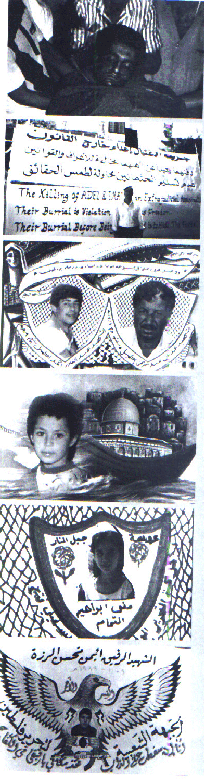 by the Israeli soldiers and
other state agents since the Intifada began on 9 December 1987, Al-Haq
fieldwork revealed that many of these deaths were willful killings within
the meaning of Article 147 of the 1949 Fourth Geneva Convention. Starting
with the definition of willful killing as an intentional killing which
is unnecessary or disproportionate under the circumstances, Al-Haq, highlighted
the continued occurrence of willful killings with alarming frequency in
the Occupied Territories.
Al-Haq
then presented in details three willful killing cases that provide fresh
evidence that Palestinians in the Occupied Territories are continuing to
face a consistent pattern of intentional violations of their right to life--
a pattern amounting to a sustained policy of willful killing sanctioned
by law and carried out by agents of the Israeli state. In all three
cases presented in this focus and backed with evidence, Al-Haq concluded
that the killing of these three victims during August, September and October
1992, was unnecessary and disproportionate; all three victims were unarmed
and have not posed any threat to the lives of Israeli soldiers.
In
the concluding remarks, Al-Haq stated that the issues discussed in the
three cases were not new; for years Palestinians have suffered at the hands
of Israeli state agents from willful killing, willful injury, obstruction
of medical aid, the killing of children, failure to protect bystanders
from harm, impermissible restrictions on the rights to freedom of expression
and peaceful assembly, attacks on persons associated with "wanted people",
disrespect for manners, customs, and religious practices and many other
abuses. Such abuses are violations of international law legalized by military
orders and decrees which criminalize many political and civil rights.
The orders and decrees are enforced by military personnel, some disguised
as Palestinians, who use vague and broad Open Fire Regulations while capturing
or killing Palestinians who are simply practicing the rights guaranteed
them under international law.
(Based
on Newsletter No 27, 1992)
Al-Haq
holds the names, details and photographs of all Palestinians killed by
Israeli soldiers or settlers, or members of the Village Leagues since November
1981, together with details of the circumstances in which the killing occurred
and whether any, and if so what, official investigation has been carried
out. Affidavits from the surviving next of kin are also taken.
Al
Haq Investigates Town Planning
By
Anthony Coon, Senior Lecturer at the Department of Environmental Planning,
University of Strathclyde, Glasgow
In
late 1988 I had a phone call from Sir Colin Buchanan: an organization in
the West bank called Al-Haq wanted to investigate Israeli policies of restricting
and demolishing homes of Palestinians. Colin Buchanan, the foremost British
town planner at the time had been going to do it, but he was nearly 80,
the intifada had begun, and could I fit this into my timetable at the university?
I
had been teaching town planning in Glasgow since 1976. Before that I had
been in Colin Buchanan's consultancy, mainly in London, Istanbul and Kuwait.
In Kuwait we drew up plans for development of city and state which, as
shown in the aerial reconnaissance photos published during the gulf war,
were largely carried out as we had planned. While there I worked with and
got to know many Palestinians, and I often thought that the West Bank would
be a fascinating place for a planner to visit: planning is an attempt to
resolve conflict, so the use of land under a belligerent military occupation
was surely the ultimate planning conundrum.
So
began an association with al Haq and with Palestine, which I have found
profoundly fulfilling. Al-Haq wanted an objective report to investigate
the needs for Palestinian development, and the extent to which and the
means by which these needs were being frustrated by Israeli policy. At
least up to that time there had been a tendency for world opinion to believe
the Israeli story that the previous plans and Jordanian law were being
faithfully followed.
The
book which resulted was enormously helped by the kindness and insights
of Raja Shehadeh and the staff of Al Haq. I particularly remember the way
the field workers smuggled me swiftly and cunningly around military check
points and through the dark streets of the intifada to homes, town halls,
sewage spillage from settlements onto Palestinian cultivation, the remains
of bulldozed houses ... The other vital support (brought into the project
by Raja) was Rami Abdul Hadi who had been drawing up town and village plans
at the Center for Engineering and Planning nearby, and who was (and remains)
unstinting in his advice and contacts.
Since
then I have returned on a consultancy contract in Nablus, Hebron and Dair
el Balla, and for the JLAC conference in November 1998. This year I have
been re-examining on behalf of Amnesty international many of the issues
which were of concern in the early 1990's, but particularly house
demolition
- in Area C and East Jerusalem. I have been particularly struck by
how little has changed in Israeli methods and pretexts since the mid 1980's,
and how similar is the plight of the inhabitants of Area C to that of the
'unrecognized villages' in Israel. There surely remains an urgent need
to coordinate the efforts of the voluntary sector in Area C and in East
Jerusalem, and to document conditions in these areas (about which little
is known except to the occupying power) - especially land ownership records,
building (and other) permit applications and demographic and economic conditions.
My
congratulations to Al Haq on the twentieth birthday.
Anthony
Coon
Anthony
Coon is the author of the Al-Haq publication
Town
Planning under Military Occupation: an examination of the law and practice
of town planning in the occupied West Bank, 1992
Sealed
entrance to a family home, 1990
The
Legal Services Program at al-Haq provides local residents with the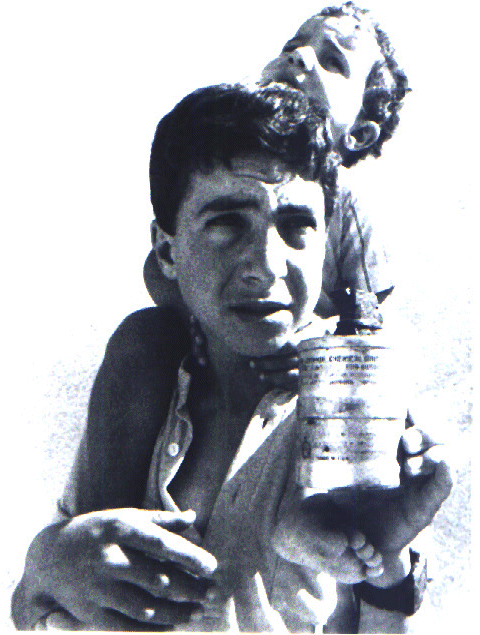 opportunity
to discuss their legal problems with lawyers at no cost. Where the
problem involves human rights abuse and does not require recourse to a
court, al-Haq seeks redress for the community or individual in question
by intervening
directly with the appropriate authorities. If, however,
our efforts meet with failure or it appears that recourse to the courts
is the only option, the person is advised to consult a lawyer. Al-Haq
does not represent individuals in court, nor does it cover legal expenses.
However, in cases of extreme violations, such as torture, killing and house
demolition, al-Haq undertakes interventions to mobilize local and international
support. Where it seems possible and necessary to fight certain patterns
of human rights violations by creating legal precedents, Al-Haq also takes
test cases to the Palestinian and Israeli High Courts. In this, as in the
legal counseling in general, Al-Haq cooperates with other specialized human
rights organizations. Thus in the year 1999 al-Haqs Legal Services Unit
received a total of 463 case, while referring many more to the Jerusalem
Legal Aid Centre, LAW, Addameer, DWRC, Womens Centre for Legal Aid and
Counseling, and other organizations. The breakdown of the cases for the
year 1999 is as follows:
Type
of Case Number of Cases Received
Violations
by Israeli authorities (soldiers, police, settlers) 12
Family
Reunification 40
Denial
of permits to enter Israel 106
Magnetic
Cards (needed to obtain working permits etc. for Israel) 102
Travel
Bans to exit Israel 76
Refusal
of Visitor permits 26
Denial
of permits to enter Gaza 4
Arrests
by Israeli Authorities (including on borders) 17
Violations
by the PNA (state security apparatus, ministries) 43
Other
cases (wrongful firing, denial of severance pay, property theft, denial
of insurance, etc.) 37
Total
Cases 463
Another
part of the Legal Service Units work is to monitor the condition of Palestinian
prisoners in Palestinian prisons and to visit political prisoners and administrative
detainees in Israeli prisons, in order to alert the public in case of any
special grievances. Al-Haq liaises with other Palestinian organizations
dealing with the prisoners issue regarding specific files, liaises with
the families of prisoners, and with the Prisoners Club to transfer money
to prisoners.
-
Selected Publications by Al-Haq -Punishing a Nation
Human Rights Violations during the
Palestinian Uprising,
December
1987- December 1988; Al-Haq 1990
This
report is a comprehensive view of the critical status of Palestinian human
rights engendered by the Israeli reaction to the uprising that began in
December 1987. It covers the range of human rights violations in the first
year of the Intifada and focuses on the most widespread and serious of
those violations. Punishing a Nation is the result of the collective effort
of the Al-Haq staff. It began with the documentation of human rights violations,
collected by a team of fieldworkers distributed geographically throughout
the West Bank. Researchers analyzed these information as well as other
public sources and documents in the light of international and local law
and, aided by Al-Haq's support staff, produced this report. Al-Haq also
published comprehensive reports on the human rights situation in the Occupied
Territories for the years 1989 (A Nation under Siege) and 1990 (Protection
Denied).
An
International Conference on the Administration of Occupied Territories
and International Law
By
Emma Playfair, Executive Director of Interights, The International Centre
for the Protection f Human Righhts
On
22 to 25 January 1988, in the unlikely context of the first month of the
Palestinian intifada, or popular uprising, Al-Haq held an international
conference in East Jerusalem, convening some of the foremost world experts
in the international laws of war and human rights. This was the first international
conference of its kind to be organized within the Occupied Territories.
Most of those attending were not supporters of the Palestinian cause but
scholars who had, until then, had little contact with the Arab-Israeli
conflict. They came to provide independent opinions on the international
laws governing the conduct of an occupying power over the people and territories
it controlled, and to review Israels administration of the West Bank and
Gaza, including East Jerusalem, against international law.
By
1987, Israel's occupation of the West Bank and Gaza was entering its third
decade, with little sign of an end. Over the previous five years, Al-Haq
had established a solid reputation for its meticulous reporting of the
human rights violations that formed part of the daily life of Palestinians
in the Occupied Territories. As well as intervening on individual violations
- either directly or by seeking the intervention of others it had published
a series of reports on such practices as deportation, administrative detention,
torture, demolition and sealing of houses and separation of families. These
interventions and reports were based on extensive fieldwork and always
supported by carefully researched legal arguments as to why these acts
constituted violations of human rights or humanitarian law. The clarity
and constraint of the reports was hard to contest and contributed to a
shift in international public opinion that had generally subscribed to
Israel's projected image as a benevolent occupier respectful of the laws
of occupation.
While
Al-Haq had to address such violations on a daily basis, it was all too
aware of the longer term threat to Palestinian rights posed by the steady
transformation of the land and infrastructure of the territories themselves,
altering, sometimes irrevocably, their character and integrity. Israel
was introducing changes to almost every element of Palestinian life to
the economic structure, the judicial system, local government, systems
of transportation, water, electricity and, most of all, to ownership and
use of land. While some such changes were undoubtedly necessary with the
passage of time, many appeared to be aimed at ensuring dependency on Israel
or access by Israel to Palestinian resources and markets, or at serving
the interests of the Israeli population being settled illegally in the
Territories, rather than at serving the long-term interests of the Palestinian
peoples future after the end of the occupation.
It
is an underlying tenet of the international law governing military occupation
that occupation is an inherently temporary state and that the status quo
should be observed, with only those changes which are necessary for the
security of the occupying forces or in the best interests of the people,
so that the ability of the territories ultimately to regain their independence
is not jeopardized. Al-Haq carefully documented the changes made by Israel
and argued that many could not be justified on the limited grounds allowed
by international law. It demonstrated further that they had profound and
adverse implications for the Palestinian governance of the territories
after the end of the occupation, and for the ability of the Palestinian
community to exercise the fundamental human right of self-determination.
Israel argued, however, that it respected the rules of international law
governing its occupation, or 'administration' as it preferred to call it,
but that the occupation was sui generis by reason of its length amongst
other things. It relied on this firstly to argue that the main body of
law relating to belligerent occupation, the Fourth Geneva Convention of
1949, was not applicable, and secondly to justify its own interpretations
of the applicable laws, often at variance with earlier interpretations.
The
difficulty faced by Al-Haq in countering this claim was that the terms
of the Hague Regulations of 1907 and the Fourth Geneva Convention are necessarily
framed as general principles, in order to cover all forms of war. While
certain provisions, such as those relating to destruction of property,
deportation of peoples and treatment of prisoners, are quite clear, there
are few details in the guidelines as to how the territories themselves
should be governed. For this, authoritative interpretation was needed,
based not only on those laws, but on the military manuals drawn up in previous
wars, and on such legal precedents as the Nuremberg and Tokyo trials that
followed the Second World War. Expertise was hard to find though, since
the laws of war were at that time viewed as an obscure branch of the law.(1)
Belligerent occupation in particular had generated little attention outside
Israel since the end of the second world war, so that Israeli scholars,
judges and officials, much of whose expertise was based on service within
Israel's army or administration, dominated the field.
In
the absence of independent scholarship on these issues, Al-Haq decided
to seek the advice of leading scholars of the laws of war, international
law and international human rights law to bring their expertise to bear
on key issues relating to the administration of occupied territories. We
recognized that for most this would require original research, since few
had considered this issue before, but we counted on being able to stimulate
the interest of academics to apply their learning to a concrete situation.
We therefore designed a research project, to culminate in an international
conference, through which international legal scholars, carefully selected
for their independence, and in most cases without prior involvement in
the conflict, would provide reasoned opinions on the current interpretations
of the international laws of war and of human rights as they applied to
Israel's occupation and treatment of the Occupied Territories. The legal
opinions had to be based on the actual situation, but published sources
on these issues are few so the international experts would be matched with
local scholars and experts who would document and analyze the factual issues
from within the Occupied Territories, often also requiring original research.
We
deliberately avoided issues which normally attracted the attention of observers,
in favor of the more subtle aspects of territorial, administrative and
infrastructural transformation which were more complex to document and
on which legal sources were few, given the rarity of long occupations.
The treatment of natural resources, the power to appropriate and change
usage of land, the taxation of the people, the reshaping of the legal system,
the integration of the economy with that of the occupying power, the settlement
of the occupiers own population in the occupied territories, the separate
administrative and legal structure applied to those settlers, and the application
of the various sources of humanitarian law and human rights law governing
the conduct of a belligerent occupier - these issues, which were steadily
eroding the potential of the West Bank and Gaza to be self-sustaining,
formed the object of our inquiry.
Identification
of leading scholars involved extensive research and consultation, and then
often careful persuasion. Some were cautious about involvement in what
they perceived as a political minefield, and needed reassurance about Al-Haq's
credentials, as to the serious nature of the initiative and that they were
genuinely being asked to voice independent opinions. International participants
included Gerhard von Glahn, author of the leading work on belligerent occupation,
Adam Roberts, one of the foremost scholars of the laws of war, Antonio
Cassese, later President of the International Criminal Tribunal for the
Former Yugoslavia, John Dugard, an expert in human rights law from South
Africa, and other eminent experts in public international law and human
rights law.
On
9 December 1987, one month before the conference was to be held, the intifada
broke out in Gaza. By the time the conference started, on 22 January 1988,
the intifada had spread to all parts of the Occupied Territories. 41 Palestinians
had been killed, almost half of them below the age of 18. Despite powerful
press coverage of the rapid escalation of violence, none of the participants
withdrew. They did, however, express concern at discussing apparently abstract
questions of law while people died outside. It became quickly apparent
though that the questions under discussion, however arcane, were at the
heart of the intifada. It was precisely because of the actions Israel was
taking in the name of the law the expropriations of land, the annexing
of Jerusalem, the absorption of the occupied territories into the occupiers
state denying a future to the people, that years of pent-up frustration
exploded into the intifada. Through meetings and visits, arranged between
sessions, the participants were able to witness both the causes of the
intifada and its violent repression by the Israeli authorities.
The
project had three elements. The first was to clarify the framework of international
law relating to belligerent occupation, particularly the application of
the Hague Regulations and the Geneva Convention, and the applicability
of human rights law in times of occupation. The second element was to examine
particular aspects of administration of occupied territories, namely the
form an administration should take, the right of association under occupation
reflecting peoples ability to participate in the administration, taxation,
and the powers and duties of an occupier in relation to land. The final
aim of the project was to consider methods of enforcement of humanitarian
and human rights law, both through law and by mobilizing public opinion
and requiring action.
Participants
rejected resoundingly Israel's contention that the Fourth Geneva Convention
does not apply to its occupation. The inherently temporary nature of occupation
was emphasized again and again, as was the illegality of any steps taken
that irreversibly alter the character of the territories occupied, except
within well-defined situations of necessity, or which seek to assert sovereignty
or to pre-empt eventual withdrawal from the territories occupied. Far from
confirming Israel's contention that the length of the occupation permitted
it to override these provisions, participants agreed that the longer the
occupation, the more important it was to hold firmly to the provisions
and to interpret them restrictively. Participants also confirmed that human
rights law applies, with certain exceptions, even under occupation, supplementing
the provisions of humanitarian law. Both international and national participants
criticized, to varying degrees, the Israeli High Courts rulings and expressed
disappointment at its role. Views differed on important points for instance
the extent to which the occupation itself is illegal (some felt that it
was, while others felt that international law does not yet support this
point), the weight that an occupier can attach to military necessity, and
the legitimacy of a levée en masse, as an expression of will of
the people.
Immediately
after the conference, Al-Haq had necessarily to devote its attention very
substantially to addressing the daily emergencies and gross violations
occurring during the intifada, which continued to stretch its capacity
to the limit for a number of years. While Al-Haqs Enforcement Project,
develop at the same time as the Conference, drew on and developed the arguments
discussed at the conference, we were not otherwise able to devote the resources
needed to develop a systematic challenge to those aspects of Israeli policy
which the conference had shown to be clearly violative of international
law, as planned. However, the publication of the papers by a respected
legal publisher ensured that the findings of the conference reached a wide
audience both within Palestine and Israel, and in the international legal
community.
The
conference exemplified Al-Haqs approach, which was that of an activist
organization, basing its work only on the rule of law and on internationally
established standards of human rights and humanitarian law, employing the
strictest professional and independent standards. Arising from Al-Haqs
frustration at the lack of available independent expertise, which hindered
its ability to address serious violations of human rights, the project
typically relied on Al-Haqs fieldwork and brought to bear both international
and local expertise to seek clarification of the crucial provisions of
international law relating to a belligerent occupation.
A
decade after the conference, its findings remain relevant not only to those
seeking to address ongoing human rights violations in the Palestinian territories,
but also to civilians caught in other situations of occupation or conflict.
The published views of legal experts are an important source of international
and customary law, so that the expert contributions to this conference
will directly contribute to the development and interpretation of humanitarian
law. We hope also that the conclusions of the international and local experts,
documenting the effects of the illegal measures and clearly establishing
the violations of international law, can be of use in negotiations towards
an end to the Israeli occupation, which international law requires, and
in the determination of restitution and compensation.
Footnotes
1)
Humanitarian law only attracted widespread popular attention several years
later with the Iraqi occupation of Kuwait and since then with the Rwanda
and Yugoslavia conflicts
International
Law and the Administration of Occupied Territories, ed. Emma Playfair (Clarendon
Press Oxford/Al-Haq, 1992)
Emma
Playfair is the author / editor of Al-Haqs following publications in English
language:
-
Administrative Detention in the Occupied West Bank and Gaza Occasional
Paper No 1, 1985
-
Demolition and Sealing of Houses as a Punitive Measure in the Israeli Occupied
West Bank; Occasional Paper No 5, 1987
-
International Law and the Administration of Occupied Territories: Two Decades
of Occupation of the West Bank and Gaza Strip. Proceedings of a conference
organized by Al-Haq; ed. by Emma Playfair, 1992
-
Selected Publications by Al-Haq -
Taxation
in the Occupied West Bank and Gaza 1967-1989
Marc
Stephens, 1990
The
Question of taxation in the Israeli occupied West Bank and the Gaza Strip
has long been a subject of intense debate and gained special importance
during the Intifada, when the residents of the Occupied Territories engaged
in a boycott of taxes. The aim of this report was to clarify the legality
of the Israeli practice of tax collection in the Occupied Palestinian Territories
in the light of international law and, in conclusion, the legality of tax
boycotts as a form of Palestinian resistance.
-
Selected Publications by Al-Haq -
The
By-Pass Road Network in the West Bank
Samira
Shah, 1996
Ever
since the occupation in 1967, Israel followed a policy of establishing
a net of settlements and roads to ensure Israeli control over the West
Bank through destroying its territorial integrity and uprooting Palestinians
from their lands on the one hand and linking the area closer to Israel
on the other hand. With the beginning of the peace process this policy
was even speeded up in an attempt to create facts on the ground. This study
is part of Al-Haq's effort not only to protocol the extend of this policy
and its effect on the Palestinian population, but also to expose its illegality
under international law and thus strengthen the Palestinian position in
the ongoing negotiations.
Since
many years Al-Haq is engaged in promoting human rights education in Palestine
through providing legal information material - like the Arabic language
series "Know Your Rights", conducting local workshops and using more unconventional
means like theatre. In this Al-Haq cooperates with various other Palestinian
organizations, for example, between 1994 and 1996 a joint campaign for
human rights education was conducted with the Palestinian Human Rights
Information Center and the Palestinian groups of Amnesty International,
focusing especially on schools and popular education in the refugee camps
and villages, but also addressing Palestinian decision makers.
In
1999 Al-Haq and the popular theater group Sanabel, produced a play entitled
"Ana Insan" (I am human). The play is based on provisions of the Universal
Declaration of Human Rights and tackles political and social problems facing
Palestinian society. Among the issues addressed are early marriage
and the "security belt" imposed by the Israeli Occupation Authorities which
denies people freedom of movement, employment opportunity rights as well
as their rights to worship and medical treatment. It also deals with abolishing
discrimination between men and women and the right of women to be partners
in the construction and development of society. Furthermore, the production
addresses children's to education and mobility as well as the rights of
disabled children to be provided sufficient care and to live a normal life.
Also
as a part of its efforts to promote human rights education, Al-Haq is currently
preparing a series of brochures on the Universal Declaration of Human Rights
that will be used in Palestinian schools.
(updated
from Newsletter No 38, 1999)
Al-Haqs
library is an extensive collection of books and periodicals relating to
human rights and international law. There are currently 3233 books
and references cataloged according to the Library of Congress classification
system in the Al-Haq library, of which 1706 are in Arabic and 1527 are
in English. Al-Haqs library is the first public law
library, specializing in human rights and international law, in the West
Bank and the Gaza Strip. The library contains Jordanian and Israeli laws,
legislation from other Arab countries, Israeli military orders, and primary
and secondary resources on international law and human rights; many of
which are otherwise unavailable to the public in the area and region. Additionally,
the library has a collection of books relating to the political, economic
and social development, and history of the Middle East. It also has periodicals
and journals regarding human rights from many different countries as well
as strong relationships of exchange built up over the years with human
rights institutions and libraries all over the world.
The
library represents an important service to the community, specifically
to academics, lawyers, lawmakers, and the populace at large, who use the
library on a regular basis. The library represents an important conduit
of information for the Palestinian population. The Al-Haq library
is currently utilized by an average of 4-5 researchers on a daily basis,
given the reputation that it has developed over the years and its specialization
in human rights law. The expansion and development of the Al-Haq
library is one of the cornerstones to sustaining the organization.
The Al-Haq library represents an important part of the Al-Haq foundation
and it is also integral to the continuation of the other Al-Haq programs.
In addition to the professional readers who utilize the Al-Haq resources,
Al-Haq professional staff also rely quite heavily on the resources contained
in the Al-Haq library to support the research they are undertaking and
their local and international campaigning work.
It
is a long-term goal of Al-Haq to provide greater access to Al-Haqs library
by extending its hours into the evening, as many researchers undertake
their work after office hours. Furthermore, as several of the universities
in Palestine, such as Al-Quds University, An-Najah University and Al-Azhar
University in Gaza, have expanded their curriculums to include international
law it will also be beneficial to students to have extended hours when
they can do research after classes. Many of these students have already
begun to undertake research at the Al-Haq library. With a resource
base of over 8000 resources, the current library space also is no longer
adequate to house all of its documents. Thus, Al-Haq also intends
in the long term to move the library to a separate, larger facility (next
door to the organizations headquarters), in order to increase accessibility
to the public. Finally, it is a long-term goal of Al-Haq to develop
a separate web-site for the library, which will also provide access to
the Al-Haq library database to enable researchers to do research from a
remote site.
-
Selected Publications by Al-Haq -
Israels
War against Education in the Occupied West Bank:
A
Penalty for the Future
Al-Haq
1988
The
restriction of academic freedom and education for Palestinians has been
part of the Israeli occupation policy from the beginning, but was heavily
intensified during the intifada. Educational institutions and activities,
teachers and students in the West Bank have been subject to a series of
repressive measures, that limited the access to education for a whole generation
and thus had serious long-term effects on the Palestinian population.
This
report focuses on the closure of schools, the prohibition of make-up classes
in alternative locations and the military occupation of school buildings
and the subsequent destruction of school property. The official Israeli
position on various military actions are compared with the measures actually
adopted, which are then analyzed in the light of local and international
law pertaining to education.
Al-Haqs
Press Releases
One
of Al-Haqs most important tools of immediate intervention are its press
releases. While drawing the local and international attention on urgent
cases of human rights violations, these press releases also provide a legal
analyses on these events and exposes where given the structure of systematic
human rights violations behind them. Thus the collection of Al-Haqs press
releases became to mirror the development of the Palestinian-Israeli conflict
during the last twenty years.
Palestinian
girl, that was injured by a bullet while being in her home
Israeli
soldiers breaking the door of a shop during an Intifada strike, Ramallah
Teargas
can thrown into a home by Israeli soldiers, 1988
Destruction
of property during a house raid
By
Dr. Lynn Welchman, Director of the Centre of Islamic and Middle Eastern
Law, SOAS, University of London
Years
after the enforcement project started at Al-Haq, I was having a conversation
with a prominent human rights lawyer about universal jurisdiction and the
deterrent potential of prosecutions, against the background of the Rwanda
and former Yugoslavia tribunals. I brought up (as one does, especially
if one has worked at Al-Haq) the issue of grave breaches of the Geneva
Conventions and she looked at me and said yes, you lot at Al-Haq were
really ahead of your time. It was, I felt, a well-deserved tribute
to the organization, its founders, and the people who worked there. The
vision of Al-Haq was so fresh and innovative, in its time and context,
that for years after its establishment you still found yourself having
to explain it - and often defend it - both in Palestine and abroad.
This was also the case with the enforcement project, a project born and
nurtured at Al-Haq which, despite developing into a difficult child, provided
a source of innovative argument and advocacy that built on Al-Haqs core
strengths to take the challenge of enforcement out to those properly charged
with it under the law.
The
founder of the enforcement project was of course Charles Shammas, one of
the original founders of Al-Haq. It was Charles who recruited me
to Al-Haq in Ramallah in the early months of 1983 when, after a rather
unnerving interview, I found myself seated for the first time ever behind
a computer (very large and complete with all sorts of suspiciously whirring
noises) working on the database project. These were very early days:
Al-Haq had at that time no telephone (we would run up Main Street to Raja
Shehadahs office if we needed to use one) and not very good wiring: the
computer in particular was sensitive to electricity dips and I remember
several occasions realizing someone was about to enter the bathroom and
yelling dont turn the light on... just too late to save my day.
Also imprinted in my memory is the first time the computer faced me (and
my life) with those two most chilling of words: FATAL ERROR. It still
makes me shudder.
By
the time the enforcement project got up and running, Al-Haq had moved into
the new office across the road and expanded its staff and its mandate
considerably. Preliminary work during 1987 showed a market (as Charles
would, inevitably, term it, to the consternation of some of our colleagues)
for the arguments and from then on, against the background of the intifada,
the enforcement team pursued the arguments for international protection
on the basis of third party states legal obligations. These arguments
proceeded from the fundamental premise that all High Contracting Parties
to the Fourth Geneva Convention Relative to the Protection of Civilian
Persons in Time of War have a direct duty under law towards the protected
population of occupied territories. This is through the inclusion
in article 1 common to all four Geneva Conventions of the inter-state
duty to ensure not only that a states own agents and institutions respect
the terms of the Conventions, but also that other state signatories respect
them in all circumstances. This duty distinguishes the position of the
international community of states from the position it generally seeks
to adopt vis-à-vis human rights violations that occur within the
sovereign territory of another state (with certain exceptions). This
duty to respect and to ensure respect for the Convention is developed
in Article 146 of the Fourth Geneva Convention, which creates an obligation
to prosecute individuals of any nationality responsible for committing
grave breaches of the Convention (that is to say, war crimes, listed in
Article 147). In 1977, the duty was further developed in Article
89 of the First Additional Protocol to the Geneva Conventions by mandating
HCPs to act individually and jointly in cases of serious violations of
the Convention or the Protocol, in cooperation with the United Nations
and in conformity with the UN Charter.
The
members of Al-Haqs enforcement team were mandated by the organization
to dedicate their work time to developing these and related legal arguments,
articulating the thinking behind them, including the link between durable
conflict resolution and the prohibition under the law of predatory and
annexationist conduct and related violations on the part of an Occupying
Power, and identifying and exploring ways and means available to powerful
third party states to discharge this obligation as effectively as possible.
It was the difference between having states assert their right to comment
on Israels behavior in the Occupied Territories, and having them move
towards statements and actions that acknowledged a legal duty to uphold
the protections of international humanitarian law in the face of the refusal
of successive Israel governments to recognize the de jure applicability
of the Convention and to behave accordingly.
Enforcement
work took members of the team to Brussels and Strasbourg to meet with MEPs
and members of the European Commission, producing painstakingly detailed
briefings on the law and the instruments controlled by European states
and the then Community through which they might fulfil their obligations.
In national contexts in Europe the team worked with domestic non-governmental
organizations and parliamentarians to bring the arguments to the attention
of their governments, with national symposia organized in London 1989,
Dublin 1990, The Hague 1991 and London again 1992. The team worked with
lawyers, academics, activists, international human rights organizations,
development agencies, civil servants and politicians. Marc Stephens paper,
published in 1989 as Enforcement of International Law in the Israeli-occupied
Territories, provided us with an initial legal briefing; otherwise most
of our writing was done in the form of targeted briefings and interventions
to and often for particular third parties and in specific contexts. At
home, the project became increasingly integrated into Al-Haqs main program,
including contributing the final chapters to each of the second and third
annual reports on human rights violations during the uprising (Nation under
Siege and Protection Denied). Enforcement arguments were incorporated
into the body of Al-Haqs interventions, press releases and group briefings.
In
pursuit of legal remedies, the enforcement team looked at setting up grave
breaches files and sought advice from European lawyers as to what would
be needed to activate the domestic legislation incorporating the grave
breaches provisions of the Fourth Geneva Convention. The grave
breaches of the Convention identified as such in the terms of the law itself
(article 147) include unlawful deportation, willful killing, unlawful confinement,
torture or inhuman treatment, and other crimes being carried out routinely
by the Israeli occupation forces against the Palestinian population at
that time. Although quite a bit of interest was raised in the subject,
it became clear (and remains so, despite recent developments and the growing
consensus around the exercise of universal jurisdiction) that the legal
remedies provided for under international humanitarian law -- in terms
of third-state prosecutions for grave breaches -- were effectively not
available for use in the protection of an occupied population unless you
had real political will on your side from the state in which the evidence
was going to be produced. Even getting the right sort of evidence
was going to be difficult for an NGO; but it was important to take
the prospect of legal remedy seriously.
Another
instrument on which the project concentrated was the EUs preferential
relations with Israel, on the basis that so long as Israel remained in
systematic and grave violation of its existing commitments to the member
states of the EU (as fellow High Contracting Parties to the Fourth Geneva
Convention) there were serious obstacles to the EU considering the extension
of further preferential terms to its relations with Israel. This
particular aspect of the work has new dimensions in the debate on the ratification
in various EU member states of the EU-Israel Association Agreement with
its human rights conditionality clause in article 2.
Much
of the enforcement teams effort went into developing legal argument and
seeking to have key actors acknowledge the implications of third party
state obligations under international humanitarian law. This meant making
the law and complex legal arguments meaningful to politicians and other
non-lawyers, without engaging ourselves in politics. It meant getting
and keeping busy peoples attention on the strength of nothing but the
rigor, integrity and innovative energy of the arguments. In all this
the enforcement team - which included many Al-Haqqers down the years
- was grounded in and supported by the energy of the organization itself,
with Al-Haqs core work providing the basis on which every argument was
founded, and Al-Haqs vision setting the objectives.
There
were landmarks along the way, including the Dublin Declaration of 1990,
when the European Council for the first time referred to the article 1
obligation in a policy declaration on the Middle East; Security Council
Resolution 681 of the same year, when the Council directly called for action
in accordance with article 1 and endorsed the idea of convening a meeting
of High Contracting Parties to discuss what measures might be taken under
the Convention. The idea of a conference was of course re-visited
this summer. Low points the same year, just by way of illustration,
included the resolute refusal (continued till today) of powerful third
parties to use the term grave breach when referring to Israels treatment
of the Palestinian population protected by the Convention. Just
as, years later, the US was to hedge during crucial months on the use of
the word genocide in relation to the massacres being carried out in Rwanda,
so the legal implications of grave breaches were constrained to the UN
resolutions regarding Iraqs conduct in Kuwait at this same time in 1990.
Like
Al-Haq itself, and perhaps human rights workers everywhere, the enforcement
project took a determinedly anti-cynical stand in the face of what were
- and are - admittedly rather compelling challenges: its whole effort was
premised on the possibility of getting influential third party states to
move - incrementally and in ways that would serve as precedent - towards
law-based enforcement of the protections enshrined in international humanitarian
law, as a part of their foreign policy. The point was to take the
law at its word, to take its guarantors at their word, and to call them
on it. Without being grandiose, the whole of humanity, and sooner
rather than later, has an interest in knowing that humanitarian law can
and will work to protect those who have effectively no other protection.
That argument still has to be made, particularly to powerful states (specifically
the EU and USA) whose record of stunning selectivity in matters of international
law enforcement, combined with the weight of their power and influence,
serves to undermine their own claims of universality of values, to the
detriment of the struggle to promote and protect human rights around the
world.
In
Palestine, the fact that international humanitarian law has been so emphatically
left out of the successive Israel-PLO agreements in the various agreements
making up the Oslo Accords has presented particular obstacles to law-based
action by key third party states. Since 1993, the continuation of the peace
process itself -- on almost any terms, it seems -- has been the overriding
political priority; and since Israel has presented any attempt to introduce
the law into the equation as interference with a properly bilateral process,
backed up in this by the US, the arguments for law-based enforcement action
have been even harder to make than before. This summer, the debate on whether
or not a conference of High Contracting Parties should be convened, as
demanded by the General Assembly, to consider measures to enforce the Convention
in the Occupied Palestinian Territory rekindled the chronic argument on
whether the political imperative of supporting the Palestinian-Israeli
peace process can be reconciled with the imperative to uphold the rule
of law. The result was, for the law, and arguably for the peace process
also, not a felicitous one.
Whether,
when the final settlement is formulated, its terms will show recognition
of and deference to the regulatory framework of international humanitarian
law; whether that same framework and other principles of international
law will be recognized as properly governing matters of redress and reparation;
in short whether, in the end, the law will finally come to the protection
of the rights of the Palestinian population, albeit after the fact for
many of them -- these are pressing and imminent enforcement-related questions
that challenge Al-Haq and other human rights organizations today.
They will moreover stand as precedent for what the law can and cannot be
made to do for those dependent upon its protection, both in Palestine and
elsewhere. These are pressing times for enforcement work.
October
1999
Lynn
Welshman is the author of Al-Haqs following publications in English language:
-
International Protection and International Diplomacy: Policy Choices for
Third Party States in the Occupied Palestinian Territories. A case study
of the TIPH (Temporary International Presence in Hebron), 1995
-Thousand
and One Homes: Israeli Demolition and Sealing of Houses in the Occupied
Palestinian Territories; Occasional Papers No 11, 1993
Teargas
can left behind after an attack of Israeli settlers from Kiryat Arba on
residents of the Deisheh refugee camp
Al-Haq
and its Societal Programs: The Women's Rights Program
By
Randa Seniora
"Go
do something with your partner Amnesty International regarding arbitrary
arrests, torture and ill treatment of Palestinian prisoners by the Israeli
military occupation, and leave women's problems to be resolved privately
and discretely by the extended Family".
This
was the immediate response of a pioneering women's figure heading a charitable
women's organization as I introduced to her the newly initiated Women's
Human Rights Program at Al-Haq in 1987. In her opinion, and in the
opinion of many others within the Palestinian society at the time, the
work of human rights organizations should only be focussed on human rights
violations committed by the Israeli military occupation. Human rights
meant to them "political rights" but not "economic, social and cultural
rights." Such rights in their opinion should only be raised in the
context of the Israeli violations of these rights. Societal human
rights violations committed against women and other marginalized groups
within the family and the society were not seen as a priority and were
kept at the very end of the Palestinian national and human rights agenda.
Al-Haqs
Relationship with the International Commission of Jurists - Geneva
Al-Haq,
Law in the Service of Man, the first Palestinian human rights institution,
began its days in April 1979 when a group of West Bank Palestinians established
it to uphold the principles of the Rule of Law and to defend Palestinians
human rights in the Occupied Palestinian Territories. It became officially
registered in 1980. Shortly thereafter, it became the West Bank affiliate
of the International Commission of Jurists in Geneva. For a
period of at least 10 years, Al-Haq was the sole affiliate of the ICJ-Geneva
in the Occupied Territories. This affiliation was particularly important
during the upheaval of the intifada. ICJ-Geneva stood steadfastly
behind Al-Haq offering it protection as a human rights institution in the
Occupied Territories during which time staff members were occasionally
harassed or even arrested by the Israeli authorities. This relationship
fostered over a twenty-year period has strengthened the work of Al-Haq
at the local level and has had considerable effect upon its work.
At the same time, this affiliation has assisted in spreading information
related to the defense of human rights in the Occupied Territories internationally
and raising awareness at the level of the ICJ regarding the rule of law.
This has been particularly important in helping the ICJ identify its priorities
in the OPT.
In
the more recent years, Adama Dieng, Secretary-General of the ICJ, has contributed
significantly to strengthening Al-Haq as a human rights institution.
The
relationship between Al-Haq and the ICJ is a very active one. The ICJ has
co-ordinated with Al-Haq several missions that examined the legal structure
of the Occupied Territories and the judicial system. The outcomes and findings
of these missions were very essential for Al-Haqs work, and are referred
to by many local and international organisations. Also, the ICJ responded
positively to Al-Haqs repeated requests to arrange for jurists with outstanding
experience to observe trials of special significance to Palestinians in
Israeli courts. The ICJ has also intervened with the Israeli authorities
on many essential issues, on the basis of information from and at the request
of Al-Haq.
The
ICJ has also provided an essential facilitating role for Al-Haq in the
UN system. Through the ICJ, Al-Haq could access the UN Commission on Human
Rights, in addition to many of the other specialised bodies of the UN.
The activities of Al-Haq in the UN have been in total co-ordination with
the ICJ, which helped in many cases to advance mutual agendas. The Vienna
World Conference on Human Rights and the appointment of a Special Rapporteur
on the Occupied Palestinian Territories are relevant examples.
Since
the establishment of the PNA, Al-Haq has closely been involved in supporting
the development of an independent Palestinian Judiciary. In
relation to this, Al-Haq in 1993 in cooperation with the ICJ held a seminar
entitled Towards an Independent Palestinian Judiciary. This took
place at the end of a two-week fact-finding mission conducted by the ICJ
and its Center for the Independence of Judges and Lawyers concerning the
situation of civil courts in the Occupied Territories. The purpose
of the mission was to pinpoint the problems and obstacles facing the judicial
system as a whole, in light of the accepted principles of the rule of law.
Following this mission the findings of it were set out in a book entitled
The Civilian Judicial System in the West Bank and Gaza: Present and Future,
as well as recommendations following the seminar. These recommendations
specifically outlined suggestions on the requirements of legal and judicial
functions that would help lead towards an independent Palestinian judiciary.
A
second mission, similar to the one carried out in 1993, was carried out
by the ICJ and its Center for the Independence of Judges and Lawyers from
January 15-25, 2000. This mission specifically was aimed at reviewing
the independence of the Palestinian Judiciary and the legal profession
in Palestine and the role of the Palestinian authorities. It also
examined the role of the international financial institutions with regards
to questions related to the functioning of the judiciary and Israeli infringements
of the administration of justice in the Occupied Territories. The
recommendations that resulted from this mission built upon the initial
recommendations that the ICJ made during its first mission in 1993.
The role of the mission was also to examine whether the previous recommendations
were carried out in the six-year period interim. In addition,
during this mission, Al-Haq in conjunction with the two other Palestinian
human rights institutions affiliated with the ICJ, the Palestinian Center
for Human Rights and LAW, held two workshops in the West Bank and the Gaza
Strip regarding The Role of the Judiciary in Civil Society.
It
is with great pleasure that we begin a new period in Al-Haqs history,
building on our past relationships and entering into new ones. In
January 2000, the United Nations Committee on Non-Governmental Organizations
recommended Al-Haq for Special Consultative Status with the United Nations
Economic and Social Council. This is truly an achievement for Al-Haq
as a human rights institution not only in Palestine but also in the Arab
world. We take this responsibility seriously in continuing to persevere
in our ultimate aim: the strengthening of the Rule of Law and the defense
of Palestinians human rights as an important aspect of reinforcing international
recognition of the rights of all peoples to self-determination.
Workshop
The Role of the Judiciary in Civil Society, Ramallah 25.2.2000
Muhammad
Abu-Harthieh (General Director of Al-Haq), Khader Shkirat (Director of
Law) Adama Dieng (Secretary-General of ICJ) and Mona Rishmawi (Director
of the Centre for the Independence of Judges and Lawyers)
Al-Haq
recommended for Special Consultative Status with ECOSOC
In
July 1996 the Economic and Social Council (ECOSOC) of the United Nations
passed a resolution, that enabled NGOs to gain an official consultative
status with the bodies of ECOSOC and UN conferences, thus acknowledging
the vital and ever growing role of NGOs in supporting the work of the UN.
This arrangement for cooperation between the ECOSOC and NGOs gives especially
national NGOs a wider and more independent access to the ECOSOC and its
mechanisms to address local and regional human rights issues related to
the International Covenant on Economic, Social and Cultural Rights in an
international forum and therefore opens new ways to generate pressure for
improvement at the international level.
Al-Haq
was informed in January 2000 by the Committee on Non-Governmental Organizations,
that it recommended to grant the Special Consultative Status in the field
of human rights to Al-Haq. Though still subject to the approval of the
ECOSOC, this accreditation, as it coincides with Al-Haqs 20th anniversary,
comes as an acknowledgement of Al-Haqs two decades long struggle for Palestinian
human rights, its legal expertise gained in this time and the high quality
of its documentation and analysis of human rights violations in the Israeli
Occupied Palestinian Territories. The ability to submit written reports,
oral statements and, on request, special studies and investigations directly
to the relevant bodies of ECOSOC, will be a great help for Al-Haqs efforts
to draw international attention to and generate international pressure
against Israeli violations of Palestinian human rights in such vital issues
as the denial of family reunification, house demolition and many more,
as well as on matters concerning social justice and development, such as
education and womens rights.
Interview
with Raja Shehadeh, founding member of Al-Haq
Mr.
Shehadeh, you have been one of the founders of Al-Haq, which achievements
did you strive for by establishing such an organization?
Before
the establishment of Al-Haq there was no local organization carrying out
human rights work. Al- Haq was the first organization to do this
kind of work.
We
also strove to create a committed organization that was politically independent.
This too was a first since many of the active non-governmental organizations
working in the occupied territories were politically affiliated and serving
one or the other of the political organizations.
We
also had the conscious objective of creating a truly democratic organization.
One that was fully owned and run by its staff.
The
spirit of voluntarism was also very important. The founding members and
several of the staff volunteered their services free of charge. They strove
for no other benefits other than the satisfaction to see the success of
their work. There was a unique and profound commitment on the part of those
involved in the creation and development of Al-Haq.
This
is as far as the type of organization which the founding members tried
to establish. As to the kind of work done by the organization, the organization
tried from the beginning to fill the enormous gap in the absence of documentation
of human rights violations committed by the Israeli occupation. The advocacy
on behalf of the victims of human rights violations was always a primary
objective as was the promotion of the rule of law. The organization also
established the first public legal and human rights library in the West
Bank.
Do
you think Al-Haq had an influence on other organizations of that kind in
the region?
The
fact, that such an outspoken and active organization as Al-Haq was possible
in the occupied territories had, I believe, a strong influence on the neighboring
countries. They looked up to Al-Haq both because of the fact that it was
able to operate at all. But they also studied carefully how it was organized.
Some of the innovative ideas generated by A- Haq extended also to the legal
approach it was taking to various matters it dealt with. The enforcement
project, for example, produced important literature which had influence
within and outside the region.
It
is important to remember that prior to the creation of Al-Haq the Israeli
Position on the nature and conduct of the occupation was the only one heard
in the world. Al-Haq was able through the approach and kind of work it
did to gain credibility and become an alternative voice which eventually
made a complete shift in the perception of the world about the nature of
the Israeli occupation.
Al-Haq
always tried to enforce the applicability of the Fourth Geneva Convention
concerning the West Bank and Gaza. Do you think it succeeded in that issue?
The
position that Al-Haq took from the beginning was that the Fourth Geneva
Convention is applicable and it used it along with the Hague Regulation
as standards against which to assess the human rights situation. In this
the organization had made many allies. Only a political process could have
succeeded in getting Israel to concede that the Fourth Geneva Convention
Applied. This was beyond the powers of the organization. But the fact that
Israel refused this did not deter the organization from insisting on its
principle position and forging ahead with its work.
Which
impact did the beginning of the peace process have on the work of Al-Haq?
It
is my belief that the organization missed an important opportunity, which
the beginning of the peace process provided for the following reasons:
First
there was the best opportunity to use the strong interest generated by
the political developments to promote the positions Al-Haq had been advocating
for years, and, second, because the organization should have used its good
standing and substantial network of friends and allies in the international
human rights movement to have more of an impact on the course and outcome
of the negotiations.
Rather
than attempt to study the new situation and see what new opportunities
it provided, the organization was paralyzed by the political considerations
of what political position it should take towards the negotiations. This
was a very grave failure which went against the ethos and tradition of
the organization.
As
a result only lip service was paid to human rights and the accords that
came out of the negotiations did not have a human rights component to them.
How
do you see the present role of a human rights organization such as Al-Haq?
The
present situation differs in many fundamental ways from the past. I have
been an outsider to the human rights work since 1991 when I left Al-Haq.
From my previous involvement I realize that only an insider is privy to
all the factors and conditions that must be taken into consideration in
developing a strategy for human rights work. It is difficult and perhaps
not prudent for me as an outsider to pontificate on these matters. What
I can say is that the important feature of the present situation is its
transitional nature. Perhaps this should influence to a large degree the
kind of work that the organization does. Transitional situations can provide
an opportunity for establishing and fortifying traditions as well as institutions
which may become much more difficult to achieve once the situation settles
into a permanent political structure.
Do
you think peoples attitudes towards human rights have changed within the
last twenty years?
The
best evidence that there has been a change in peoples attitude is the
fact that when Al-Haq began no one could understand what human rights work
meant. There was a lot of suspicion surrounding the work and its motivation.
Challenge and suspicion remain. There will always be those who reject human
rights work, but they are now in the minority.
At
the same time the human rights education must be an ongoing activity. Much
of Todays perceptions have also to do with how the past is viewed. One
of the important developments which have occurred, I believe, is that there
is an understanding now that human rights work was not only a feature of
the occupation and should end with the end of occupation.
How
does the fact that the PA came into power influence Al-Haqs work?
The
emphasis in Al-Haqs work has always been the legal aspects. The PA tends
to neglect the legal aspects. There is a lot of work for Al-Haq to do in
developing the rule of law and acting as a watchdog to ensure that the
legal developments are consistent with the human right principles. There
is much work for the organization to do and much ingenuity is needed to
determine where the line should be drawn between human rights work and
political work.
At
the beginning you mentioned that Al-Haq was also established as a new-idea
organization quoting participation of its members and its democratic structure.
Should the way the organization is structured change after this transitional
period? Could a membership model comply with our needs?
The
initial structure the organization took was related to what it aimed to
achieve. There was no recognition of human rights as a profession. The
organization wanted to develop human rights activists rather than employees
in a human rights organization. This objective has now been achieved. The
structure of the organization should develop in line with the organizations
objectives.
Whether
the organization should become a membership organization is related to
whether it wants to become a pressure group which will have impact as a
movement that draws strength from its membership. But if Al-Haq wants to
continue to be an organization that provides very specialized work, it
may not need to change into a membership organization. It should also be
borne in mind that a membership organization is more susceptible to political
pressure.
Lots
of our work has been done in the field of woman's rights, especially through
our publications. We still have not installed a woman's rights unit but
we are helping other organization out in that field. So do you think that
Al-Haq has contributed to the issue of woman's rights?
In
the past there was a strong womens right movement. Al-Haqs role was to
provide it with legal advice and promote the legal aspect of the work of
the movement. I believe that much has been achieved in this regard. The
legal considerations are fully incorporated in the activities of the womens
movements. Many specialized womens rights organizations have been established
which are very effective.
Under
the prevailing conditions Al-Haq has to find its own niche providing services
that others cannot provide due to the special nature and connections of
the organization. Al-Haq should continue to work in the field of womens
rights in pursuit of its general aim which is the enforcement of the rule
of law.
Al-Haq
used international podiums, UN-mechanisms, international campaigns and
conferences as a way of promoting and defending human rights. Do you think
this is a role that Al-Haq should continue to have under the PA?
Al-Haq
must have strategy of how to help Palestine move ahead in the future as
far as human rights are concerned. In future it could help Palestine as
a state join the various human rights convention and afterwards help ensure
that they are implemented.
Retaining
the connection with the international bodies remains an important function
for Al-Haq. You are part of the world. In former times we used these fora
and institutions to advocate human rights positions. Now you have to make
the necessary adjustments and continue to interact with the Human rights
movement worldwide for the service of the organizations present objectives.
Israeli
police arresting boy during a demonstration in Jerusalem, 1989
-
Selected publications by Al-Haq -
Torture
for Security
The
systematic torture and ill treatment of Palestinians by Israel
Melissa
Phillips, 1995
Since
its inception in 1979, Al-Haq has been concerned with the problem of torture
in Israeli interrogation centers. This study represents the culmination
of Al-Haqs efforts over many years to achieve a cessation of the practice,
and to alert the international community to the prevalence of this systematic,
widespread and gross violation of Palestinians human rights.
Hopes
that the practice of torture would end with the peace process were frustrated.
The use of torture continued, in spite of the fact, that Israel is a Party
signatory to the Convention Against Torture and Other Cruel, Inhuman or
Degrading Treatment or Punishment (CAT) since 1991. As recently as September
1999 and only after a long and determined campaign by human rights organizations,
including Al-Haq, the Israeli High Court of Justice finally decided, that
torture is indeed illegal in Israel. However, the High court decision did
not rule out the possibility to legitimize the use of torture through new
legislation. Thus, at the moment, four bill have been introduced to the
Knesset two with the aim to pass a law that would officially allow torture
for so called security reasons, while the other two promote the implementation
of a total ban on torture in Israeli legislation. The issue has yet to
be decided by the Knesset. Meanwhile, the practice of torture against Palestinian
detainees in Israeli interrogation centers was not brought to an end by
the High Court decision, but new excuses were found for it: for example
hand cuffing in painful positions is now explained to be necessary to protect
interrogators from presumably aggressive and dangerous detainees.
In
addition, the occurrence of torture against Palestinians in custody of
the Palestinian Security Apparatus gives further need to Al-Haq and other
human rights organizations to continue working on the subject of torture.
STOP
SEPARATING PALESTINIAN FAMILIES!
An
International Campaign on the Question of Family Reunification
(Based
on Newsletter No 23, 1991)
THE
PROBLEM. The roots of the problem of Palestinian dispersion go back
to the war of 1948, when more than one half of the population of Palestine
lost their homeland and their right to live there. This was made
worse after the June war of 1967, when the remainder of Palestine was occupied
and tens of thousands more were made homeless, some for the second time.
In
the areas occupied since 1967, the Israeli authorities proceeded to implement
a series of policies and measures, which resulted in the loss of the right
of residency for Palestinians of the Occupied Territories. From the
Israeli authorities' point of view permanent residence and consequently
family reunification is not an inalienable right for the Palestinians.
Rather, permanent residence is considered a privilege granted in accordance
with certain criteria set by the authorities themselves. This policy
is detrimental to the right of a family to permanent residence and reunification
and creates serious humanitarian and economic problems for tens of thousands
of Palestinian families. These problems continue unabated.
THE
CAMPAIGN. Given the humanitarian nature of the issue of family reunification,
and the large number of people it affects, Al-Haq decided in 1990 to initiate
an international campaign by mobilizing public opinion through the media,
human rights and other non-governmental institutions. The public pressure
exerted will hopefully succeed in effecting a change in Israeli policy
towards family reunification. Further, it is Al-Haq's view that by publicizing
widely the issue of Palestinian family reunification, public attention
will be drawn to one of the most important aspects of the Palestinian problem:
the dispersion and dispossession of the Palestinian people from their lands
and homes.
The
campaign, being the first of its kind to be adopted by Al-Haq, also represents
a new, more activist approach in the organization's work. Lessons learned
from this campaign will undoubtedly affect Al-Haq's approach to human rights
activism, and will possibly open the way to other campaigns on important
human rights issues in the future.
For
further information in English see Al-Haq's Occasional Paper No 8; "The
Right to Unite", by C. Whittcome, 1990
Al-Haq's
"Women, Justice and Law" Campaign
(Based
on Newsletter No. 33, 1994)
A
conference took place between 16-19 September 1994 arising out of the project
entitled: Women, Justice and Law: Towards the Empowerment of Palestinian
Women. The conference brought together more than 500 women and men
to discuss and adopt strategies for securing the rights of Palestinian
women through law. It marked the culmination of a yearlong campaign
throughout the Gaza Strip and West Bank to raise awareness and promote
wide discussion of women and the law.
The
conference and the campaign were organized by a steering committee of women
activists under the auspices of Al-Haq, designed to bring together and
build upon campaign activities and to formulate clear and effective action
plans to promote the rights of women in the areas of health, education,
work and social welfare, civil and political life, personal status law,
and protection against violence. The campaign included a number of
different activities ranging from presentations and public discussions,
local workshops, producing and distributing educational material to articles
in the local press.
The
wide participation of over 200 women in the campaign and conference preparation
and the rich input by way of grass-roots participation ensured that efforts
to develop strategies for the empowerment of women through law were rooted
in and responsive to the day-to-day realities that characterize Palestinian
women's lives. The results of the campaign were used to draw up the
program plan for Al-Haq's following Women's Rights Project.
Al-Haq's
"Stop Destroying Palestinian Homes" Campaign
(Based
on Newsletter No. 27, 1992)
Al-Haq
continues to pursue its campaign to halt house demolition and sealing.
The aim of this campaign is to stop the destruction of houses in the Occupied
Territories, which are demolished or sealed for "security" reasons, and
to obtain compensation for the victims of these measures. Al-Haq has completed
the preparations for all of the further requirements of the campaign, including
explanatory booklets, T-shirts, and posters.
For
the purpose of arriving at a conclusive analysis of the impacts of the
illegal destruction of houses on the Palestinian population, Al-Haq has
thoroughly documented all the houses, which were demolished or sealed for
"security reasons" during the period from January 1981 to the end of December
1991. Al-Haq is also monitoring the demolition of houses by the Israeli
Authorities for alleged contravention of building permit law.
For
more information in English see following Al-Haq publications: Occasional
Papers No 5 "Demolition and Sealing of Houses as a Punitive Measure in
the Israeli Occupied West Bank", by E. Playfair, 1987; No. 10 "Missiles
and Dynamite: The Israeli Military Forces' Destruction of Palestinian Homes
with Anti-Tank-Missiles and High Powered Explosives" by T. Taylor, 1993;
and No 11, "Thousand and one Homes: Israeli Demolition and sealing of Houses
in the Occupied Palestinian Territories", by L.Welshman, 1993; and J. Quigley:
"Legal Consequences of the Demolition of Houses by Israel in the West Bank
and Gaza", 1995
Campaign
to End ID Card Confiscation
This
campaign was initiated by Al-Haq and other Palestinian human rights groups
in March 1999 to support their Israeli partners as they challenged the
legality of Israeli ID card confiscation in the Israeli Supreme Court.
The campaign quickly developed monumentum and by August its membership
grew to include 23 Palestinian and Israeli human rights organizations and
a number of international groups and supporters.
The
background for this campaign is Israel's aggressive policy of reducing
the Palestinian population and heritage in Jerusalem, thus changing facts
on the ground in order to consolidate Israeli control over Jerusalem in
sight of the final status talks. Israel forced the status of "residency"
on the Palestinian population in Jerusalem after the war in 1967 and the
illegal annexation of East Jerusalem. A status that transformed Palestinians
into strangers in their hometown and made their residency rights dependent
on Israeli good will. In December 1995 Israel introduced the "Center of
Life" policy, forcing Palestinians to prove that they reside and work or
attend school in Jerusalem in order to have their ID cards renewed. This
enabled the increase of ID card confiscation by 600%, affecting an estimated
number of more then 8000 individuals between 1996-98.
Though
the Campaign resulted in the Supreme Court ruling that each case of ID
cart confiscation has to be discussed separately, the situation on the
ground did not change so far and thousands of Palestinian Jerusalemites
are still threatened with having their ID cards confiscated and consequently
to lose their right to live in their home town. Thus the efforts of the
campaign to put an end to the Israeli policy of ID card confiscation continue.
Selected
Publication by Al-Haq:
Israelis
war against education in the occupied West Bank: A penalty for the Future
Al-Haq
1988
The
restriction of academic freedom and education for Palestinians has been
part of the Israeli occupation policy from the beginning, but was heavily
intensified during the Intifada. Education institutions and activities,
teachers and students in the West Bank have been subject to a series of
repressive measures, that limited the access to education for a whole generation
and thus had serious long-term effects on the Palestinian population.
This report focuses on the closure
of schools, the prohibition of make-up classes in alternative locations
and the military occupation of school buildings and the subsequent destruction
of school property. The official Israeli position on various military
actions are compared with the measures actually adopted, which are then
analyzed in the light of local and international law pertaining to education.
Al-Haq:
The First Twenty Years
By
Joost Hiltermann, Human Rights Watch
It
was on a crisp November day in 1984 that I first stepped into the small
apartment on Ramallahs main street that housed the offices of what was
then known as Law in the Service of Man (a somewhat limping translation
of the more universal Al-Qanoun min Ajal al-Insaan: Law in the Service
of the? Human Being?). The receptionist (who doubled as administrative
assistant) sat in an entrance space immediately off a small glassed-in
veranda. The dining room served as meeting room-cum-library.
Two small bedrooms offered working space for researchers. And the
tiny bathroom accommodated copies of the organizations few but accumulating
publications, stacked neatly on thin metal shelves that I, in an unthinking
moment, once managed to collapse on top of me. (There must have been
a small kitchen as well, but I do not remember it now).
A
handful of staff resided there in the fall of 1984. The organizations
founders, gainfully employed elsewhere, would stop by for meetings.
The three field investigators visited periodically to hand over and discuss
their latest yield. There were, if memory serves me, at most two
or three computers.
I
came to Al-Haq just at the time when it was primed for a major expansion,
having got its books in order and, thanks to a handful of pioneering reports
and actions, starting to receive the attention and, increasingly, accolades
of key western institutions. And it had the luck to arrive on the
scene at what was from a funding perspective a particularly propitious
time, the happy coincidence of the rapid growth of an international human
rights movement and the equally stunning emergence of an indigenous institutional
infrastructure in the Occupied Territories. By the time the popular
uprising broke out in late 1987, Al-Haq was able to deploy the strengths
of one in the service of the other, and vice versa, becoming in the process
an influential Palestinian voice at the height of a major human rights
emergency.
The
founders of LSM/Al-Haq, Raja Shehadeh, Jonathan Kuttab and Charles Shammas
started
their professional careers in the West Bank just as a new generation of
activists had begun to graduate from high schools and colleges. This
was the post-1967 generation, born perhaps before the June War but who
had their formative period in the ferment that followed the 1973 War and
Yasir Arafats landmark speech at the United Nations in 1974. The
external solution - a dream, really, of Arab states sweeping in to liberate
the Palestinian masses - had been laid to rest, and a new national movement
began to take form whose weight lay essentially inside the territory of
historic Palestine. At a grassroots level this new movement found
its expression first in voluntary work committees that fanned out across
villages and refugee camps to perform services that the occupying power
would not. Politically, it took the shape of student activism, including
demonstrations and strikes, and the emergence of a local leadership
which
was promptly subjected to threats, detention and deportation by the military
government. In the late 1970s, under the Likud partys interpretation
of the autonomy plan agreed to in the Camp David Accords, the new civilian
government
in the Occupied Territories proceeded to expropriate vast new tracts of
land and to weave a web of military orders that made a mockery of whatever
law had existed in 1967. This permitted the occupier to insinuate
itself into all aspects of Palestinian society with the aim of subverting,
dividing and, ultimately, pacifying it: an autonomy entirely on Israels
terms.
The
new laws and new violations screamed out for a new approach. A fresh
crop of recruits from schools and universities provided the intellectual
core and urgent energy of an array of initiatives launched in the late
1970s and early 1980s. The womens movement emerged in the West Bank
and Gaza at this time; the trade unions became infused with new life; the
student movement expanded; and a grassroots primary health movement was
spawned from the ruins of the civilian governments health system.
Taking
a nod from the international human rights movement that took off in earnest
only after the 1975 Helsinki Accords, Al-Haqs founders were keenly attuned
to the need for devising new strategies to contest the ever-growing reach
of a predatory occupying power and its highly mobile citizenry. The
institution they established alongside other institutions that began to
come into their own in this period: the universities, the Arab Studies
Society, the Arab Thought Forum, and others, as well as aforementioned
grassroots movements became by its very objectives a part of what sociologist
Salim Tamari has referred to as a strategy of informal resistance to the
military occupation. Planted squarely in the society that had given
rise to it, Al-Haq offered a glimpse to its constituency of the alternative
path that might be taken to divest itself of the occupation. It began
to provide an ever-growing audience with new linguistic tools and a concrete
methodology to challenge specific actions by the governing authority.
These were presented in the form of the Know Your Rights series, one of
Al-Haqs most important undertakings during its first decade. These
booklets inculcated in those who read them the crucial notion that not
only did they - Palestinians, victims, fighters, people - have fundamental
rights, but they had a right to assert these rights, and the booklets showed
them how they might begin to do so.
Even
as Al-Haq was playing an educational role toward its home constituency,
it reached out to the outside world both for a receptive audience and for
protection, as the military government could never be trusted not to kick
in the doors one day and shut the place down. This, too, required
a great educational effort, as a deep-seated prejudice against Palestinians
dissuaded many activists in the United States and elsewhere from turning
their attention to the Middle East and rendered Al-Haqs objectives and
methodology immediately suspect. If the organization succeeded in
making its case abroad, this was due less to its advocacy strategy, which
for a long time was barely a strategy at all, than to its professionalism
in documenting and reporting what even the most skeptical observer would
have to admit were unconscionable violations of human rights. And
the Israelis offered a helping hand, of course, by engaging in public acts
of collective punishment, like house demolitions.
The
Palestinian institutions and grassroots organizations that proliferated
in the 1980s were served by their semi-legal status (even if the military
government denied them a license to operate formally, by applying for a
license they had signaled their intent to function openly and carry out
legal activities), the material and political support they received from
governments and institutions abroad, and the fact that Israel had an inwardly
democratic and open society that was broadly permissive of outspoken criticism
of the outrages committed across the Green Line. But it was especially
because of Israels outward democratic posture that the military government
found it very difficult to crack down on institutions like Al-Haq, assuming
for a moment that such institutions presented any sort of real threat to
the occupiers hold over the territory and its population. The Israeli
state had a constant task to mollify its supporters in the U.S. and Europe,
who saw little wrong with plucky groups like Al-Haq as long as such groups
stayed away from advocating violence and terrorism. The genius of
the method fashioned by Al-Haqs founders was that Al-Haq took Israel at
its word (of being a democracy, as well as a self-declared reluctant, tolerant
and benign occupier) and, playing fully by the rules of a democratic society,
held it to its declared commitments, pressing it further and further as
it retreated into a growing tangle of self-generated contradictions.
How could punishing a terrorist be said to compute with destroying the
home in which that persons family lived?
There
is no doubt that the occupying power became its own worst enemy, its crude
tactics exposed and exploited by Al-Haqs sophisticated reporting.
Yet the strength of Israel was such that no amount of reporting could have
brought an end to the military occupation. It took a largely nonviolent
popular uprising, massive repression marked by the extremely crude and
brutal tactics of a Yitzhak Rabin, and the sudden interest of the mass
media in the Palestinian reality to reverse what had seemed irreversible.
The leaders of the grassroots organizations at least, those not already
in prison or exile metamorphosed into the leaders of the uprising.
And Al-Haq, its credibility established by years of accurate reporting
and its voice amplified by the force of the mass movement, blasted onto
the international scene. Its magnum opus on the first year of the
uprising, Punishing a Nation, became a standard reference work for human
rights groups, journalists and policy makers alike. Holly Burkhalter,
an early admirer of Al-Haq who as advocacy director of Human Rights Watch
oversaw the production and distribution of the U.S. edition of Punishing
a Nation, today sees the significance of Al-Haq as twofold: There werent
at that time that many groups in the South that were doing highly sophisticated
human rights investigations, she says. The movement, even in the
West, was very young. To have that kind of quality of documentation,
especially from Palestinians, was very important in dispelling the prejudice
that existed. In the United States a Palestinian was an adjective
modifying the noun terrorist. Al-Haqs work was essential in getting
out the truth not only about human rights violations in the Occupied Territories,
but about the Palestinians themselves.
That
was then and this is now. As the intifada turned inward and petered
out, Al-Haq lost much of its audience and its steam, while it also began
to pay the price of too rapid and uncontrolled a growth in the late 1980s.
The 1993 Oslo Accords and the arrival of the Palestinian Authority further
threw the organization into confusion, and except for pursuing the brilliant
innovation that was its human rights enforcement project, it was forced
to spend the better part of the 1990s trying to regain its footing.
Today, as it marks its twentieth anniversary, Al-Haq is a transformed organization,
a different beast altogether, set to mark a course in tune with the requirements
of the new situation prevailing in Palestine.
To
me Al-Haq will always be the Al-Haq that I knew intimately then, the Al-Haq
that gave me my best friends, that taught me my passable Arabic and gave
me insight and an entrée into Palestinian society, and most importantly
that showed me the power of human rights. My five years in Palestine
for me were a rite of passage, my formative years, the threshold that separates
the before from the after in my life. Working for Al-Haq was frustrating
at times the infuriating but indispensable legalese of its analysis; the
primary institutional (elite) focus of its activism. It often forced
me to step outside and engage in extracurricular activities: writing articles
for magazines in the U.S., Britain and the Netherlands, traveling throughout
the West Bank to document house demolitions while delivering basic necessities
to the newly homeless, and making friends among the people who were most
affected by the daily depredations of the occupier
all
of this on top of research and writing relating to my doctoral studies.
But my experience at Al-Haq never was anything but authentic, full of meaning,
extraordinary.
When
I left Al-Haq in 1990 it occupied a large office across the street from
the old one, with two dozen well-trained staff, plenty of computers, and
its spirit unbent despite the never-ending misery it had mandated itself
to document in towns, villages and refugee camps. I sometimes now
recall, at night when my children have gone to sleep and I have a moment
to myself, the sounds that uniquely evoke for me my privileged existence
in what was my home for five matchless years: the constant roar of the
bulldozers razing dwellings and trees to make way for new settlements,
the angry bark of soldiers breaking open stores on strike, and the wailing
of mothers newly bereaved. But also, amidst the din, distinctly and
unmistakably, the steadfast and rhythmic tap tap tap of the keyboards at
Al-Haq.
October
1999
Joost
Hilterman is the author of Al-Haqs following publications in English language:
-
Israel's Deportation Policy in the Occupied West Bank and Gaza; Occasional
Paper No. 2, 1986
-
Al-Haq's Response to the Chapter on Israel and the Occupied Territories
in the U.S. State Department's "Country Report on Human Rights Practices
for 1984"; 1986
Al-Haq's
Paralegal in Hebron Arrested, Served with Administrative Detention
On
10 March 1994, Sha'wan Jabarin, the paralegal in Al-Haq's Hebron office
for legal services, was arrested and served with a six month administrative
detention order. After a meticulous search of his house that did
not spare even picture frames, documents relating to Al-Haq's work were
confiscated. Mr. Jabarin was not informed at the time of his apprehension
of the reasons for his arrest. He spent 40 days in detention without
charge. During his detention, Mr. Jabarin was interrogated by the
Israeli authorities, primarily about his involvement in the writing of
an Al-Haq report on the harassment of Palestinians by Israeli settlers.
In the absence of any charges Al-Haq had to conclude that Mr. Jabarin's
arrest and detention was solely a punishment for his human rights activities.
Mr. Jabarin was served with six month administrative detention, which was
renewed three times, amounting to two years of detention, without any charges
being brought against him. Still, his release did not bring to end
harassment and restrictions: till today, March 2000, the Israeli Authorities
are preventing Mr. Jaberin from leaving the country, thus restricting his
personal freedom of movement and his ability to represent Al-Haq on international
conferences.
(Based
on Newsletter No 31, 1994)
Human
Rights Focus, 21 November 1992
Willful
Killings: A Sustained Israeli Policy in the Occupied Palestinian Territories
Based on its own documentation of
over 1070 killings of Palestinian civilians by the Israeli soldiers and
other state agents since the Intifada began on 9 December 1987, Al-Haq
fieldwork revealed that many of these deaths were willful killings within
the meaning of Article 147 of the 1949 Fourth Geneva Convention. Starting
with the definition of willful killing as an intentional killing which
is unnecessary or disproportionate under the circumstances, Al-Haq, highlighted
the continued occurrence of willful killings with alarming frequency in
the Occupied Territories.
Al-Haq
then presented in details three willful killing cases that provide fresh
evidence that Palestinians in the Occupied Territories are continuing to
face a consistent pattern of intentional violations of their right to life--
a pattern amounting to a sustained policy of willful killing sanctioned
by law and carried out by agents of the Israeli state. In all three
cases presented in this focus and backed with evidence, Al-Haq concluded
that the killing of these three victims during August, September and October
1992, was unnecessary and disproportionate; all three victims were unarmed
and have not posed any threat to the lives of Israeli soldiers.
In
the concluding remarks, Al-Haq stated that the issues discussed in the
three cases were not new; for years Palestinians have suffered at the hands
of Israeli state agents from willful killing, willful injury, obstruction
of medical aid, the killing of children, failure to protect bystanders
from harm, impermissible restrictions on the rights to freedom of expression
and peaceful assembly, attacks on persons associated with "wanted people",
disrespect for manners, customs, and religious practices and many other
abuses. Such abuses are violations of international law legalized by military
orders and decrees which criminalize many political and civil rights.
The orders and decrees are enforced by military personnel, some disguised
as Palestinians, who use vague and broad Open Fire Regulations while capturing
or killing Palestinians who are simply practicing the rights guaranteed
them under international law.
(Based
on Newsletter No 27, 1992)
Al-Haq
holds the names, details and photographs of all Palestinians killed by
Israeli soldiers or settlers, or members of the Village Leagues since November
1981, together with details of the circumstances in which the killing occurred
and whether any, and if so what, official investigation has been carried
out. Affidavits from the surviving next of kin are also taken.
Al
Haq Investigates Town Planning
By
Anthony Coon, Senior Lecturer at the Department of Environmental Planning,
University of Strathclyde, Glasgow
In
late 1988 I had a phone call from Sir Colin Buchanan: an organization in
the West bank called Al-Haq wanted to investigate Israeli policies of restricting
and demolishing homes of Palestinians. Colin Buchanan, the foremost British
town planner at the time had been going to do it, but he was nearly 80,
the intifada had begun, and could I fit this into my timetable at the university?
I
had been teaching town planning in Glasgow since 1976. Before that I had
been in Colin Buchanan's consultancy, mainly in London, Istanbul and Kuwait.
In Kuwait we drew up plans for development of city and state which, as
shown in the aerial reconnaissance photos published during the gulf war,
were largely carried out as we had planned. While there I worked with and
got to know many Palestinians, and I often thought that the West Bank would
be a fascinating place for a planner to visit: planning is an attempt to
resolve conflict, so the use of land under a belligerent military occupation
was surely the ultimate planning conundrum.
So
began an association with al Haq and with Palestine, which I have found
profoundly fulfilling. Al-Haq wanted an objective report to investigate
the needs for Palestinian development, and the extent to which and the
means by which these needs were being frustrated by Israeli policy. At
least up to that time there had been a tendency for world opinion to believe
the Israeli story that the previous plans and Jordanian law were being
faithfully followed.
The
book which resulted was enormously helped by the kindness and insights
of Raja Shehadeh and the staff of Al Haq. I particularly remember the way
the field workers smuggled me swiftly and cunningly around military check
points and through the dark streets of the intifada to homes, town halls,
sewage spillage from settlements onto Palestinian cultivation, the remains
of bulldozed houses ... The other vital support (brought into the project
by Raja) was Rami Abdul Hadi who had been drawing up town and village plans
at the Center for Engineering and Planning nearby, and who was (and remains)
unstinting in his advice and contacts.
Since
then I have returned on a consultancy contract in Nablus, Hebron and Dair
el Balla, and for the JLAC conference in November 1998. This year I have
been re-examining on behalf of Amnesty international many of the issues
which were of concern in the early 1990's, but particularly house
demolition
- in Area C and East Jerusalem. I have been particularly struck by
how little has changed in Israeli methods and pretexts since the mid 1980's,
and how similar is the plight of the inhabitants of Area C to that of the
'unrecognized villages' in Israel. There surely remains an urgent need
to coordinate the efforts of the voluntary sector in Area C and in East
Jerusalem, and to document conditions in these areas (about which little
is known except to the occupying power) - especially land ownership records,
building (and other) permit applications and demographic and economic conditions.
My
congratulations to Al Haq on the twentieth birthday.
Anthony
Coon
Anthony
Coon is the author of the Al-Haq publication
Town
Planning under Military Occupation: an examination of the law and practice
of town planning in the occupied West Bank, 1992
Sealed
entrance to a family home, 1990
The
Legal Services Program at al-Haq provides local residents with the opportunity
to discuss their legal problems with lawyers at no cost. Where the
problem involves human rights abuse and does not require recourse to a
court, al-Haq seeks redress for the community or individual in question
by intervening directly with the appropriate authorities. If, however,
our efforts meet with failure or it appears that recourse to the courts
is the only option, the person is advised to consult a lawyer. Al-Haq
does not represent individuals in court, nor does it cover legal expenses.
However, in cases of extreme violations, such as torture, killing and house
demolition, al-Haq undertakes interventions to mobilize local and international
support. Where it seems possible and necessary to fight certain patterns
of human rights violations by creating legal precedents, Al-Haq also takes
test cases to the Palestinian and Israeli High Courts. In this, as in the
legal counseling in general, Al-Haq cooperates with other specialized human
rights organizations. Thus in the year 1999 al-Haqs Legal Services Unit
received a total of 463 case, while referring many more to the Jerusalem
Legal Aid Centre, LAW, Addameer, DWRC, Womens Centre for Legal Aid and
Counseling, and other organizations. The breakdown of the cases for the
year 1999 is as follows:
Type
of Case Number of Cases Received
Violations
by Israeli authorities (soldiers, police, settlers) 12
Family
Reunification 40
Denial
of permits to enter Israel 106
Magnetic
Cards (needed to obtain working permits etc. for Israel) 102
Travel
Bans to exit Israel 76
Refusal
of Visitor permits 26
Denial
of permits to enter Gaza 4
Arrests
by Israeli Authorities (including on borders) 17
Violations
by the PNA (state security apparatus, ministries) 43
Other
cases (wrongful firing, denial of severance pay, property theft, denial
of insurance, etc.) 37
Total
Cases 463
Another
part of the Legal Service Units work is to monitor the condition of Palestinian
prisoners in Palestinian prisons and to visit political prisoners and administrative
detainees in Israeli prisons, in order to alert the public in case of any
special grievances. Al-Haq liaises with other Palestinian organizations
dealing with the prisoners issue regarding specific files, liaises with
the families of prisoners, and with the Prisoners Club to transfer money
to prisoners.
-
Selected Publications by Al-Haq -Punishing a Nation
Human Rights Violations during the
Palestinian Uprising,
December
1987- December 1988; Al-Haq 1990
This
report is a comprehensive view of the critical status of Palestinian human
rights engendered by the Israeli reaction to the uprising that began in
December 1987. It covers the range of human rights violations in the first
year of the Intifada and focuses on the most widespread and serious of
those violations. Punishing a Nation is the result of the collective effort
of the Al-Haq staff. It began with the documentation of human rights violations,
collected by a team of fieldworkers distributed geographically throughout
the West Bank. Researchers analyzed these information as well as other
public sources and documents in the light of international and local law
and, aided by Al-Haq's support staff, produced this report. Al-Haq also
published comprehensive reports on the human rights situation in the Occupied
Territories for the years 1989 (A Nation under Siege) and 1990 (Protection
Denied).
An
International Conference on the Administration of Occupied Territories
and International Law
By
Emma Playfair, Executive Director of Interights, The International Centre
for the Protection f Human Righhts
On
22 to 25 January 1988, in the unlikely context of the first month of the
Palestinian intifada, or popular uprising, Al-Haq held an international
conference in East Jerusalem, convening some of the foremost world experts
in the international laws of war and human rights. This was the first international
conference of its kind to be organized within the Occupied Territories.
Most of those attending were not supporters of the Palestinian cause but
scholars who had, until then, had little contact with the Arab-Israeli
conflict. They came to provide independent opinions on the international
laws governing the conduct of an occupying power over the people and territories
it controlled, and to review Israels administration of the West Bank and
Gaza, including East Jerusalem, against international law.
By
1987, Israel's occupation of the West Bank and Gaza was entering its third
decade, with little sign of an end. Over the previous five years, Al-Haq
had established a solid reputation for its meticulous reporting of the
human rights violations that formed part of the daily life of Palestinians
in the Occupied Territories. As well as intervening on individual violations
- either directly or by seeking the intervention of others it had published
a series of reports on such practices as deportation, administrative detention,
torture, demolition and sealing of houses and separation of families. These
interventions and reports were based on extensive fieldwork and always
supported by carefully researched legal arguments as to why these acts
constituted violations of human rights or humanitarian law. The clarity
and constraint of the reports was hard to contest and contributed to a
shift in international public opinion that had generally subscribed to
Israel's projected image as a benevolent occupier respectful of the laws
of occupation.
While
Al-Haq had to address such violations on a daily basis, it was all too
aware of the longer term threat to Palestinian rights posed by the steady
transformation of the land and infrastructure of the territories themselves,
altering, sometimes irrevocably, their character and integrity. Israel
was introducing changes to almost every element of Palestinian life to
the economic structure, the judicial system, local government, systems
of transportation, water, electricity and, most of all, to ownership and
use of land. While some such changes were undoubtedly necessary with the
passage of time, many appeared to be aimed at ensuring dependency on Israel
or access by Israel to Palestinian resources and markets, or at serving
the interests of the Israeli population being settled illegally in the
Territories, rather than at serving the long-term interests of the Palestinian
peoples future after the end of the occupation.
It
is an underlying tenet of the international law governing military occupation
that occupation is an inherently temporary state and that the status quo
should be observed, with only those changes which are necessary for the
security of the occupying forces or in the best interests of the people,
so that the ability of the territories ultimately to regain their independence
is not jeopardized. Al-Haq carefully documented the changes made by Israel
and argued that many could not be justified on the limited grounds allowed
by international law. It demonstrated further that they had profound and
adverse implications for the Palestinian governance of the territories
after the end of the occupation, and for the ability of the Palestinian
community to exercise the fundamental human right of self-determination.
Israel argued, however, that it respected the rules of international law
governing its occupation, or 'administration' as it preferred to call it,
but that the occupation was sui generis by reason of its length amongst
other things. It relied on this firstly to argue that the main body of
law relating to belligerent occupation, the Fourth Geneva Convention of
1949, was not applicable, and secondly to justify its own interpretations
of the applicable laws, often at variance with earlier interpretations.
The
difficulty faced by Al-Haq in countering this claim was that the terms
of the Hague Regulations of 1907 and the Fourth Geneva Convention are necessarily
framed as general principles, in order to cover all forms of war. While
certain provisions, such as those relating to destruction of property,
deportation of peoples and treatment of prisoners, are quite clear, there
are few details in the guidelines as to how the territories themselves
should be governed. For this, authoritative interpretation was needed,
based not only on those laws, but on the military manuals drawn up in previous
wars, and on such legal precedents as the Nuremberg and Tokyo trials that
followed the Second World War. Expertise was hard to find though, since
the laws of war were at that time viewed as an obscure branch of the law.(1)
Belligerent occupation in particular had generated little attention outside
Israel since the end of the second world war, so that Israeli scholars,
judges and officials, much of whose expertise was based on service within
Israel's army or administration, dominated the field.
In
the absence of independent scholarship on these issues, Al-Haq decided
to seek the advice of leading scholars of the laws of war, international
law and international human rights law to bring their expertise to bear
on key issues relating to the administration of occupied territories. We
recognized that for most this would require original research, since few
had considered this issue before, but we counted on being able to stimulate
the interest of academics to apply their learning to a concrete situation.
We therefore designed a research project, to culminate in an international
conference, through which international legal scholars, carefully selected
for their independence, and in most cases without prior involvement in
the conflict, would provide reasoned opinions on the current interpretations
of the international laws of war and of human rights as they applied to
Israel's occupation and treatment of the Occupied Territories. The legal
opinions had to be based on the actual situation, but published sources
on these issues are few so the international experts would be matched with
local scholars and experts who would document and analyze the factual issues
from within the Occupied Territories, often also requiring original research.
We
deliberately avoided issues which normally attracted the attention of observers,
in favor of the more subtle aspects of territorial, administrative and
infrastructural transformation which were more complex to document and
on which legal sources were few, given the rarity of long occupations.
The treatment of natural resources, the power to appropriate and change
usage of land, the taxation of the people, the reshaping of the legal system,
the integration of the economy with that of the occupying power, the settlement
of the occupiers own population in the occupied territories, the separate
administrative and legal structure applied to those settlers, and the application
of the various sources of humanitarian law and human rights law governing
the conduct of a belligerent occupier - these issues, which were steadily
eroding the potential of the West Bank and Gaza to be self-sustaining,
formed the object of our inquiry.
Identification
of leading scholars involved extensive research and consultation, and then
often careful persuasion. Some were cautious about involvement in what
they perceived as a political minefield, and needed reassurance about Al-Haq's
credentials, as to the serious nature of the initiative and that they were
genuinely being asked to voice independent opinions. International participants
included Gerhard von Glahn, author of the leading work on belligerent occupation,
Adam Roberts, one of the foremost scholars of the laws of war, Antonio
Cassese, later President of the International Criminal Tribunal for the
Former Yugoslavia, John Dugard, an expert in human rights law from South
Africa, and other eminent experts in public international law and human
rights law.
On
9 December 1987, one month before the conference was to be held, the intifada
broke out in Gaza. By the time the conference started, on 22 January 1988,
the intifada had spread to all parts of the Occupied Territories. 41 Palestinians
had been killed, almost half of them below the age of 18. Despite powerful
press coverage of the rapid escalation of violence, none of the participants
withdrew. They did, however, express concern at discussing apparently abstract
questions of law while people died outside. It became quickly apparent
though that the questions under discussion, however arcane, were at the
heart of the intifada. It was precisely because of the actions Israel was
taking in the name of the law the expropriations of land, the annexing
of Jerusalem, the absorption of the occupied territories into the occupiers
state denying a future to the people, that years of pent-up frustration
exploded into the intifada. Through meetings and visits, arranged between
sessions, the participants were able to witness both the causes of the
intifada and its violent repression by the Israeli authorities.
The
project had three elements. The first was to clarify the framework of international
law relating to belligerent occupation, particularly the application of
the Hague Regulations and the Geneva Convention, and the applicability
of human rights law in times of occupation. The second element was to examine
particular aspects of administration of occupied territories, namely the
form an administration should take, the right of association under occupation
reflecting peoples ability to participate in the administration, taxation,
and the powers and duties of an occupier in relation to land. The final
aim of the project was to consider methods of enforcement of humanitarian
and human rights law, both through law and by mobilizing public opinion
and requiring action.
Participants
rejected resoundingly Israel's contention that the Fourth Geneva Convention
does not apply to its occupation. The inherently temporary nature of occupation
was emphasized again and again, as was the illegality of any steps taken
that irreversibly alter the character of the territories occupied, except
within well-defined situations of necessity, or which seek to assert sovereignty
or to pre-empt eventual withdrawal from the territories occupied. Far from
confirming Israel's contention that the length of the occupation permitted
it to override these provisions, participants agreed that the longer the
occupation, the more important it was to hold firmly to the provisions
and to interpret them restrictively. Participants also confirmed that human
rights law applies, with certain exceptions, even under occupation, supplementing
the provisions of humanitarian law. Both international and national participants
criticized, to varying degrees, the Israeli High Courts rulings and expressed
disappointment at its role. Views differed on important points for instance
the extent to which the occupation itself is illegal (some felt that it
was, while others felt that international law does not yet support this
point), the weight that an occupier can attach to military necessity, and
the legitimacy of a levée en masse, as an expression of will of
the people.
Immediately
after the conference, Al-Haq had necessarily to devote its attention very
substantially to addressing the daily emergencies and gross violations
occurring during the intifada, which continued to stretch its capacity
to the limit for a number of years. While Al-Haqs Enforcement Project,
develop at the same time as the Conference, drew on and developed the arguments
discussed at the conference, we were not otherwise able to devote the resources
needed to develop a systematic challenge to those aspects of Israeli policy
which the conference had shown to be clearly violative of international
law, as planned. However, the publication of the papers by a respected
legal publisher ensured that the findings of the conference reached a wide
audience both within Palestine and Israel, and in the international legal
community.
The
conference exemplified Al-Haqs approach, which was that of an activist
organization, basing its work only on the rule of law and on internationally
established standards of human rights and humanitarian law, employing the
strictest professional and independent standards. Arising from Al-Haqs
frustration at the lack of available independent expertise, which hindered
its ability to address serious violations of human rights, the project
typically relied on Al-Haqs fieldwork and brought to bear both international
and local expertise to seek clarification of the crucial provisions of
international law relating to a belligerent occupation.
A
decade after the conference, its findings remain relevant not only to those
seeking to address ongoing human rights violations in the Palestinian territories,
but also to civilians caught in other situations of occupation or conflict.
The published views of legal experts are an important source of international
and customary law, so that the expert contributions to this conference
will directly contribute to the development and interpretation of humanitarian
law. We hope also that the conclusions of the international and local experts,
documenting the effects of the illegal measures and clearly establishing
the violations of international law, can be of use in negotiations towards
an end to the Israeli occupation, which international law requires, and
in the determination of restitution and compensation.
Footnotes
1)
Humanitarian law only attracted widespread popular attention several years
later with the Iraqi occupation of Kuwait and since then with the Rwanda
and Yugoslavia conflicts
International
Law and the Administration of Occupied Territories, ed. Emma Playfair (Clarendon
Press Oxford/Al-Haq, 1992)
Emma
Playfair is the author / editor of Al-Haqs following publications in English
language:
-
Administrative Detention in the Occupied West Bank and Gaza Occasional
Paper No 1, 1985
-
Demolition and Sealing of Houses as a Punitive Measure in the Israeli Occupied
West Bank; Occasional Paper No 5, 1987
-
International Law and the Administration of Occupied Territories: Two Decades
of Occupation of the West Bank and Gaza Strip. Proceedings of a conference
organized by Al-Haq; ed. by Emma Playfair, 1992
-
Selected Publications by Al-Haq -
Taxation
in the Occupied West Bank and Gaza 1967-1989
Marc
Stephens, 1990
The
Question of taxation in the Israeli occupied West Bank and the Gaza Strip
has long been a subject of intense debate and gained special importance
during the Intifada, when the residents of the Occupied Territories engaged
in a boycott of taxes. The aim of this report was to clarify the legality
of the Israeli practice of tax collection in the Occupied Palestinian Territories
in the light of international law and, in conclusion, the legality of tax
boycotts as a form of Palestinian resistance.
-
Selected Publications by Al-Haq -
The
By-Pass Road Network in the West Bank
Samira
Shah, 1996
Ever
since the occupation in 1967, Israel followed a policy of establishing
a net of settlements and roads to ensure Israeli control over the West
Bank through destroying its territorial integrity and uprooting Palestinians
from their lands on the one hand and linking the area closer to Israel
on the other hand. With the beginning of the peace process this policy
was even speeded up in an attempt to create facts on the ground. This study
is part of Al-Haq's effort not only to protocol the extend of this policy
and its effect on the Palestinian population, but also to expose its illegality
under international law and thus strengthen the Palestinian position in
the ongoing negotiations.
Since
many years Al-Haq is engaged in promoting human rights education in Palestine
through providing legal information material - like the Arabic language
series "Know Your Rights", conducting local workshops and using more unconventional
means like theatre. In this Al-Haq cooperates with various other Palestinian
organizations, for example, between 1994 and 1996 a joint campaign for
human rights education was conducted with the Palestinian Human Rights
Information Center and the Palestinian groups of Amnesty International,
focusing especially on schools and popular education in the refugee camps
and villages, but also addressing Palestinian decision makers.
In
1999 Al-Haq and the popular theater group Sanabel, produced a play entitled
"Ana Insan" (I am human). The play is based on provisions of the Universal
Declaration of Human Rights and tackles political and social problems facing
Palestinian society. Among the issues addressed are early marriage
and the "security belt" imposed by the Israeli Occupation Authorities which
denies people freedom of movement, employment opportunity rights as well
as their rights to worship and medical treatment. It also deals with abolishing
discrimination between men and women and the right of women to be partners
in the construction and development of society. Furthermore, the production
addresses children's to education and mobility as well as the rights of
disabled children to be provided sufficient care and to live a normal life.
Also
as a part of its efforts to promote human rights education, Al-Haq is currently
preparing a series of brochures on the Universal Declaration of Human Rights
that will be used in Palestinian schools.
(updated
from Newsletter No 38, 1999)
Al-Haqs
library is an extensive collection of books and periodicals relating to
human rights and international law. There are currently 3233 books
and references cataloged according to the Library of Congress classification
system in the Al-Haq library, of which 1706 are in Arabic and 1527 are
in English. Al-Haqs library is the first public law
library, specializing in human rights and international law, in the West
Bank and the Gaza Strip. The library contains Jordanian and Israeli laws,
legislation from other Arab countries, Israeli military orders, and primary
and secondary resources on international law and human rights; many of
which are otherwise unavailable to the public in the area and region. Additionally,
the library has a collection of books relating to the political, economic
and social development, and history of the Middle East. It also has periodicals
and journals regarding human rights from many different countries as well
as strong relationships of exchange built up over the years with human
rights institutions and libraries all over the world.
The
library represents an important service to the community, specifically
to academics, lawyers, lawmakers, and the populace at large, who use the
library on a regular basis. The library represents an important conduit
of information for the Palestinian population. The Al-Haq library
is currently utilized by an average of 4-5 researchers on a daily basis,
given the reputation that it has developed over the years and its specialization
in human rights law. The expansion and development of the Al-Haq
library is one of the cornerstones to sustaining the organization.
The Al-Haq library represents an important part of the Al-Haq foundation
and it is also integral to the continuation of the other Al-Haq programs.
In addition to the professional readers who utilize the Al-Haq resources,
Al-Haq professional staff also rely quite heavily on the resources contained
in the Al-Haq library to support the research they are undertaking and
their local and international campaigning work.
It
is a long-term goal of Al-Haq to provide greater access to Al-Haqs library
by extending its hours into the evening, as many researchers undertake
their work after office hours. Furthermore, as several of the universities
in Palestine, such as Al-Quds University, An-Najah University and Al-Azhar
University in Gaza, have expanded their curriculums to include international
law it will also be beneficial to students to have extended hours when
they can do research after classes. Many of these students have already
begun to undertake research at the Al-Haq library. With a resource
base of over 8000 resources, the current library space also is no longer
adequate to house all of its documents. Thus, Al-Haq also intends
in the long term to move the library to a separate, larger facility (next
door to the organizations headquarters), in order to increase accessibility
to the public. Finally, it is a long-term goal of Al-Haq to develop
a separate web-site for the library, which will also provide access to
the Al-Haq library database to enable researchers to do research from a
remote site.
-
Selected Publications by Al-Haq -
Israels
War against Education in the Occupied West Bank:
A
Penalty for the Future
Al-Haq
1988
The
restriction of academic freedom and education for Palestinians has been
part of the Israeli occupation policy from the beginning, but was heavily
intensified during the intifada. Educational institutions and activities,
teachers and students in the West Bank have been subject to a series of
repressive measures, that limited the access to education for a whole generation
and thus had serious long-term effects on the Palestinian population.
This
report focuses on the closure of schools, the prohibition of make-up classes
in alternative locations and the military occupation of school buildings
and the subsequent destruction of school property. The official Israeli
position on various military actions are compared with the measures actually
adopted, which are then analyzed in the light of local and international
law pertaining to education.
Al-Haqs
Press Releases
One
of Al-Haqs most important tools of immediate intervention are its press
releases. While drawing the local and international attention on urgent
cases of human rights violations, these press releases also provide a legal
analyses on these events and exposes where given the structure of systematic
human rights violations behind them. Thus the collection of Al-Haqs press
releases became to mirror the development of the Palestinian-Israeli conflict
during the last twenty years.
Palestinian
girl, that was injured by a bullet while being in her home
Israeli
soldiers breaking the door of a shop during an Intifada strike, Ramallah
Teargas
can thrown into a home by Israeli soldiers, 1988
Destruction
of property during a house raid
By
Dr. Lynn Welchman, Director of the Centre of Islamic and Middle Eastern
Law, SOAS, University of London
Years
after the enforcement project started at Al-Haq, I was having a conversation
with a prominent human rights lawyer about universal jurisdiction and the
deterrent potential of prosecutions, against the background of the Rwanda
and former Yugoslavia tribunals. I brought up (as one does, especially
if one has worked at Al-Haq) the issue of grave breaches of the Geneva
Conventions and she looked at me and said yes, you lot at Al-Haq were
really ahead of your time. It was, I felt, a well-deserved tribute
to the organization, its founders, and the people who worked there. The
vision of Al-Haq was so fresh and innovative, in its time and context,
that for years after its establishment you still found yourself having
to explain it - and often defend it - both in Palestine and abroad.
This was also the case with the enforcement project, a project born and
nurtured at Al-Haq which, despite developing into a difficult child, provided
a source of innovative argument and advocacy that built on Al-Haqs core
strengths to take the challenge of enforcement out to those properly charged
with it under the law.
The
founder of the enforcement project was of course Charles Shammas, one of
the original founders of Al-Haq. It was Charles who recruited me
to Al-Haq in Ramallah in the early months of 1983 when, after a rather
unnerving interview, I found myself seated for the first time ever behind
a computer (very large and complete with all sorts of suspiciously whirring
noises) working on the database project. These were very early days:
Al-Haq had at that time no telephone (we would run up Main Street to Raja
Shehadahs office if we needed to use one) and not very good wiring: the
computer in particular was sensitive to electricity dips and I remember
several occasions realizing someone was about to enter the bathroom and
yelling dont turn the light on... just too late to save my day.
Also imprinted in my memory is the first time the computer faced me (and
my life) with those two most chilling of words: FATAL ERROR. It still
makes me shudder.
By
the time the enforcement project got up and running, Al-Haq had moved into
the new office across the road and expanded its staff and its mandate
considerably. Preliminary work during 1987 showed a market (as Charles
would, inevitably, term it, to the consternation of some of our colleagues)
for the arguments and from then on, against the background of the intifada,
the enforcement team pursued the arguments for international protection
on the basis of third party states legal obligations. These arguments
proceeded from the fundamental premise that all High Contracting Parties
to the Fourth Geneva Convention Relative to the Protection of Civilian
Persons in Time of War have a direct duty under law towards the protected
population of occupied territories. This is through the inclusion
in article 1 common to all four Geneva Conventions of the inter-state
duty to ensure not only that a states own agents and institutions respect
the terms of the Conventions, but also that other state signatories respect
them in all circumstances. This duty distinguishes the position of the
international community of states from the position it generally seeks
to adopt vis-à-vis human rights violations that occur within the
sovereign territory of another state (with certain exceptions). This
duty to respect and to ensure respect for the Convention is developed
in Article 146 of the Fourth Geneva Convention, which creates an obligation
to prosecute individuals of any nationality responsible for committing
grave breaches of the Convention (that is to say, war crimes, listed in
Article 147). In 1977, the duty was further developed in Article
89 of the First Additional Protocol to the Geneva Conventions by mandating
HCPs to act individually and jointly in cases of serious violations of
the Convention or the Protocol, in cooperation with the United Nations
and in conformity with the UN Charter.
The
members of Al-Haqs enforcement team were mandated by the organization
to dedicate their work time to developing these and related legal arguments,
articulating the thinking behind them, including the link between durable
conflict resolution and the prohibition under the law of predatory and
annexationist conduct and related violations on the part of an Occupying
Power, and identifying and exploring ways and means available to powerful
third party states to discharge this obligation as effectively as possible.
It was the difference between having states assert their right to comment
on Israels behavior in the Occupied Territories, and having them move
towards statements and actions that acknowledged a legal duty to uphold
the protections of international humanitarian law in the face of the refusal
of successive Israel governments to recognize the de jure applicability
of the Convention and to behave accordingly.
Enforcement
work took members of the team to Brussels and Strasbourg to meet with MEPs
and members of the European Commission, producing painstakingly detailed
briefings on the law and the instruments controlled by European states
and the then Community through which they might fulfil their obligations.
In national contexts in Europe the team worked with domestic non-governmental
organizations and parliamentarians to bring the arguments to the attention
of their governments, with national symposia organized in London 1989,
Dublin 1990, The Hague 1991 and London again 1992. The team worked with
lawyers, academics, activists, international human rights organizations,
development agencies, civil servants and politicians. Marc Stephens paper,
published in 1989 as Enforcement of International Law in the Israeli-occupied
Territories, provided us with an initial legal briefing; otherwise most
of our writing was done in the form of targeted briefings and interventions
to and often for particular third parties and in specific contexts. At
home, the project became increasingly integrated into Al-Haqs main program,
including contributing the final chapters to each of the second and third
annual reports on human rights violations during the uprising (Nation under
Siege and Protection Denied). Enforcement arguments were incorporated
into the body of Al-Haqs interventions, press releases and group briefings.
In
pursuit of legal remedies, the enforcement team looked at setting up grave
breaches files and sought advice from European lawyers as to what would
be needed to activate the domestic legislation incorporating the grave
breaches provisions of the Fourth Geneva Convention. The grave
breaches of the Convention identified as such in the terms of the law itself
(article 147) include unlawful deportation, willful killing, unlawful confinement,
torture or inhuman treatment, and other crimes being carried out routinely
by the Israeli occupation forces against the Palestinian population at
that time. Although quite a bit of interest was raised in the subject,
it became clear (and remains so, despite recent developments and the growing
consensus around the exercise of universal jurisdiction) that the legal
remedies provided for under international humanitarian law -- in terms
of third-state prosecutions for grave breaches -- were effectively not
available for use in the protection of an occupied population unless you
had real political will on your side from the state in which the evidence
was going to be produced. Even getting the right sort of evidence
was going to be difficult for an NGO; but it was important to take
the prospect of legal remedy seriously.
Another
instrument on which the project concentrated was the EUs preferential
relations with Israel, on the basis that so long as Israel remained in
systematic and grave violation of its existing commitments to the member
states of the EU (as fellow High Contracting Parties to the Fourth Geneva
Convention) there were serious obstacles to the EU considering the extension
of further preferential terms to its relations with Israel. This
particular aspect of the work has new dimensions in the debate on the ratification
in various EU member states of the EU-Israel Association Agreement with
its human rights conditionality clause in article 2.
Much
of the enforcement teams effort went into developing legal argument and
seeking to have key actors acknowledge the implications of third party
state obligations under international humanitarian law. This meant making
the law and complex legal arguments meaningful to politicians and other
non-lawyers, without engaging ourselves in politics. It meant getting
and keeping busy peoples attention on the strength of nothing but the
rigor, integrity and innovative energy of the arguments. In all this
the enforcement team - which included many Al-Haqqers down the years
- was grounded in and supported by the energy of the organization itself,
with Al-Haqs core work providing the basis on which every argument was
founded, and Al-Haqs vision setting the objectives.
There
were landmarks along the way, including the Dublin Declaration of 1990,
when the European Council for the first time referred to the article 1
obligation in a policy declaration on the Middle East; Security Council
Resolution 681 of the same year, when the Council directly called for action
in accordance with article 1 and endorsed the idea of convening a meeting
of High Contracting Parties to discuss what measures might be taken under
the Convention. The idea of a conference was of course re-visited
this summer. Low points the same year, just by way of illustration,
included the resolute refusal (continued till today) of powerful third
parties to use the term grave breach when referring to Israels treatment
of the Palestinian population protected by the Convention. Just
as, years later, the US was to hedge during crucial months on the use of
the word genocide in relation to the massacres being carried out in Rwanda,
so the legal implications of grave breaches were constrained to the UN
resolutions regarding Iraqs conduct in Kuwait at this same time in 1990.
Like
Al-Haq itself, and perhaps human rights workers everywhere, the enforcement
project took a determinedly anti-cynical stand in the face of what were
- and are - admittedly rather compelling challenges: its whole effort was
premised on the possibility of getting influential third party states to
move - incrementally and in ways that would serve as precedent - towards
law-based enforcement of the protections enshrined in international humanitarian
law, as a part of their foreign policy. The point was to take the
law at its word, to take its guarantors at their word, and to call them
on it. Without being grandiose, the whole of humanity, and sooner
rather than later, has an interest in knowing that humanitarian law can
and will work to protect those who have effectively no other protection.
That argument still has to be made, particularly to powerful states (specifically
the EU and USA) whose record of stunning selectivity in matters of international
law enforcement, combined with the weight of their power and influence,
serves to undermine their own claims of universality of values, to the
detriment of the struggle to promote and protect human rights around the
world.
In
Palestine, the fact that international humanitarian law has been so emphatically
left out of the successive Israel-PLO agreements in the various agreements
making up the Oslo Accords has presented particular obstacles to law-based
action by key third party states. Since 1993, the continuation of the peace
process itself -- on almost any terms, it seems -- has been the overriding
political priority; and since Israel has presented any attempt to introduce
the law into the equation as interference with a properly bilateral process,
backed up in this by the US, the arguments for law-based enforcement action
have been even harder to make than before. This summer, the debate on whether
or not a conference of High Contracting Parties should be convened, as
demanded by the General Assembly, to consider measures to enforce the Convention
in the Occupied Palestinian Territory rekindled the chronic argument on
whether the political imperative of supporting the Palestinian-Israeli
peace process can be reconciled with the imperative to uphold the rule
of law. The result was, for the law, and arguably for the peace process
also, not a felicitous one.
Whether,
when the final settlement is formulated, its terms will show recognition
of and deference to the regulatory framework of international humanitarian
law; whether that same framework and other principles of international
law will be recognized as properly governing matters of redress and reparation;
in short whether, in the end, the law will finally come to the protection
of the rights of the Palestinian population, albeit after the fact for
many of them -- these are pressing and imminent enforcement-related questions
that challenge Al-Haq and other human rights organizations today.
They will moreover stand as precedent for what the law can and cannot be
made to do for those dependent upon its protection, both in Palestine and
elsewhere. These are pressing times for enforcement work.
October
1999
Lynn
Welshman is the author of Al-Haqs following publications in English language:
-
International Protection and International Diplomacy: Policy Choices for
Third Party States in the Occupied Palestinian Territories. A case study
of the TIPH (Temporary International Presence in Hebron), 1995
-Thousand
and One Homes: Israeli Demolition and Sealing of Houses in the Occupied
Palestinian Territories; Occasional Papers No 11, 1993
Teargas
can left behind after an attack of Israeli settlers from Kiryat Arba on
residents of the Deisheh refugee camp
Al-Haq
and its Societal Programs: The Women's Rights Program
By
Randa Seniora
"Go
do something with your partner Amnesty International regarding arbitrary
arrests, torture and ill treatment of Palestinian prisoners by the Israeli
military occupation, and leave women's problems to be resolved privately
and discretely by the extended Family".
This
was the immediate response of a pioneering women's figure heading a charitable
women's organization as I introduced to her the newly initiated Women's
Human Rights Program at Al-Haq in 1987. In her opinion, and in the
opinion of many others within the Palestinian society at the time, the
work of human rights organizations should only be focussed on human rights
violations committed by the Israeli military occupation. Human rights
meant to them "political rights" but not "economic, social and cultural
rights." Such rights in their opinion should only be raised in the
context of the Israeli violations of these rights. Societal human
rights violations committed against women and other marginalized groups
within the family and the society were not seen as a priority and were
kept at the very end of the Palestinian national and human rights agenda.
When I joined Al-Haq in August 1987 as the coordinator of the Women's Rights Program, I was given free hand to develop the project as I saw
most suitable. No clear vision was still there: in no more than few words, I was told that "women's rights were human rights", and therefore "its
due time to integrate women's rights into human rights and see them as an integral part of human rights." It was obvious that the organization
was motivated by its strong commitment to the idea of human rights and its conviction of the interrelated and invisible relationship between
civil, political rights and economic social and cultural rights. But there was no clear vision as to how to transfer such an idea from theory into
practice; much has been left for future brainstorming within the organization and the initiative of the coordinator.
Prior to that, there were two other societal programs started by Al-Haq; "The Labor Rights Program initiated in 1985 and the "Rights to
Development Program" initiated in 1986. All programs were structurally within the Research Unit of the Center. Despite that, coordinators of all
three programs although researchers themselves, had to strive for their projects within the unit and with other units of the organization. Being
under occupation meant that despite the significance of the issues raised, and despite realizing the impact of social on the political and visa
versa, monitoring and working on Israeli violations of Palestinian rights was given priority over any other work. This was even more so during
the Palestinian Intifada in December 1987. It was not until a couple of years later that we realized that the Intifada was a matter of everyday life
within the Palestinian society, and that we needed to focus on some problematic human rights issues that are not necessarily related to Israeli
violations of human rights.
From the early nineties, Al-Haq's societal programs have witnessed a significant turning point. Much more attention was given to societal
problems. With regard to the Women's Rights Program, much more emphasis was given to violations of women's rights within the family and
society. Different projects were initiated. Some merely focussed on issues related to women within the Palestinian society, such as training and
legal literacy programs to highlight sexual discrimination in existing law' especially Family Status Law. While other projects focussed on the
impact of Israeli violations of human rights on women; such as the impact of Israeli policies related to family reunification, house demolition and
other violations of human rights on the lives of Palestinian women. Others were issues related to gender based violence; the impact of the
Intifada on the exacerbation of this problem within the Palestinian family.
The early nineties have generally witnessed an important development within the Palestinian society.
Both women's organizations and specialized professional women's centers started to address legal and social problems related to women. The
societal problems related to clear discrimination in existing laws and practice within the society meant that problems of marriage, divorce,
custody of children, the enforcement of the veil on women and violence cannot go unnoticed. Different professional organizations initiated
projects to address these issues. Al-Haq started to function within a Palestinian environment much more sensitive to women's human rights
issues.
The peak was the 1994 "Women, Justice and Law: Towards the Empowerment of Palestinian Women". The project aimed at initiating social
discussion within the Palestinian society on the legal and social status of Palestinian women. Although initiated by Al-Haq, the project was
carried out in collaboration with different women's organizations. Numerous workshops and discussions were undertaken in different places in
the West Bank and Gaza. The work culminated by an international conference held in September 1994, and plans of action were developed.
Later such plans of action were adopted and implemented by other women's human rights organizations such as the Women's Center for Legal
Aid and Counseling. The political transformations within the Palestinian society after Oslo, and the transfer of some powers to the Palestinian
Authority, and the election of a Palestinian Legislative Council in 1996, has opened new options for Palestinian women. Today we see Al-Haq
and other human rights and women's rights organizations lobbying for legislation and policies based on equality, non-discrimination and
respect for women's human rights.
Working with Al-Haq on the Women's Rights Program for over ten years has meant a lot to me. Al-Haq was the initiator of the idea of human
rights within the Palestinian society and in this sense was in and by itself a school for many of us who are currently active in the field of human
rights within the Palestinian society. It is there at Al-Haq where I started with a job but ended with a life-long commitment to the idea of human
rights.
AL-HAQS LIST OF PUBLICATIONS 1999 A Selection
The Israeli settlements in Light of International Humanitarian Law. By Nasser Alrayess. Al-Haq 1999 Arabic
Analysis of Palestinian Civil Service Law 1998. By Dr. Adnan Amer. Al-Haq 1999. Arabic
In light of the Israeli Draft law on Denying Compensation to Palestinians: Accountability of the Israeli Occupier for Violations of Palestinians
Rights. By Mustafa Mari and Munir Pujara. Al-Haq 1998. English
Plunder, Destruction and Despoliation.. An Analysis of Israelis Violations of the International Law of Cultural Property in the Occupied West
Bank and Gaza Strip. By Joanna Oyediran. Al-Haq 1997. English
The Right to Housing in the Gaza Strip. A Joint Study With The Gaza-Based Palestinians Center for Human Rights. By Issam Younis. Al-Haq &
PCHR 1997. Arabic
The By-Pass Road Network in the West Bank. An Analysis of the Effects of the By-Pass Road Network on the Palestinian Territories. By
Samira Shah. Al-Haq 1997. English
Notes on the Proposed Labor Law in Palestine. By Mervat Rishmawi. Al-Haq 1997. Arabic
Israeli Legislation and Procedures Regarding Residency in the Occupied Palestinian Territories. By Rizeq Shuquir. Al-Haq 1997. Arabic
The Right to Freedom of Asembly: An Analysis of the Position of the Palestinian National Authority. By Mustafa Mari., Al-Haq 1997. English
Equality Rights of Palestinian Female Workers. By Mervat Rishmawi. Al-Haq 1997. Arabic
The Proposed International Criminal Court: A True Mechanism to Implement Universal Criminal Justice? By Riziq Shuqeir. Al-Haq 1997. Arabic
Human Rights and Sustainable Human Development in Palestine. By Marvat Rishmawi. Published Jointly in 1997 by Al-Haq and the
Sustainable Human Development Project in Palestine. Arabic
Reconstruction of the Events of Late September 1996 in the West Bank and the Gaza Strip. Al-Haq 1997. Arabic\English
Report on the 1996 Palestinian Elections. A joint report by Al-Haq, the London-based Article 19 and the Geneva-based International
Commission of Jurists. 1997. English
Human Rights in the Proposed Palestinian Basic Law During the Interim Period. Al-Haq 1996. Arabic
Women With Special Needs: Towards Equal Rights and Equal Opportunities. By Angela Gaff, Intissar Qawas and Amineh Odeh. Al-Haq 1996.
Arabic
Jerusalem: Its Legal Status and the Possibility of a Durable Settlement . By Riziq Shuqair. Al-Haq 1996. Arabic\English
Torture for Security: The Systematic Torture and Ill-Treatment of Palestinians by Israel. By Melissa Phillips. Al-Haq 1995. English.
Legal Consequences of the Demolition of Houses by Israel in the West Bank and Gaza. By Professor John Quigley. Al-Haq 1995. Arabic
The Human Rights of Persons with Disabilities. By Angela Gaff. Al-Haq 1994 Arabic
The Applicability of Human Rights Law to Occupied Territories: The case of the Occupied Palestinian Territories. By Linda Bevis. Al-Haq 1994.
English
A Human Rights Assessment of the Declaration of Principles on Interim Self-Government Arrangements for Palestinians. Al-Haq 1994.
Arabic\English
An Ailing System. Israeli Militery Government Health Insurance in the Occupied Palestinian Territories. By Linda Bevis and Zuhair Sabbagh.
Al-Haq 1993 Arabic \ English
Thousand and One Homes: Israeli Demolition and Sealing of Houses in the Occupied Palestinian Territories. A By Lynn Welchman. Al-Haq
1993. English.
Missiles and Dynamite: The Israeli Military Forces Destruction of Palestinian Homes with Anti-Tank Missiles and High-Powered Explosives.
By Tom Taylor. Al-Haq 1993. Arabic \ English
An Illusion of Legality: A Legal Analysis of Israels Mass Deportation of Palestinian on 1st Dec. 1992. By Angela Gaff. Al-Haq 1993. Arabic
International Law and the Administration of Occupied Territories: Two Decades of Occupation of the West Bank and Gaza Strip. Proceeding of
a Conference Organized by Al-Haq, edited by Emma Playfair. Clarendon Press, Oxford, 1992. English
Town Planning Under Military Occupation : An Examination of the law and Practice of Town Planning in the Occupied West Bank. Prepared for
Al-Haq by Professor Anthony Coon. Al-Haq 1992. English
Victims of Torture Speak Out. Testimonies of Thirteen Palestinian Victims of Torture. Edited by Riziq Shuqair. Al-Haq 1992. Arabic / English
Protection Denied: Continuing Israeli Human Rights Violations in the Occupied Palestinian Territories, 1990. Al-Haq 1991. English
Taxation in the Occupied West Bank 1967-1989. By Marc Stephens. Al-Haq 1990. English
The Right to Unit. The family Reunification Question in the Occupied Palestinian Territories: Law and Practice. By Candy Whittome. Al-Haq
1990 English
A Nation under Siege: Al-Haq Annual Report on Human Rights in the Occupied Palestinian Territories 1989. Al-Haq 1990. English
Enforcement of International Law in the Israeli-Occupied Territories. By Marc Stephens. Al-Haq 1989 English
Punishing a Nation: Human Rights Violations During the Palestinian Uprising, December 1987 - December 1988. Al-Haq 1988. English
Occupiers Law: Israel and West Bank. Prepared for Al-Haq by Raja Shehadeh Revised Edition. Institute of Palestine Studies, 1988. Arabic
Demolition and Sealing of Houses as a Punitive Measure in the Israeli Occupied West Bank. By Emma Playfair. Al-Haq 1987 English
Planning in Whose Interest? Land Use Planning as a Strategy for Judaization. By Mona Rishmawi. No.4. Al-Haq 1986 English
Palestinian Women: Their Historical Experience and Situation. By Mona Rishmawi. Al-Haq 1986. Arabic
Israels Deportation Policy in the Occupied West Bank and Gaza. By Joost Hiltermann. Al-Haq 1986. English
Al-Haq would like to thank all those people who contributed to its work over the first 20 years
Lina Abdallah, Reem Abd al-Hadi, Lora Abrahams, Gamal Abouali, Yusef Abu al-Jidyan, Nawal Abu Hadid, Raqiyya Abu Qatish, Lamis
al-Alami, Mohammad Ayoub, Nizar Ayoub, Omar Ayoub, Fateh Azzam, Iyad al-Barghouti, Khaled Batrawi, Kaima Bennoune, Linda Bevis,
Kathy Cook, Suhail Daibes, Hussain Daifallah, Samer Dajani, Arwa Dana, Judie Dick, Virgil Falloon, Angela Gaff, Maherin Gangat, George
Giacaman, Iyad al-Haddad, Osama Halabi, Sumaya Hamdan, Nabeel Handal, Pauline Hanna, Afaf Harb, Naila Hasbout, Nadine Hasassian,
Francis Hasso, Roger Heacock, Raqiya Hilal, Timothy Hillier, Joost Hiltermann, Paul Hunt, Nina Ismail, Tawfiq Jabarin, Ali Jarbawi, Nadia Jabri,
Ahmad Jaradat, Zahi Jaradat, Najwa Jardali, Abdul-Karim Kanaan, Toni Khashram, Asma Khader, Lima Khayyo, Eileen Kuttab, Moustafa Mari,
Amid Masri, Ann McMillan, Sami Mshasha, Amr Musa, Akram Nakhleh, Mohammad Namara, Shereen Naser, Joanna Oyediran, Amina Oudeh,
Osama Oudeh, Samiyya Oudeh, Melissa Phillips, Emma Playfair, Mounir Pujara, Hanan Qatan, Souha Qatan, Intisar Qouass, Mouin Rabbani,
Mirvat Rishmawi, Mona Rishmawi, William Roshman, Izz-Eddine al-Ruzzi, Zuhair Sabbagh, Khalid Safi, Lamia Samamkeh, Jaqueline Shahinian,
Khamis Shalabi, Charles Shammas, Ghazi Shashtari, Aziz Shehadeh, Fuad Shehadeh, Raja Shehadeh, Rami Shehadeh, Riziq Shuqair, Randa
Sinyora, Marc Stevens, Sarah Sullivan, Sharon Sullivan, Akram Tamimi, Inger Tangborn, Lisa Taraki, Tom Taylor, Raba'a Wadi, Lynn
Welchman, Joanna Wells, Candy Whittome, Issam Younes, Ibtisam Zaqout
Heidi Niggemann,
Steve Kosokoff,
Mark Pfletschinge,
Lina Zalatimo,
Suehila el-Kateb.
Al-Haq would like to apologize for those names which may be missing on this list.
Present Board of Trusties
Said Zeidani (Chair)
Ala' al-Bakri
Lily Faidi
Jonathan Kuttab
Camille Mansour
Dalal Salameh
Nidal Taha
Amin Thalji
Present Staff
Mohammad Abu Harthieh (Dir.)
Muhammad Abdrabboh
Nasser Abu Khdeir
Daoud Dirawi
Shawan Jabarin
Amneh Mabad
Rafeef Mujahid
Lina Mustaklem
Nasser al-Raiis
Khader Rantisi
Ellen Saliba
Fayed Snaf
Emily Edson(Vol)
Ornella Di Loreto(Vol.)
Al-Haqs Funders:
Australian Embassy
CEBEMO
Chistian Aid
Church of Brethren
Church of Sweden Aid
Consulat General De France
Danchurch Aid
EEC
Evangelische Zentralstelle fuer Entwicklungshilfe E.V. (EZE)
Finish Representative Office
Ford Foundation
ICCO
ICJ
ICJ Swedish Section
Joseph Rowntree Reform Trust LT
Lawyer Committee for Human Rights
Norwegian Law Students
Norwegian Representative Office
NOVIB
Rhododendron Trust
SIDA
Sidcot School
Swiss Development Cooperation
United Church Board for World Ministries
United Church of Canada, Division of World Outreach
Al-Haqs Funders in 1999 and 2000
British Council
British Consulate General
Canada Fund
Royal Danish Representative Office
Ford Foundation
Friedrich Ebert Stiftung
ICJ / Center of Independent Lawyers
ICJ / Swedish Section
Institute of International Education
Landmine Monitor
Mission and Worldservice of the Reformed Churches in the Netherlands
National Council of Churches
Norwegian Peoples Aid
Oxfam Great Britain
Representative office of Norway \ Ministry of foreign Affairs Norway
Ministry of Foreign Affairs of Finland
United Church Board for World Ministries
UNAIS
Windows destroyed by Israeli soldiers
School raided by Israeli soldiers during the Intifada